






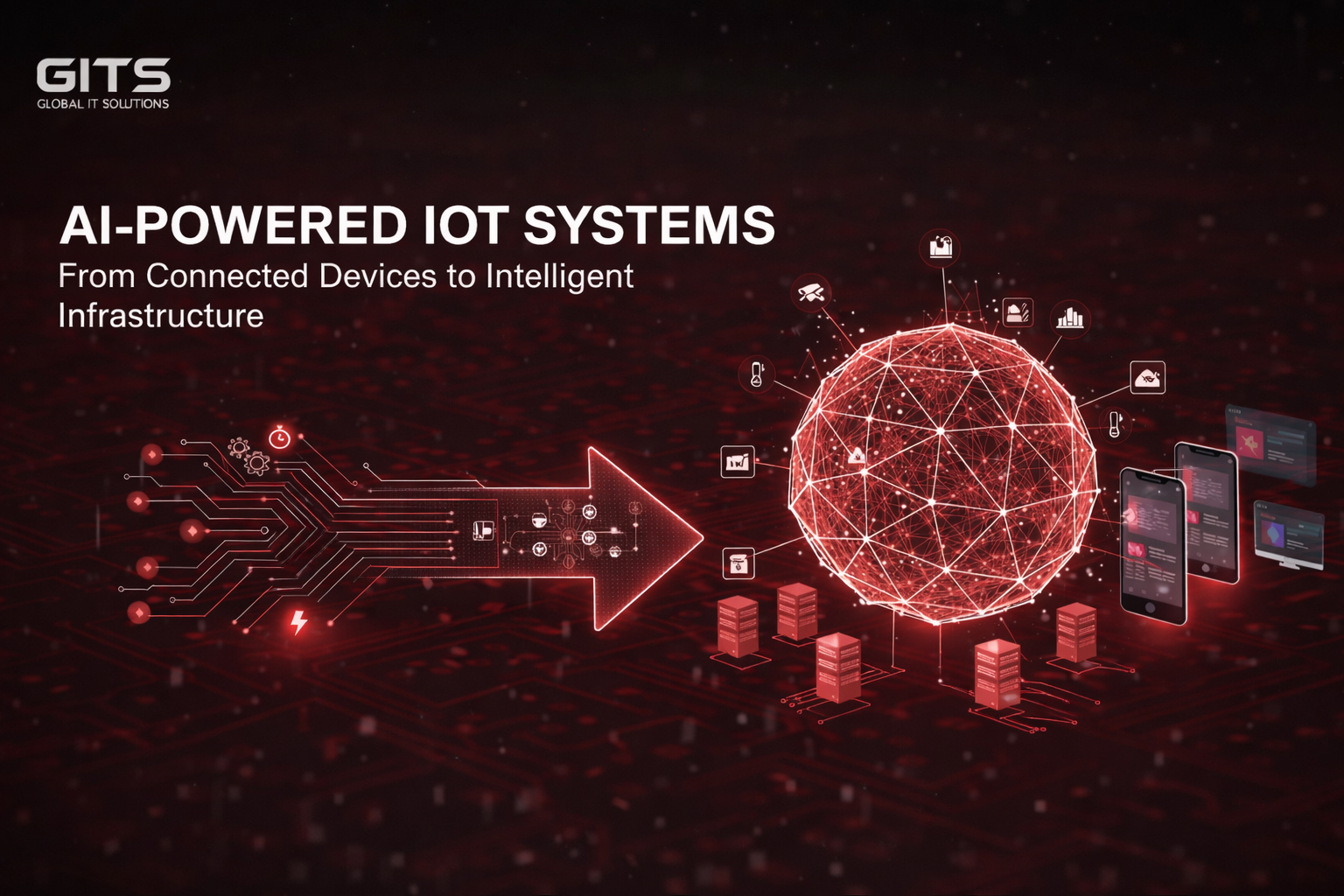
The Internet of Things has fundamentally changed how data is collected and shared across devices. Sensors embedded in machines, vehicles, and infrastructure continuously stream information about their environment and operational state. However, traditional IoT systems remain largely observational. They collect data, transmit it, and display dashboards—but meaningful decisions often still rely on human interpretation or rigid, rule-based logic. As systems grow in scale and complexity, this model quickly reaches its limits. The integration of Artificial Intelligence is reshaping this paradigm. AI-powered IoT systems introduce learning, prediction, and autonomous decision-making into connected environments. Instead of simply reporting what has happened, these systems begin to understand what is happening, anticipate what may happen next, and respond in real time. As a result, IoT evolves from basic connectivity into intelligent infrastructure capable of adapting to real-world conditions.
What Defines an AI-Powered IoT System?
An AI-powered IoT system embeds artificial intelligence technologies—such as machine learning, computer vision, and advanced analytics—directly into the IoT architecture.
Rather than stopping at data visualization, these systems continuously analyze incoming data streams to identify patterns, detect anomalies, and generate predictions. When certain conditions are met, they can automatically trigger actions without waiting for manual intervention. Over time, AI models improve as they learn from operational data, making the system more accurate, resilient, and context-aware.
This shift fundamentally changes the role of IoT: from passive monitoring to active participation in operational decision-making.
Why AI Is Becoming Essential in IoT Architectures
Modern IoT environments generate data at a scale that exceeds the capacity of manual analysis or traditional rule-based systems. In industrial plants, smart cities, and energy networks, millions of data points are produced every second, often requiring immediate interpretation.
AI addresses this challenge by learning directly from data instead of relying on predefined rules. It enables organizations to move from reactive responses to predictive and preventive operations. AI-powered IoT systems can make real-time decisions across large networks, detect early signs of operational risk, and reduce costs by automating repetitive or time-sensitive actions.
Without AI, IoT systems remain data-rich but insight-poor, offering visibility without intelligence.
Core Architectural Components
AI-powered IoT systems are typically built on four tightly connected layers.
At the foundation are IoT sensors and devices that collect raw data such as temperature, vibration, images, sound, and location. This data is transmitted through secure connectivity and data pipelines to processing layers.
The intelligence layer consists of AI and machine learning models that analyze incoming data to recognize patterns, classify events, or predict future outcomes. Supporting this is a carefully designed edge–cloud computing architecture. Some decisions must be made close to the devices for low latency, while others benefit from cloud-scale processing and long-term analysis.
Determining where intelligence runs—at the edge, in the cloud, or across both—is a critical architectural decision that directly impacts performance, scalability, and cost.
Industry Applications in Practice
Across industries, AI-powered IoT systems are already delivering measurable value.
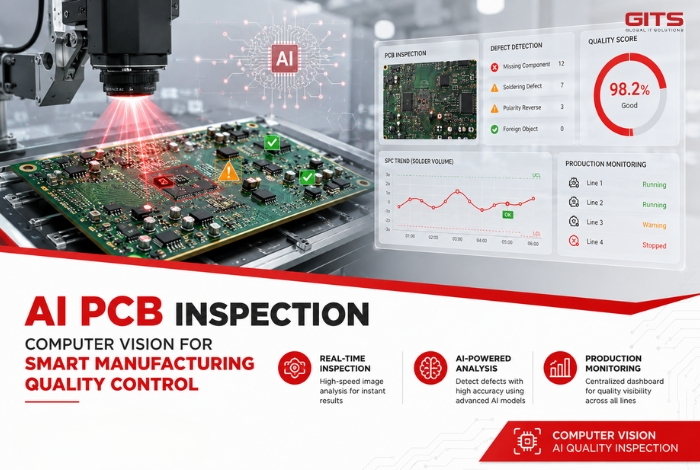
In manufacturing, they enable predictive maintenance and real-time quality inspection, reducing downtime and improving production efficiency. Smart cities use intelligent IoT networks to optimize traffic flow, enhance public safety, and manage urban infrastructure more effectively. In healthcare and energy, these systems support early risk detection, continuous monitoring, and operational optimization, improving both reliability and sustainability.
In each case, the value comes not just from connectivity, but from intelligence embedded into everyday operations.
GITS’ Practical Approach to AI-Powered IoT
In real-world deployments, success depends less on individual AI models and more on how the entire system is designed, integrated, and operated.
GITS approaches AI-powered IoT from an end-to-end perspective. Solutions combine computer vision, AI backend systems, web and mobile applications, and cloud infrastructure into a unified architecture. This ensures that AI insights are not isolated experiments, but actionable outputs integrated into existing workflows and systems.
By focusing on scalability, reliability, and seamless integration with enterprise environments, GITS helps organizations transform raw IoT data into intelligence that supports real operational decisions.
Looking Ahead
AI-powered IoT represents the next stage of digital infrastructure. As AI models become more efficient and intelligence moves closer to edge devices, connected systems will gain greater autonomy and responsiveness.
In this evolution, IoT will no longer simply connect assets. It will actively support decision-making, risk management, and operational optimization across the enterprise.
The future of IoT is not just connected. It is intelligent by design.