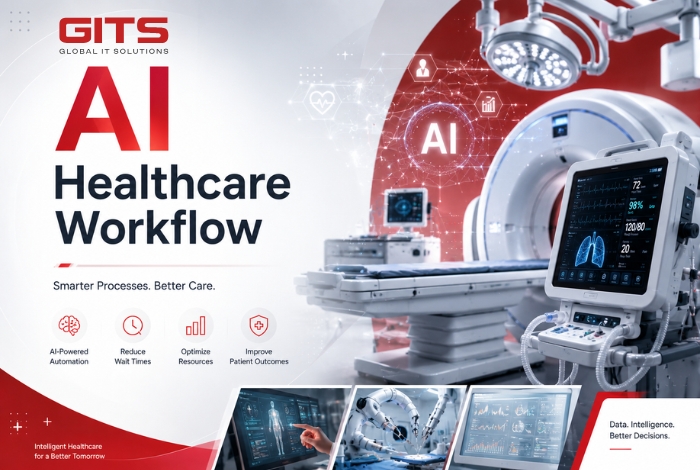
AI-powered patient workflow optimization refers to the use of artificial intelligence to automate and improve the entire patient journey across hospitals and healthcare organizations. This includes appointment scheduling, patient intake, medical record management, care coordination, and clinical support.
As the global healthcare industry faces rising operational pressure, staff shortages, aging populations, and increasing patient demand, AI-driven healthcare workflow automation is becoming a critical digital transformation strategy across Japan, South Korea, Vietnam, and global healthcare markets.
According to healthcare technology research, AI can reduce administrative workloads by up to 30% while significantly shortening patient waiting times and improving hospital efficiency.
Why Hospitals Need AI Workflow Optimization
Growing Pressure on Healthcare Systems
Many healthcare organizations still rely on manual processes that limit operational efficiency.
Common challenges include:
– Long patient waiting times
– Inefficient patient routing
– Fragmented medical data
– Administrative overload for healthcare staff
– Slow appointment coordination
These issues directly affect:
– Patient satisfaction
– Quality of care
– Hospital operating costs
– Staff productivity
– Healthcare service efficiency
In countries such as Japan, where aging populations are rapidly increasing healthcare demand, AI healthcare automation is becoming essential for sustainable hospital operations.
Hospitals Need AI Workflow Optimization
How AI Optimizes Patient Workflows
AI-Powered Patient Intake Automation
One of the most common healthcare AI applications is automating patient intake and scheduling processes.
AI agents can support:
– Automated appointment scheduling
– Insurance verification
– Smart appointment reminders
– Initial symptom assessment
– 24/7 AI chatbot support
Using Natural Language Processing (NLP), AI chatbots can communicate in multiple languages, making them ideal for international healthcare environments and global patient services.
Key Benefits
– Reduced waiting times
– Faster patient check-in
– Fewer manual input errors
– Lower administrative workload
AI-Driven Patient Flow Management
Managing patient flow is one of the biggest operational challenges for modern hospitals.
AI can analyze real-time healthcare data to:
– Predict patient volumes
– Optimize physician schedules
– Manage room allocation
– Reduce bottlenecks
Improve resource allocation
For example, if emergency room congestion is predicted, AI systems can automatically recommend:
– Staff redistribution
– Patient rerouting
– Operational alerts
– Schedule adjustments
This enables hospitals to operate more proactively and efficiently.
AI for Medical Records and Clinical Support
AI does not replace doctors. Instead, it enhances healthcare productivity and clinical efficiency.
Popular AI healthcare applications include:
AI Medical Scribe
Voice-powered automated medical documentation.
AI Documentation Automation
Automatic generation of healthcare reports and records.
Smart EMR Integration
Real-time electronic medical record synchronization.
AI Clinical Decision Support
AI-assisted diagnosis and treatment recommendations.
As a result, healthcare professionals can spend more time focusing on patient care rather than administrative tasks.
AI Optimizes Patient Workflows
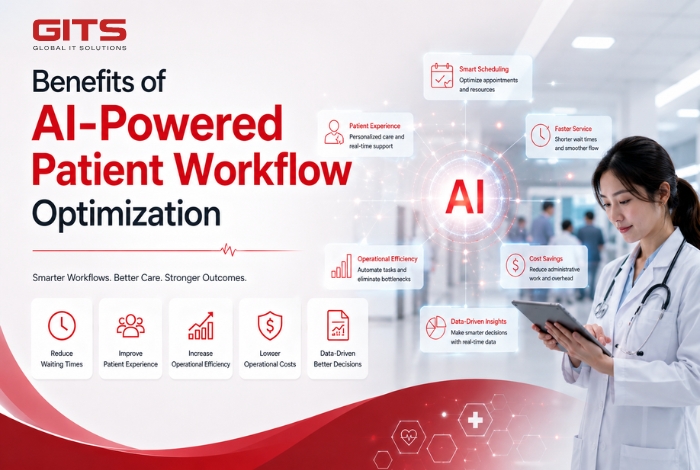
Benefits of AI-Powered Patient Workflow Optimization
Reduced Patient Waiting Time
One of the most visible benefits of AI workflow optimization is shorter waiting times.
AI helps hospitals by:
– Optimizing scheduling
– Improving patient routing
– Reducing operational bottlenecks
– Accelerating check-in and discharge processes
Many healthcare organizations report waiting time reductions of up to 35% after implementing AI healthcare workflow systems.
Improved Patient Experience
Patient experience has become a major competitive factor in modern healthcare.
AI enhances patient engagement through:
– 24/7 virtual support
– Multi-channel communication
– Personalized healthcare services
– Smart notifications
– Post-treatment follow-up support
In markets such as South Korea and Japan, AI healthcare solutions are becoming a core foundation of smart hospital ecosystems.
Lower Healthcare Operating Costs
AI automates repetitive administrative tasks, including:
– Scheduling
– Billing
– Insurance processing
– Data entry
– Patient routing
This allows healthcare providers to:
– Reduce labor costs
– Increase operational efficiency
– Minimize manual errors
– Optimize healthcare resources
Better Data-Driven Decision Making
AI can process large-scale healthcare data to support:
– Risk prediction
– Early abnormality detection
– Readmission forecasting
– Personalized treatment planning
– Hospital capacity optimization
These capabilities are becoming essential for predictive healthcare and next-generation smart hospitals.
Benefits of AI-Powered Patient Workflow Optimization
Leading AI Technologies in Healthcare
Major global technology companies are heavily investing in healthcare AI infrastructure, including:
– Microsoft
– Google Cloud
– IBM
– Oracle
– NVIDIA
Key AI technologies driving healthcare transformation include:
AI Technology
Healthcare Application
NLP
AI chatbots and patient communication
Machine Learning
Treatment demand prediction
Predictive Analytics
Hospital operations optimization
Computer Vision
Medical imaging analysis
AI Agents
Workflow automation
Leading AI Technologies in Healthcare
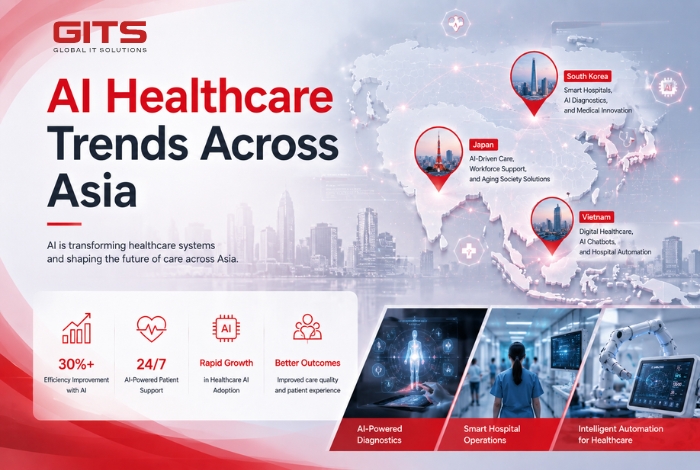
AI Healthcare Trends Across Asia
Japan Accelerates Smart Healthcare
Japan is rapidly adopting AI healthcare solutions to address:
– Medical staff shortages
– Aging population challenges
– Rising chronic disease cases
Hospitals are increasingly implementing:
– AI nursing assistants
– Remote patient monitoring
– Smart triage systems
– Intelligent scheduling platforms
South Korea Expands Smart Hospitals
South Korea is one of the global leaders in smart hospital innovation.
Healthcare providers are investing heavily in:
– AI diagnostics
– Medical robotics
– Intelligent patient management
– Digital healthcare platforms
Vietnam Accelerates Healthcare Digital Transformation
Vietnam is experiencing rapid growth in healthcare digital transformation initiatives.
Key focus areas include:
– AI healthcare chatbots
– Hospital management systems
– Smart appointment scheduling
– Electronic medical records
– AI-driven healthcare analytics
This creates significant opportunities for healthcare organizations to strengthen long-term competitiveness.
AI Healthcare Trends Across Asia
Challenges of Implementing AI in Healthcare
Healthcare Data Security
Healthcare data is highly sensitive and requires:
– Data encryption
– Access control
– Regulatory compliance
– Cybersecurity frameworks
Legacy System Integration
Many hospitals still rely on outdated systems that complicate data interoperability.
Key solutions include:
– API integration
– Cloud modernization
– Interoperability architecture
Organizational Transformation
AI adoption is not only about technology implementation.
FAQ About AI-Powered Patient Workflow Optimization
What is AI-powered patient workflow optimization?
It is the use of AI technologies to automate and optimize healthcare operations, patient management, and clinical workflows.
Can AI reduce hospital waiting times?
Yes. AI-powered scheduling and patient flow management systems can significantly reduce waiting times and operational bottlenecks.
Is AI healthcare secure?
Yes, when implemented with proper cybersecurity measures and healthcare compliance standards such as HIPAA and GDPR.
Will AI replace doctors?
No. AI is designed to support healthcare professionals by improving efficiency and reducing administrative workload.
The Future of AI in Healthcare Operations
AI-powered patient workflow optimization is becoming a foundational element of next-generation smart hospitals.
From automated patient intake and intelligent scheduling to clinical support and operational optimization, AI is transforming healthcare delivery worldwide.
Healthcare organizations that adopt AI early will gain long-term advantages in operational efficiency, patient satisfaction, and global healthcare competitiveness.
Choosing an IT outsourcing partner is no longer simply about finding a vendor that can provide developers at a competitive rate. For businesses navigating AI
Global supply chains are becoming harder to manage through traditional workflows. Demand changes faster, supplier risks emerge unexpectedly, inventory data is fragmented, and logistics teams
Vietnam is no longer positioned simply as a destination for low-cost software development. The Vietnam IT Outsourcing Market is moving toward higher-value services, including AI
As enterprises accelerate AI adoption, cybersecurity is facing a new challenge: AI agents are no longer passive tools. They can access data, call APIs, make
The automotive industry is undergoing one of its most significant transformations in decades. As vehicles become increasingly connected, manufacturers are shifting beyond hardware production to
Industrial workplaces are becoming increasingly automated, yet one challenge remains difficult to eliminate: work-related musculoskeletal disorders (MSDs) caused by repetitive movements and improper working postures.
In today’s electronics manufacturing industry, every defective PCB that reaches the next production stage can trigger expensive rework, production downtime, delayed deliveries, and even product
Manufacturing, energy, logistics, and industrial enterprises continue to face growing pressure to improve procurement efficiency while maintaining full visibility across increasingly complex supply chains. As