






Choosing an IT outsourcing partner is no longer simply about finding a vendor that can provide developers at a competitive rate. For businesses navigating AI adoption, digital transformation and increasingly complex technology ecosystems, the wrong decision can lead to delayed releases, rising costs, communication gaps and technical debt that takes years to resolve.
This is why companies in Japan, South Korea, Vietnam and global markets need a more practical way to evaluate an IT outsourcing company Vietnam. The right partner should not only execute requirements. It should understand your business context, reduce delivery risk and provide the technical foundation needed to scale.
This guide introduces a practical evaluation framework for choosing an IT outsourcing partner in Vietnam.
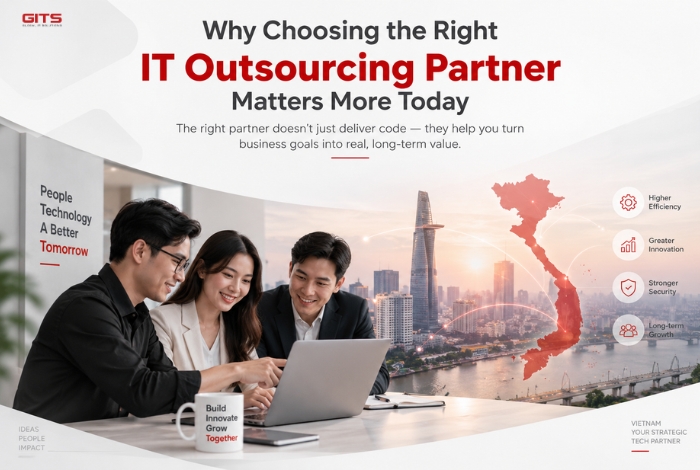
Why Choosing the Right IT Outsourcing Partner Matters More Today
Vietnam has become an increasingly attractive destination for IT outsourcing thanks to its strong engineering talent, cost competitiveness and growing experience in working with international businesses. However, these advantages alone do not guarantee project success.
Many companies still face the same challenges after outsourcing: developers can write code but do not fully understand business requirements, teams struggle with communication across countries, project quality depends heavily on individual engineers, or the vendor cannot support new priorities such as AI Services, Agentic AI and automation.
The key question, therefore, is not simply “Which outsourcing company has the lowest price?” It is “Which partner can reliably turn our business requirements into scalable technology outcomes?”
A strong evaluation framework helps decision-makers compare vendors beyond hourly rates and team size.
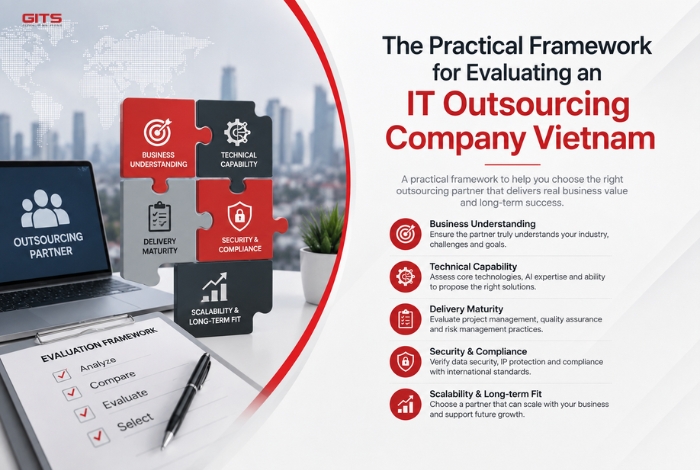
The Practical Framework for Evaluating an IT Outsourcing Company Vietnam
When evaluating potential partners, businesses should assess five core dimensions: business understanding, technical capability, delivery maturity, security and long-term scalability.
1. Business Understanding Before Technical Execution
A capable outsourcing partner should first understand what the technology is expected to achieve.
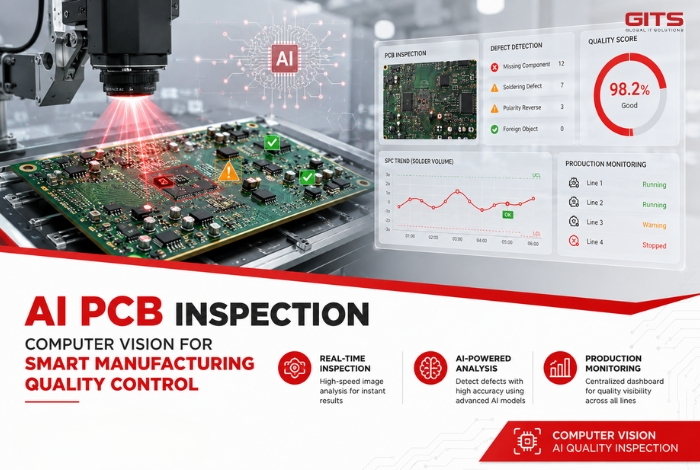
For example, a logistics company may need more than a mobile application. It may need a connected Technical Solution that improves fleet visibility, automates operational decisions and integrates data across multiple systems. A manufacturing company may require AI-powered quality monitoring rather than simply adding AI features to an existing platform.
Ask potential vendors how they approach requirement discovery, solution consulting and technical architecture. A partner that immediately starts discussing programming languages before understanding your business problem may only be acting as a resource provider.
The stronger choice is a team that can translate business objectives into a practical AI Solution or software roadmap.
2. Evaluate Technical Depth and AI Readiness
Traditional software development capabilities remain essential, but AI is changing what businesses should expect from an outsourcing partner.
An IT outsourcing company Vietnam should demonstrate expertise across relevant technologies while also having a clear approach to AI adoption. This does not mean every project needs generative AI. It means the partner should know when AI creates real business value and when conventional software is the better solution.
Key areas to evaluate include:
– Custom software and enterprise system development
– Cloud, APIs and system integration
– Data platforms and analytics
– AI Services and machine learning implementation
– AI Agents for workflow automation and decision support
– Agentic AI for multi-step and autonomous business processes
– Legacy modernization and AI Transformation, or AX
Ask for real use cases, architecture examples and measurable outcomes. Technical buzzwords without proven implementation experience should be treated carefully.
3. Look Beyond Developer Skills: Assess Delivery Maturity
Strong individual engineers do not automatically create a strong delivery organization.
This is particularly important for Japanese and Korean companies, where quality consistency, clear reporting, predictable schedules and long-term collaboration often matter as much as technical capability.
Evaluate how the vendor manages the full delivery lifecycle:
– How are requirements documented and approved?
– How are risks identified and escalated?
– What quality assurance processes are used?
– How are project progress and KPIs reported?
– How does the team handle changes in scope or priorities?
A mature partner should have repeatable processes rather than relying on informal communication or individual effort. This becomes critical when scaling from a small development team to a multi-project technology partnership.
Communication and Cultural Alignment Are Part of Delivery Quality
For cross-border outsourcing, communication problems can become technical problems.
Different expectations around decision-making, documentation, feedback and escalation can slow down delivery even when the engineering team is highly capable. Businesses working with partners in Vietnam should therefore assess communication structure, language capabilities and experience serving international markets.
For Japanese and Korean clients, the ability to understand working culture and maintain transparent, structured communication can significantly reduce outsourcing risk.
4. Make Security and Intellectual Property Non-Negotiable
As outsourcing teams gain access to customer data, business logic and proprietary systems, security should be evaluated from the beginning rather than added during contract negotiations.
Ask how the partner manages access control, source code protection, secure development, vulnerability management and incident response. For AI projects, businesses should also understand how sensitive data is handled when working with AI models, AI Agents or external platforms.
The right partner should provide clear governance around data ownership and intellectual property. This is especially important for enterprises operating across multiple markets or regulated industries such as healthcare, education and financial services.
5. Choose a Partner That Can Scale With Your Business
Your technology requirements today may not reflect your requirements in two years.
A company may initially outsource one product team, then expand into cloud modernization, AI automation or enterprise-wide AX. Choosing separate vendors for every new initiative can create fragmented architecture and additional management costs.
Look for an outsourcing partner with the ability to scale in three areas: team capacity, technical capability and strategic involvement.
The best relationship evolves from project delivery to long-term technology partnership. Your vendor should be able to support immediate development needs while helping identify future opportunities for automation, AI Services and digital innovation.
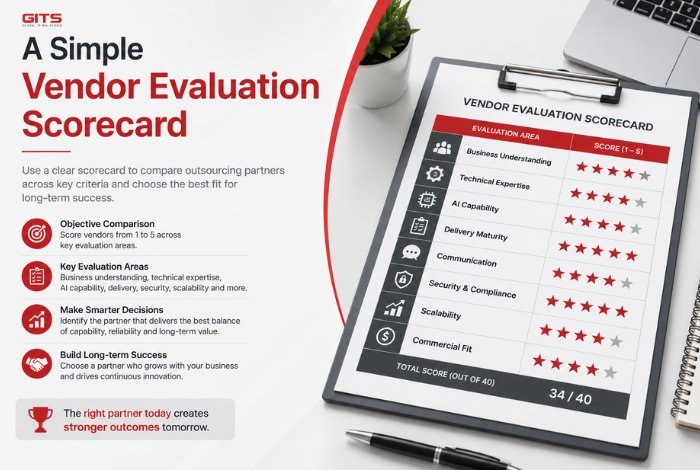
A Simple Vendor Evaluation Scorecard
To make the selection process more objective, assign each vendor a score from 1 to 5 across the following areas:
| Evaluation Area | What to Assess |
|---|---|
| Business Understanding | Ability to understand industry challenges and business goals |
| Technical Expertise | Software, cloud, data, AI and integration capabilities |
| AI Readiness | Practical experience with AI Agents, Agentic AI and AI Solutions |
| Delivery Maturity | Project management, QA, reporting and risk control |
| Communication | Transparency, responsiveness and cross-cultural collaboration |
| Security | Data protection, IP management and secure development practices |
| Scalability | Ability to support larger teams and future technology initiatives |
| Commercial Fit | Transparent pricing and sustainable long-term value |
The highest score should not automatically determine the final choice. A lower-cost vendor may appear attractive initially but create higher costs through rework, poor architecture or delivery delays.
Instead, evaluate the overall balance between capability, reliability and long-term business value.
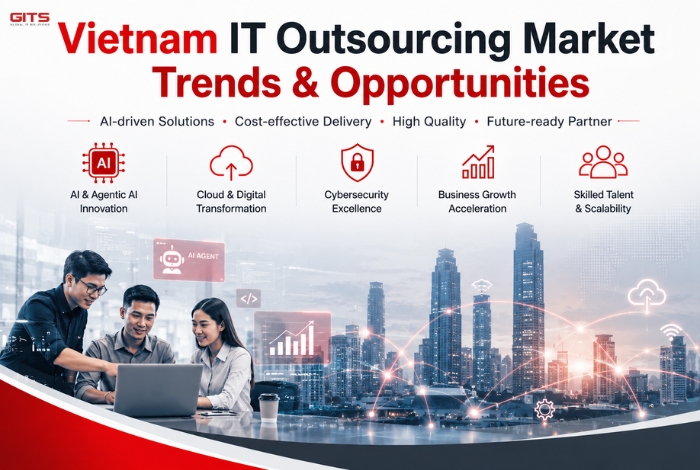
>>> See More: Vietnam IT Outsourcing Market: Trends & Opportunities
Choose a Technology Partner, Not Just an Outsourcing Vendor
Selecting an IT outsourcing company Vietnam is ultimately a strategic business decision.
The strongest partner is not necessarily the company with the largest team or the lowest development rate. It is the one that understands your business challenges, brings the right technical expertise, delivers with consistency, protects your assets and can grow alongside your technology strategy.
As AI Agents, Agentic AI and AX reshape how businesses operate, outsourcing partners must offer more than development capacity. Companies need technology teams that can connect strategy, engineering and AI innovation into measurable business outcomes.
Use this practical evaluation framework to look beyond price and portfolios. Choose a partner that can help your organization build reliable solutions today while staying ready for the next stage of digital and AI transformation.