





Managing customer relationships is essential to business growth. However, for enterprises operating across multiple distributors, sales channels, and retail outlets, customer management alone is not enough to ensure efficient operations.
Many businesses invest in CRM systems to strengthen customer relationships and improve sales performance, yet still struggle with fragmented order processing, limited inventory visibility, and inconsistent distributor performance data.
This raises an important question: What is the difference between DMS vs CRM, and why do growing enterprises need both systems to optimize their sales and distribution operations?
Understanding how these systems work together is critical to building a connected, data-driven business.
Understanding DMS and CRM: Two Systems, Different Business Objectives
Although Distribution Management Systems (DMS) and Customer Relationship Management (CRM) systems both support business growth, they address different operational requirements.
What Is a CRM System?
Customer Relationship Management (CRM) is a technology solution designed to manage customer information, interactions, and sales activities throughout the customer lifecycle.
A CRM system helps businesses centralize customer data, track sales opportunities, manage pipelines, and strengthen customer engagement.
Its primary focus is understanding customers, improving relationships, and supporting revenue growth.
For enterprises with complex sales processes, CRM provides better visibility into customer behavior, sales activities, and potential business opportunities.
What Is a Distribution Management System (DMS)?
A Distribution Management System (DMS) is designed to manage and optimize distribution operations across manufacturers, distributors, wholesalers, and retail outlets.
Unlike CRM, which focuses on customer relationships, DMS focuses on the execution and control of distribution activities.
A comprehensive DMS typically supports order processing, distributor management, inventory visibility, sales performance monitoring, and distribution coordination.
By consolidating operational data into one platform, businesses can gain better control over their distribution networks and improve coordination across multiple sales channels.
DMS vs CRM: What Are the Key Differences?
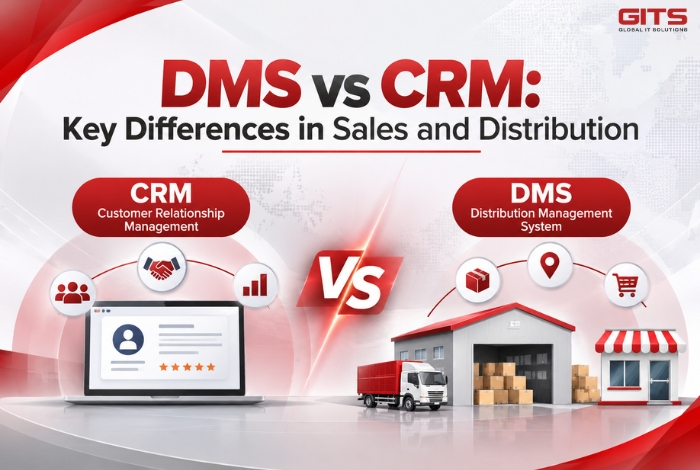
The fundamental difference between DMS vs CRM lies in their operational focus.
CRM manages customer relationships and sales opportunities, while DMS manages the distribution processes that move products through the supply chain.
The following comparison highlights their key differences:
| Business Function | CRM | DMS |
|---|---|---|
| Primary focus | Customer relationships | Distribution operations |
| Customer management | Customer profiles and interactions | Distributor and outlet management |
| Sales management | Sales pipeline and opportunities | Orders and sell-out performance |
| Order processing | Sales-related activities | Order creation and processing |
| Inventory visibility | Usually limited or integration-dependent | Inventory monitoring across distribution channels |
| Performance tracking | Sales activities and conversion | Distributor and distribution performance |
| Main objective | Improve customer engagement and revenue | Optimize distribution efficiency and control |
These systems are not direct replacements for each other. Instead, they serve complementary roles within enterprise sales operations.
Why CRM Alone Cannot Solve Distribution Challenges
For businesses operating in manufacturing, FMCG, wholesale, and retail, sales performance depends on more than customer relationships.
A company may have a well-organized CRM system but still lack visibility into what happens after a sales opportunity turns into an order.
This gap creates several operational challenges.
1. Fragmented Order and Inventory Data
When order processing and inventory information are managed across disconnected systems, businesses struggle to maintain consistent operational data.
Sales teams may not have accurate visibility into product availability, while distributors face delays in confirming orders and coordinating fulfillment.
2. Limited Visibility into Distributor Performance
Without centralized distribution data, management teams may find it difficult to monitor distributor activities, outlet coverage, order status, and actual sell-out performance.
This limits their ability to identify underperforming channels and respond to changing market demand.
3. Disconnected Sales and Distribution Operations
When sales and distribution teams work with separate information systems, communication gaps become inevitable.
Inconsistent data and manual coordination can increase administrative workloads, delay decisions, and reduce overall operational efficiency.
The real challenge is not simply managing customers. It is connecting customer demand with actual distribution execution.
>>> See More: Enterprise Digital Transformation: From Disconnected Systems to Connected Operations
Integrating DMS and CRM: Building a Connected Sales Ecosystem
Instead of treating DMS and CRM as competing solutions, enterprises should consider how these systems can work together.
CRM provides customer insights and sales opportunities, while DMS translates business demand into actionable distribution operations.
When integrated effectively, the two systems create a more connected flow of information across the enterprise.
Key business benefits include:
– End-to-end visibility: Connect customer demand, order processing, inventory information, and distribution performance.
– Improved operational efficiency: Reduce manual data entry, duplicated processes, and information gaps between departments.
– Better distributor coordination: Strengthen communication and collaboration across manufacturers, distributors, and retail channels.
– Data-driven decision-making: Consolidate business information to support more accurate sales planning and operational decisions.
Furthermore, integration with ERP, supply chain platforms, and AI-powered solutions can extend enterprise capabilities beyond traditional sales and distribution management.
The Role of AI Agents and Digital Transformation in Modern Distribution
As enterprise operations become increasingly data-driven, businesses are moving beyond conventional management software toward intelligent and connected technology ecosystems.
AI Agents and Agentic AI can support workflows such as order exception monitoring, inventory alerts, sales data analysis, and operational recommendations, depending on system integration and implementation scope.
Combined with reliable DMS and CRM data, AI-powered solutions can help enterprises reduce repetitive tasks, improve operational responsiveness, and support more informed decisions.
This evolution also contributes to Business Process Integration and AI Transformation (AX), enabling organizations to move toward more intelligent, automated, and adaptive business operations.
However, successful transformation starts with a solid foundation: connected systems, consistent data, and clearly defined business processes.
How GITS Helps Enterprises Connect Sales and Distribution Operations
At GITS, we understand that enterprise digital transformation requires more than implementing individual software solutions. It requires connecting business processes, operational data, and technology into a unified ecosystem.
GITS delivers enterprise technology solutions designed to address complex operational challenges across manufacturing, distribution, logistics, and other industries.
Through integrated DMS, CRM, and business process solutions, enterprises can improve operational visibility, strengthen cross-functional collaboration, and build more scalable business operations.
Our approach focuses on aligning technology with real business requirements, helping organizations reduce operational complexity and establish a stronger foundation for digital transformation.
Whether your business needs better distributor management, more efficient order processing, or integrated sales operations, GITS provides technical solutions tailored to your business objectives.

DMS and CRM Work Better Together for Smarter Business Operations
Understanding DMS vs CRM is the first step toward building a more efficient sales and distribution ecosystem.
CRM helps enterprises understand and manage customer relationships, while DMS provides the operational control needed to manage distributors, orders, inventory, and distribution performance.
Neither system can fully replace the other. Their combined capabilities help businesses bridge the gap between customer demand and distribution execution.
For enterprises seeking sustainable growth, the next step is not simply managing customers better, but connecting the entire sales and distribution operation.
With GITS as your technology partner, transform disconnected business processes into a more integrated, efficient, and intelligent enterprise ecosystem.
Connect with GITS to explore the right digital solutions for your business.