





Vietnam AI IT Outsourcing for Enterprise AI Systems
Vietnam AI IT outsourcing services are becoming a core strategy for global enterprises looking to build scalable, production-ready AI systems. As artificial intelligence and machine learning rapidly move from experimentation to real-world deployment, companies are increasingly turning to Vietnam to access high-quality engineering teams, mature delivery models, and long-term AI system development capabilities.
Today, across global industries, more than 70% of enterprises are already applying AI to optimize operations, automate processes, and enhance data-driven decision making. At the same time, the strategic question is no longer whether to adopt AI. Instead, in this context, it is about where and how sustainable AI capabilities should be built. As a result, and more importantly, Vietnam has emerged as a leading destination for enterprise AI development, with GITS at the forefront delivering enterprise AI solutions, enterprise software platforms, and end-to-end IT outsourcing services.
—
Vietnam AI IT outsourcing is evolving into an enterprise AI systems market
Vietnam IT outsourcing was once primarily associated with web and mobile development. However, over the past few years, this landscape has fundamentally changed.
In fact, and more specifically, over the last three years, AI and data-related outsourcing projects have grown more than 2.5x, and now over 30% of new outsourcing contracts include AI or data platforms as a core foundation. Therefore, rather than simply supplying developers, Vietnam IT outsourcing is increasingly focused on designing, building, and operating AI systems.
Consequently, Vietnam is no longer just an execution hub. It is rapidly becoming a strategic environment where enterprises design long-term AI architectures, operational pipelines, and scalable data platforms.
—
Why Vietnam is becoming a strategic location for enterprise AI
National AI strategy and digital infrastructure
Vietnam has positioned AI as a national priority. Accordingly, the government and private sector continue to invest heavily in AI talent development, data infrastructure, smart manufacturing, digital healthcare, and smart city initiatives. As a result, enterprises entering Vietnam benefit from a stable foundation for long-term enterprise AI development.
–
A rapidly expanding AI talent ecosystem
Vietnam produces over 50,000 IT graduates annually. Notably, 15–20% specialize in AI, data, and advanced computing fields. Moreover, demand for AI engineers is growing at over 25% each year, enabling enterprises to build scalable, long-term AI teams rather than short-term project groups.
—
Why global enterprises choose Vietnam AI IT outsourcing for enterprise AI
From cost efficiency to AI organization strategy
Today, enterprises choose Vietnam not only for cost efficiency, but also for the ability to build sustainable AI organizations.
In particular, key drivers include long-term talent scalability (64%), access to AI expertise (58%), and balanced cost-to-quality performance (55%).
Therefore, enterprises increasingly view Vietnam AI IT outsourcing not as a procurement decision, but as a strategic move to establish durable AI execution capability.
–
From experimentation to operational AI
Meanwhile, enterprises increasingly focus AI projects in Vietnam on production deployment.
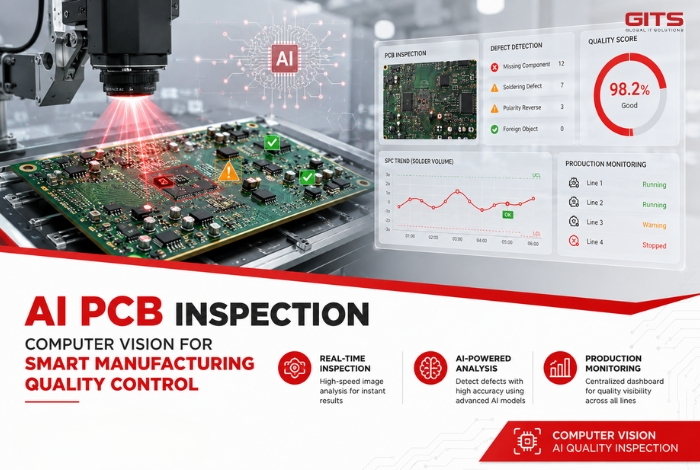
For example, from computer vision in manufacturing to demand forecasting in logistics and automation in enterprise systems, Vietnam is delivering operational AI solutions rather than isolated prototypes.
As a result, enterprises are shifting away from PoC-centered models toward AI systems that directly support revenue, operations, and decision-making.
—
GITS’ role in Vietnam’s AI execution ecosystem
At GITS, we work closely with enterprises to design, build, and evolve AI systems that operate in real business environments. Across current enterprise projects, we consistently observe three major shifts in how organizations approach AI execution.
• Enterprises are integrating AI more deeply into core system architectures across business environments.
• Meanwhile, companies are rapidly expanding MLOps and AI system engineering roles.
• At the partnership level, long-term co-development models are becoming the dominant form of collaboration.
Through this approach, GITS integrates AI into WMS, IoT, and enterprise platforms, enabling organizations to turn AI into a scalable operational capability. Ultimately, our focus is not only on building AI, but on embedding AI into how enterprises operate.
—
Vietnam’s AI direction toward 2026
Vietnam’s AI market continues to grow at 25–30% annually. Looking ahead to 2026, operational AI systems will significantly outpace PoC-based initiatives.
• Beyond isolated model development, enterprise teams are building integrated, enterprise-grade AI platforms.
• Rather than short-term PoCs, companies now prioritize long-term operational AI systems.
• At a strategic level, outsourcing execution is evolving into co-design and long-term technology partnerships.
Consequently, Vietnam is shifting from “learning AI” to “executing AI at enterprise scale.”
—
Conclusion: Vietnam AI IT outsourcing is now part of enterprise AI strategy
For modern enterprises, the strategic question is no longer:
“Should we use AI?”
Instead, it is:
“Where and how should we build AI as an operational capability?”
In this context, Vietnam AI IT outsourcing has become a strategic answer for enterprises building long-term AI capabilities.
And more importantly, GITS is positioned to help enterprises transform AI from experimentation into production-ready, scalable systems.