





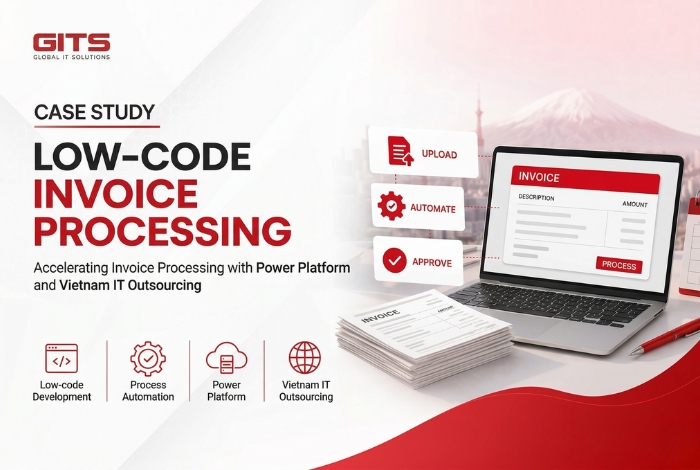
In today’s rapidly evolving digital landscape, enterprises across Japan and South Korea are accelerating their digital transformation journeys. Automation is no longer a strategic option but a critical necessity, especially in back-office operations such as invoice processing, where large volumes of repetitive tasks consume significant time and resources without creating proportional business value.
Low-code invoice processing has emerged as a practical and scalable solution, particularly for enterprises operating within legacy system environments. Instead of replacing existing systems entirely, organizations can leverage low-code platforms to modernize workflows incrementally while maintaining operational stability. When combined with the capabilities of Vietnam IT outsourcing, businesses gain access to highly skilled technical resources, cost efficiency, and faster implementation cycles, making transformation both feasible and sustainable.
Client background
The client in this case study is a large Japanese enterprise managing a broad network of business partners and handling a substantial volume of invoices on a monthly basis. Despite its scale, the company relied heavily on traditional operational methods, particularly in its invoice processing workflow.
Invoice data was primarily stored in scattered Excel files across multiple departments, with no centralized data management system. The operational process followed a familiar but inefficient pattern: invoices were printed, sent to partners for data entry, and then manually re-entered into internal systems. Each step depended heavily on human intervention, increasing both processing time and the likelihood of errors.
While this process had been considered reliable for years, its limitations became increasingly apparent as transaction volumes grew. The company faced mounting pressure to improve processing speed and operational efficiency in a highly competitive market. However, replacing the entire system posed significant risks in terms of cost, complexity, and operational disruption. This created a strong need for a solution that could modernize existing workflows without compromising stability.
Technical challenges
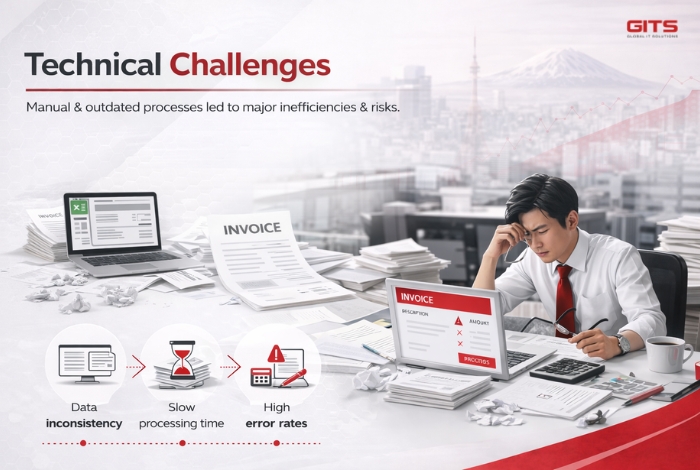
The limitations of the legacy system were not isolated issues but interconnected challenges that compounded over time. One of the most critical problems was data inconsistency. With invoice data dispersed across multiple Excel files and manually transferred between stages, maintaining a single source of truth became nearly impossible. Even minor discrepancies could lead to larger inconsistencies across the system.
Operational efficiency was another major concern. Each invoice had to pass through multiple processing steps, often involving delays between departments. As the number of invoices increased, these bottlenecks intensified, significantly slowing down the overall workflow and placing additional strain on operational teams.
Human error was an unavoidable consequence of manual data entry. Repetitive tasks increased the likelihood of mistakes, which could lead to incorrect financial records, delayed payments, and strained relationships with partners. Furthermore, the system lacked scalability. Any increase in invoice volume required proportional increases in manpower, driving up operational costs without improving efficiency.
These challenges formed a cycle that limited the company’s ability to grow and adapt. Without a fundamental change in approach, the system would continue to hinder rather than support business expansion.
Solution implementation
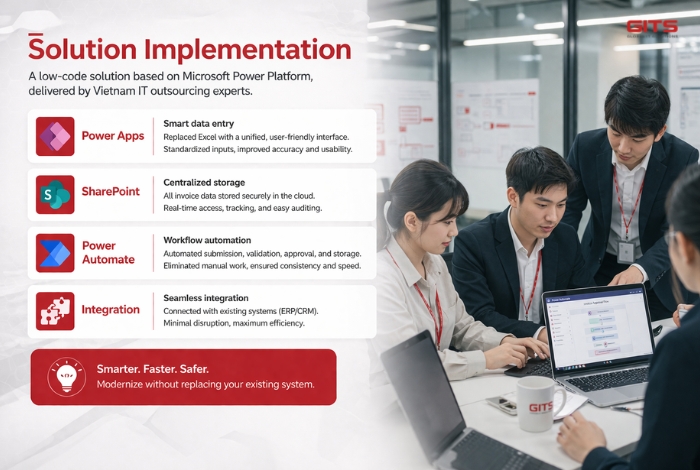
To address these challenges, the company partnered with a Vietnam IT outsourcing team to implement a low-code solution based on Microsoft Power Platform. This approach allowed the organization to modernize its invoice processing workflow without the need for a complete system overhaul.
The solution began with Power Apps, which was used to develop a unified and user-friendly data entry interface. This replaced the fragmented Excel-based system with a standardized structure, enabling users to input and access data consistently across the organization. By eliminating multiple versions of data files, the company significantly improved data accuracy and usability.
SharePoint was introduced as a centralized data repository, ensuring that all invoice data was stored securely in the cloud and accessible in real time. This not only enhanced data visibility but also enabled efficient tracking and auditing of all transactions, reinforcing transparency across the workflow.
The core of the solution was Power Automate, which enabled the automation of the entire invoice processing lifecycle. From data submission and validation to approval workflows and storage, each step was streamlined through automated processes. This eliminated manual intervention, reduced processing delays, and ensured consistent execution of business rules.
Importantly, the solution was designed to integrate seamlessly with the company’s existing systems. This minimized disruption during implementation and preserved the value of legacy infrastructure, making the transition smooth and low-risk.
Measurable outcomes
The implementation of low-code invoice processing delivered immediate and measurable improvements across multiple dimensions. Processing time was significantly reduced, as automated workflows eliminated delays and manual dependencies. Tasks that previously took days could now be completed within a fraction of the time.
Data accuracy improved dramatically, with manual input errors largely eliminated through standardized forms and automated validation processes. This enhanced the reliability of financial data and reduced the need for rework.
From a cost perspective, the company achieved substantial savings by reducing reliance on manual labor and avoiding the need for large-scale system redevelopment. The use of Vietnam IT outsourcing further optimized costs while maintaining high development quality.
The new system also introduced a high level of scalability. As invoice volumes increase, the system can handle additional workloads without requiring proportional increases in staffing. This positions the company for sustainable growth without operational constraints.
Perhaps most importantly, the organization gained full visibility into its invoice processing operations. With centralized data and real-time tracking, management can monitor workflows, identify bottlenecks, and make informed decisions more effectively.
Project scope and timeline
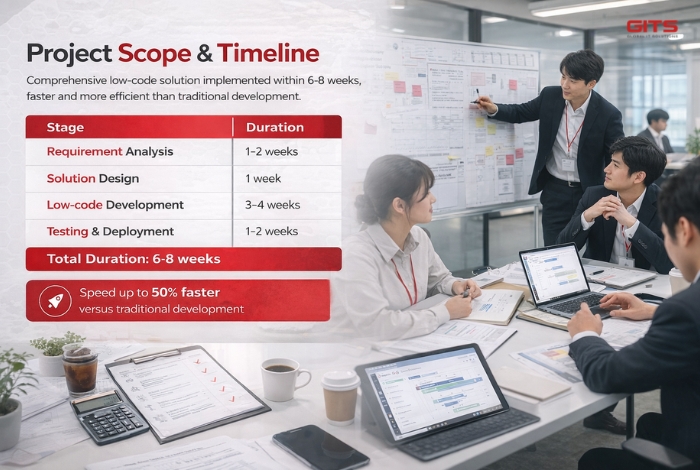
The project was executed with a focused scope but delivered significant impact across the organization’s operations. The system included key modules such as data input, processing, and approval workflows, all designed to function seamlessly within the existing IT ecosystem.
One of the most notable aspects of the project was its rapid implementation timeline. The entire process, from requirement analysis and solution design to development, testing, and deployment, was completed within six to eight weeks. This represents a substantial reduction compared to traditional software development approaches, highlighting the efficiency of low-code platforms.
The ability to deliver results quickly not only accelerated the company’s digital transformation but also reduced implementation risks. For Japanese enterprises, where stability and precision are paramount, this balance between speed and reliability is particularly valuable.
Low-code invoice processing as a foundation for sustainable digital transformation
This case study demonstrates that effective digital transformation does not always require complex or disruptive solutions. By adopting a low-code approach and leveraging Vietnam IT outsourcing, the company was able to address its operational challenges in a practical and efficient manner.
The results extend beyond immediate performance improvements. The organization now has a flexible and scalable foundation that supports continuous innovation and future growth. In an increasingly competitive business environment, this capability is not just an advantage but a necessity.
Low-code invoice processing, when implemented strategically, becomes more than a technical upgrade. It evolves into a critical enabler of long-term business agility, operational excellence, and sustainable digital transformation.