






As cyber threats continue to evolve, enterprise security teams face an overwhelming volume of vulnerability reports, security advisories, and threat intelligence feeds. Every day, organizations receive updates from sources such as CVE, CISA, NVD, PSIRT, and software vendors, making manual analysis increasingly difficult.
Security engineers often spend hours reviewing technical documents, assessing business impact, and determining remediation priorities. This manual process delays incident response, increases operational costs, and limits the ability to scale cybersecurity operations.
To solve this challenge, many enterprises across Japan, South Korea, Vietnam, and global markets are adopting RAG AI (Retrieval-Augmented Generation). By combining enterprise knowledge with Large Language Models (LLMs), organizations can automate threat intelligence analysis while improving accuracy and response speed.
Customer Background
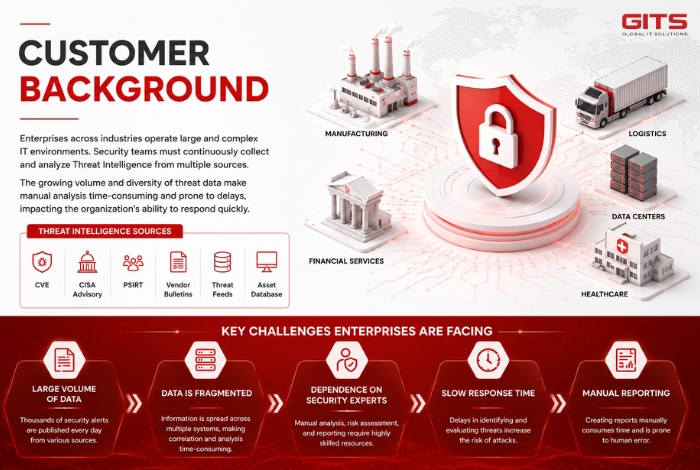
A manufacturing enterprise needed a more efficient way to analyze cybersecurity advisories affecting thousands of IT assets and production systems.
The security team monitored multiple information sources, including:
– CVE
– CISA Security Advisories
– Vendor Security Bulletins
– PSIRT Notifications
– Internal security databases
Because every advisory required manual interpretation, engineers spent significant time identifying affected systems, evaluating risks, and preparing reports. As the number of vulnerability disclosures increased, the existing workflow became unsustainable.
The company required an AI-powered platform capable of understanding technical documents, correlating external intelligence with internal assets, and generating reliable security recommendations automatically.
Technical Challenges
Massive Volumes of Threat Intelligence
Security advisories are published daily by governments, vendors, and cybersecurity organizations. Reviewing these documents manually consumes valuable engineering resources and slows response times.
Fragmented Enterprise Data
Threat intelligence exists across multiple platforms, including vulnerability databases, asset inventories, and internal documentation. Engineers must manually connect these data sources before determining actual business impact.
Dependence on Cybersecurity Experts
Accurate vulnerability assessment requires experienced security professionals. As skilled cybersecurity talent becomes increasingly scarce, organizations struggle to scale manual analysis.
Delayed Incident Response
Without automation, identifying affected assets and prioritizing remediation may take hours or even days, increasing the risk of successful cyberattacks.
RAG AI Solution
The enterprise implemented a RAG AI-powered Threat Intelligence Analysis Platform that combines Retrieval-Augmented Generation with enterprise knowledge and Large Language Models.
Unlike conventional AI assistants, the platform retrieves relevant enterprise documents before generating responses. This approach ensures recommendations are based on the latest security intelligence instead of relying solely on pretrained model knowledge.
The platform automatically:
– Collects security advisories from multiple sources
– Standardizes structured and unstructured data
– Retrieves relevant enterprise knowledge
– Summarizes technical reports
– Identifies affected assets
– Assesses vulnerability severity
– Recommends mitigation actions
– Generates executive-ready reports
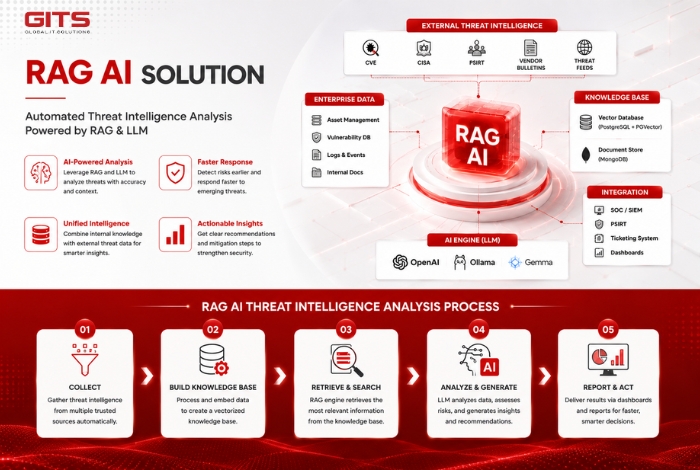
Enterprise Architecture
The solution uses a cloud-native architecture built for scalability and enterprise integration.
Data Collection
Security information is continuously synchronized from CVE, CISA, PSIRT, vendor advisories, REST APIs, and internal systems.
Knowledge Repository
Documents are transformed into vector embeddings and stored in PostgreSQL with PGVector, while MongoDB maintains raw security records.
AI Engine
Large Language Models, including OpenAI GPT or Gemma, retrieve relevant enterprise knowledge before generating responses. This Retrieval-Augmented Generation process significantly reduces hallucinations and improves factual accuracy.
Enterprise Integration
REST APIs enable seamless connectivity with SOC, SIEM, PSIRT, and other enterprise security platforms.
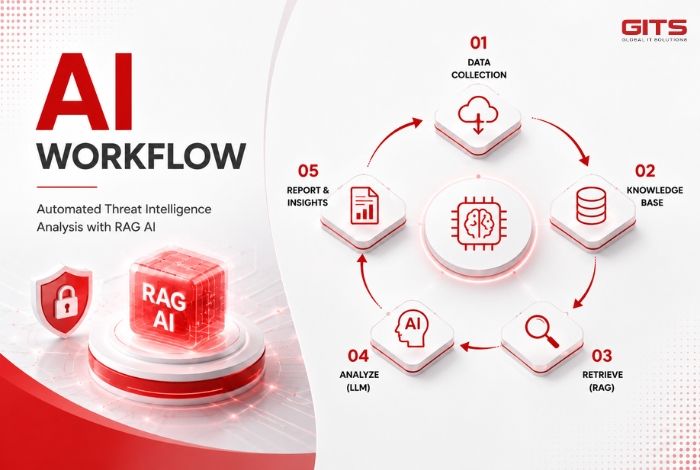
AI Workflow
The platform automates the complete threat intelligence lifecycle through five intelligent steps.
First, it collects security information from trusted external and internal sources.
Next, documents are standardized and converted into semantic vector embeddings.
The RAG engine then retrieves the most relevant knowledge before passing contextual information to the LLM.
Based on retrieved data, the AI identifies affected systems, evaluates business impact, recommends mitigation strategies, and produces structured security reports.
Finally, the reports are delivered through an intuitive web dashboard or integrated directly into enterprise security workflows.
Measurable Results
Following deployment, the enterprise achieved significant operational improvements.
– Approximately 70% reduction in manual document analysis.
– Around 60% faster incident response through automated vulnerability assessment.
– Improved accuracy by generating recommendations based on real-time enterprise knowledge.
– Reduced workload for cybersecurity engineers.
– Scalable support for millions of security documents across multiple business units.
These improvements enabled security teams to focus on strategic initiatives such as threat hunting, compliance, and proactive risk management instead of repetitive document analysis.
Project Scope and Timeline
The implementation followed a structured four-phase approach.
Phase 1 (2–3 Weeks)
Assess enterprise security infrastructure and design the solution architecture.
Phase 2 (4–6 Weeks)
Develop the RAG pipeline, AI Engine, vector database, backend APIs, and web interface.
Phase 3 (2 Weeks)
Integrate with enterprise systems such as SOC, SIEM, PSIRT, and asset management platforms.
Phase 4 (2 Weeks)
Perform testing, user training, optimization, and production deployment.
This phased approach minimizes implementation risk while enabling rapid business value.
>>> See More: Rag Chatbot for product knowledge: How enterprise deliver accurate AI-Powered Customer Support
Why RAG AI Outperforms Traditional LLMs
Traditional Large Language Models rely primarily on pretrained knowledge, which may become outdated as new vulnerabilities emerge.
By contrast, RAG AI retrieves the latest enterprise documents before generating responses. This enables organizations to access real-time security intelligence, reduce hallucinations, improve explainability, and maintain compliance with enterprise governance requirements.
For industries such as manufacturing, logistics, healthcare, and finance, RAG AI provides a more reliable foundation for AI-powered cybersecurity operations.
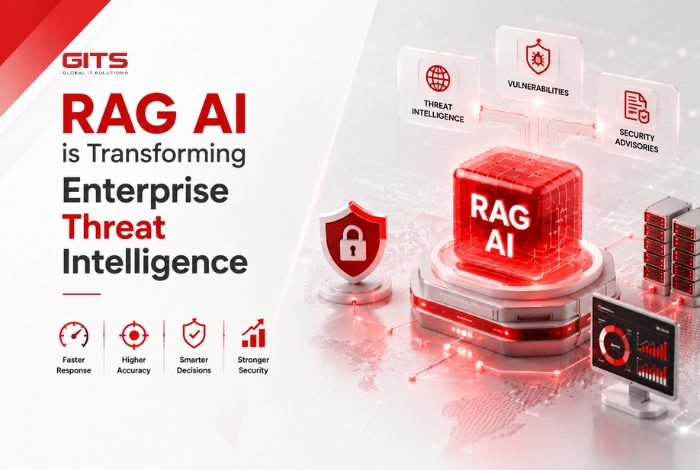
RAG AI is Transforming Enterprise Threat Intelligence
Cybersecurity teams can no longer rely solely on manual analysis to manage today’s rapidly expanding threat landscape.
By combining Retrieval-Augmented Generation (RAG) with Large Language Models, enterprises can automate vulnerability analysis, accelerate incident response, and improve decision-making with trusted, enterprise-specific knowledge.
As organizations continue investing in AI-driven security operations, RAG AI is becoming a foundational technology for scalable, intelligent, and future-ready threat intelligence platforms.