





In manufacturing, a production plan can look perfect in the morning and become outdated before the end of the day.
A delayed material shipment, an unexpected machine failure, an urgent order, a quality issue, or the absence of a skilled operator can trigger a chain reaction across the entire production schedule. Yet in many factories, planners still need to collect data from multiple systems, assess the impact manually, communicate with different departments, and rebuild the schedule under intense time pressure.
This is where AI production scheduling is becoming increasingly important.
Instead of treating scheduling as a static planning exercise, manufacturers can use AI Agents and Agentic AI to continuously understand operational changes, evaluate constraints, simulate alternatives, and recommend or execute the next best scheduling action. Recent research in Advanced Planning and Scheduling (APS) is also moving toward multi-agent architectures that combine domain knowledge, optimization and AI-assisted coordination for more adaptive production planning.
For manufacturers operating in Japan, Korea, Vietnam and global markets, the opportunity is not simply to automate scheduling. It is to reduce the time between disruption and decision.
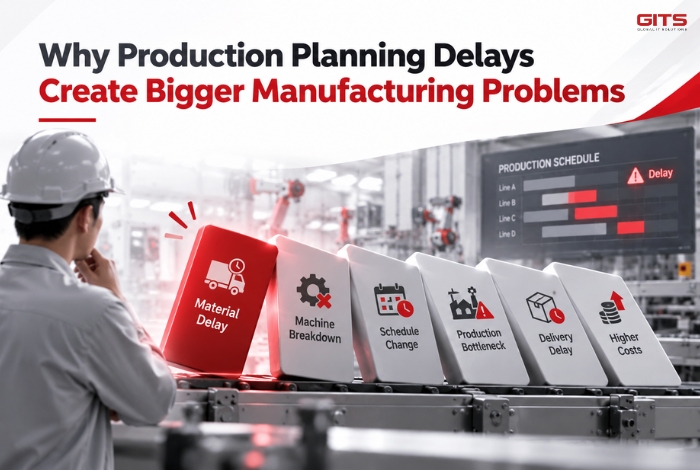
Why Production Planning Delays Create Bigger Manufacturing Problems
Production scheduling is rarely isolated from the rest of the business. A change to one machine or work order can affect material availability, labor allocation, delivery commitments, inventory levels and downstream processes.
The real problem is that traditional planning workflows often operate with a time lag.
By the time planners discover a disruption, gather the necessary information and agree on a response, the factory may already be operating according to an outdated plan. Teams then rely on phone calls, spreadsheets, manual overrides and the experience of a few key planners to keep production moving.
This creates several familiar bottlenecks:
– Schedules take too long to update when conditions change.
– Critical production knowledge depends heavily on experienced individuals.
– Data is fragmented across ERP, MES, APS, spreadsheets and shop-floor systems.
– Teams struggle to evaluate multiple scheduling scenarios quickly.
– Bottlenecks are identified after they begin affecting throughput and delivery.
– Urgent decisions can optimize one department while creating problems elsewhere.
For manufacturers facing shorter lead times, higher product variety and more volatile supply conditions, this reactive approach is becoming increasingly difficult to sustain. Modern manufacturing scheduling must account for changing objectives and constraints rather than assuming that the original plan will remain valid throughout execution.
What Is AI Production Scheduling?
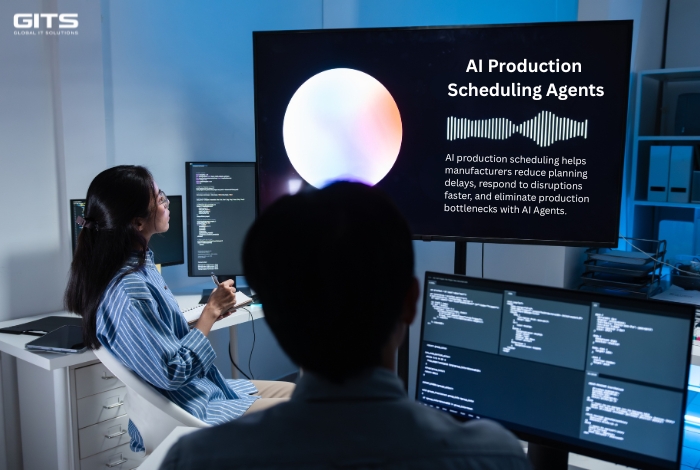
AI production scheduling uses artificial intelligence, operational data and optimization technologies to improve how manufacturers create, evaluate and adjust production schedules.
A more advanced approach combines AI with scheduling engines and AI Agents. Rather than functioning as a standalone chatbot, an AI Production Scheduling Agent can connect to relevant enterprise and operational systems, understand the current production context and coordinate actions based on defined business objectives.
For example, when a critical machine becomes unavailable, the system can assess the affected orders, alternative machine capacity, material readiness, operator availability and customer delivery priorities. It can then compare possible responses instead of asking a planner to manually rebuild every dependency from scratch.
The goal is not to replace mathematical optimization or APS technology. In fact, one of the most promising directions is the combination of Agentic AI with proven simulation, constraint and optimization models. AI Agents can help interpret changing situations, orchestrate workflows and coordinate specialized knowledge, while optimization engines calculate feasible scheduling decisions.
How AI Agents Transform Production Scheduling Decisions
The real value of AI Agents comes from their ability to support a continuous decision-making loop.
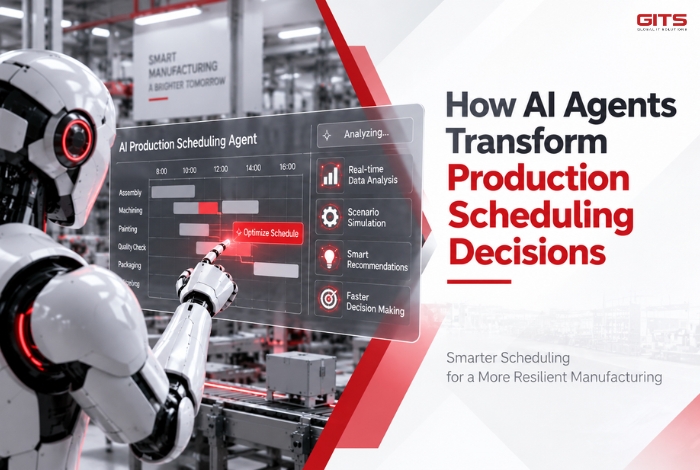
AI Production Scheduling in a Dynamic Factory Environment
A production scheduling agent can continuously work through four key stages.
Understand the current situation. The agent gathers relevant signals from connected systems, such as production progress, machine status, inventory, incoming materials, quality information and order priorities.
Identify the impact. When an event occurs, the AI evaluates which orders, resources and production stages may be affected.
Generate and assess alternatives. The system can work with optimization and simulation capabilities to compare different sequencing, allocation or rescheduling scenarios against defined KPIs.
Recommend the next best action. Planners receive actionable options with clearer reasoning about trade-offs, allowing them to make decisions faster and with more context.
This represents an important shift from using AI only to explain what happened toward using Agentic AI to support how the business should respond. In operational scheduling, that distinction matters because identifying a problem is only the first step. The real business value comes from reducing the time required to decide what to do next.
Where Manufacturers Can Reduce Production Bottlenecks
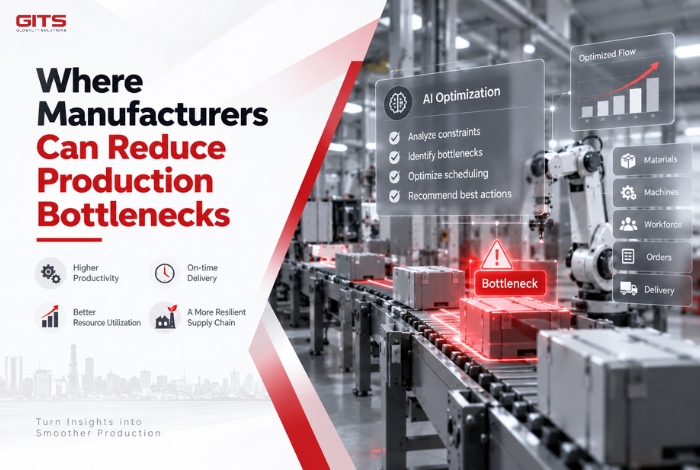
The benefits of an AI Solution for production scheduling are particularly relevant in environments with complex constraints and frequent changes.
A high-mix manufacturer, for example, may need to balance setup times, specialized machines, labor skills and different customer priorities. A delay in one process can quickly create WIP accumulation at the next stage. AI production scheduling can help identify how sequencing decisions affect the actual constraint instead of optimizing each work center independently.
In make-to-order manufacturing, the priority may be protecting delivery commitments. In this case, an AI Agent can evaluate whether a new urgent order should enter the schedule and what trade-offs this would create for existing commitments.
For manufacturers in Japan and Korea, where operational excellence, quality consistency and process standardization are often critical, AI Agents can also help capture scheduling knowledge that has traditionally depended on experienced planners. This supports greater knowledge continuity while maintaining human control over critical decisions.
For rapidly growing manufacturers in Vietnam and other emerging production hubs, AI Services can provide an opportunity to modernize planning capabilities without immediately replacing every existing system. The most practical Technical Solution may be an intelligent layer that connects with current ERP, MES or APS infrastructure and improves decision-making around it.
>>> See More: Multi-Agent Supply Chain: End-to-End Orchestration with AI
AI Agents Need Reliable Manufacturing Data and Clear Guardrails
AI production scheduling is not simply a matter of connecting a language model to factory data.
Manufacturing decisions are constraint-heavy and business-critical. An effective AI Solution needs access to reliable operational information, clear rules about what the agent can do and strong integration with deterministic technologies such as APS, optimization engines and simulation models.
Manufacturers should therefore focus on three foundations.
First, identify the scheduling decisions that currently consume the most time or depend on manual coordination. A focused use case, such as disruption management at a bottleneck process, is often more valuable than attempting full autonomy immediately.
Second, connect the AI Agent to the systems that provide the operational context required for reliable decisions. Poor or delayed data can lead to poor scheduling recommendations.
Third, maintain human oversight based on decision criticality. AI can accelerate analysis and propose actions, while production planners remain responsible for approving high-impact decisions according to defined governance rules.
This human-AI collaboration model is particularly important as manufacturers move from AI experimentation toward enterprise-scale AX, where AI becomes embedded in operational workflows rather than remaining a separate technology initiative. Production-ready AI Agents also require deliberate approaches to orchestration, testing, security and governance.
From Reactive Rescheduling to Intelligent Production Operations
The future of manufacturing will not be defined by a schedule that never changes. It will be defined by how quickly and intelligently a manufacturer can respond when the schedule must change.
AI production scheduling gives manufacturers a path to reduce planning delays, detect emerging bottlenecks earlier and evaluate complex trade-offs at a speed that manual workflows cannot consistently achieve. By combining AI Agents, Agentic AI, optimization and real-time operational data, businesses can move from repeatedly rebuilding plans to continuously improving decisions.
For manufacturers, the question is no longer whether production conditions will change. They will.
The real competitive question is: How fast can your organization turn disruption into the next best production decision?