






For decades, logistics companies have invested heavily in digital transformation, yet many operations still rely on fragmented systems, manual planning and reactive decision-making. Rising labor shortages, increasing customer expectations and growing supply chain complexity are exposing the limits of traditional automation.
This is where AI Agents in Logistics are becoming a game changer.
Unlike conventional AI tools that analyze data or generate recommendations, AI Agents can understand business goals, make decisions, coordinate multiple systems and execute actions autonomously. By 2030, they are expected to become the digital workforce behind modern logistics operations, helping businesses improve efficiency, resilience and customer satisfaction.
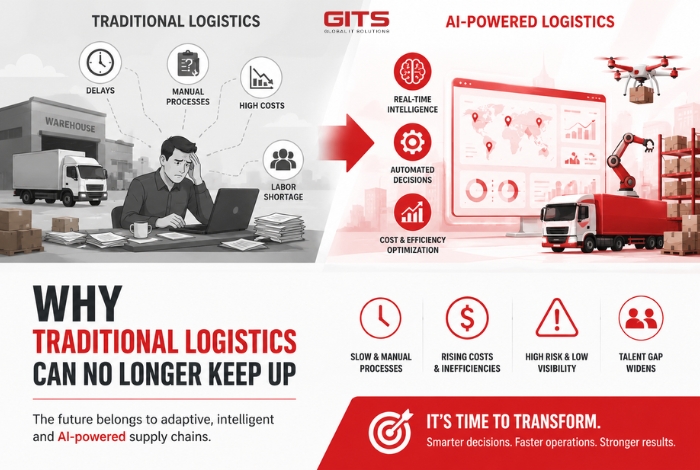
Why Traditional Logistics Can No Longer Keep Up
Today’s logistics organizations face challenges that technology alone has not fully solved.
Warehouse teams continue to struggle with labor shortages. Transportation planners spend hours adjusting delivery schedules. Inventory decisions remain reactive, while disruptions caused by weather, demand fluctuations or supplier delays create unexpected operational risks.
Although many enterprises have implemented Warehouse Management Systems (WMS), Transportation Management Systems (TMS) or Enterprise Resource Planning (ERP), these platforms often operate independently. Employees are still responsible for collecting information, comparing reports and making operational decisions manually.
As supply chains become increasingly dynamic, businesses need systems capable of thinking, collaborating and acting in real time—not simply storing data.
AI Agents in Logistics Move Beyond Automation
Traditional automation follows predefined workflows.
AI Agents go much further by continuously learning from operational data, collaborating across multiple business systems and independently executing tasks based on changing business conditions.
Instead of waiting for human intervention, AI Agents can identify potential risks, evaluate available options and initiate the most effective response within seconds.
For logistics companies, this means faster decision-making, lower operational costs and significantly improved responsiveness across the entire supply chain.
How AI Agents Create Business Value
Rather than replacing existing logistics platforms, AI Agents enhance them by orchestrating intelligent decisions across the entire operation.
Key capabilities include:
– Autonomous warehouse coordination
– Intelligent inventory optimization
– Predictive transportation planning
– Real-time disruption management
– Cross-system workflow orchestration
– AI-powered customer service support
These capabilities transform disconnected software into an intelligent logistics ecosystem.
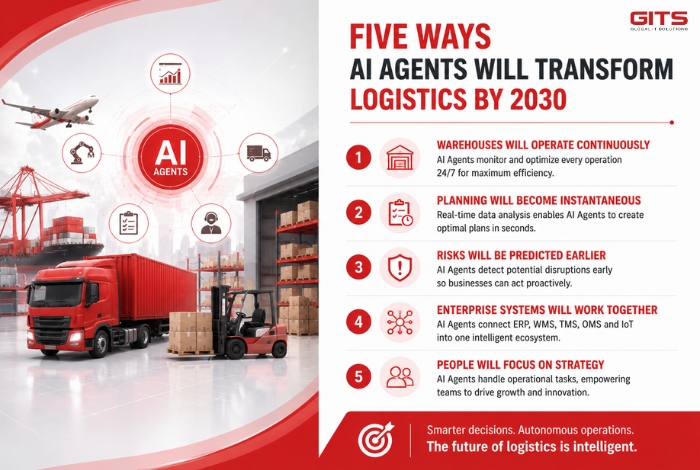
Five Ways AI Agents Will Transform Logistics by 2030
Warehouses Will Operate Continuously
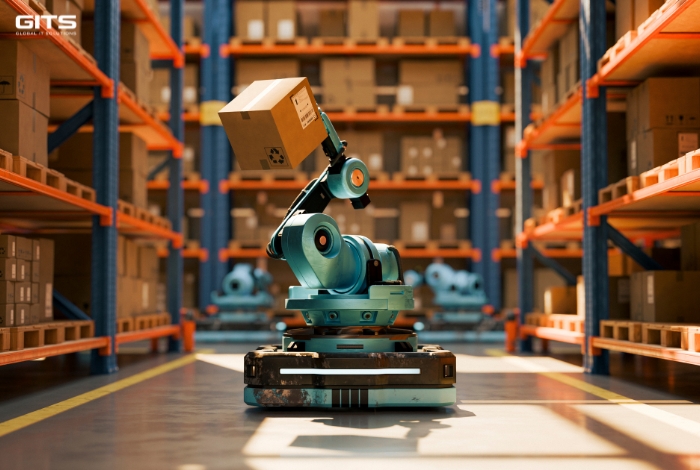
Modern warehouses generate enormous amounts of operational data every second. AI Agents monitor inventory movements, workforce availability and equipment performance simultaneously, ensuring operations continue efficiently around the clock.
Instead of responding after problems occur, businesses gain continuous optimization across inbound, storage and outbound processes.
Planning Will Become Instantaneous
Manual planning can no longer keep pace with today’s supply chain volatility.
AI Agents analyze customer demand, transportation capacity, weather conditions, production schedules and inventory levels simultaneously, generating optimized operational plans within seconds.
This dramatically reduces planning time while improving delivery accuracy and resource utilization.
Supply Chain Risks Will Be Predicted Earlier
Unexpected disruptions remain one of the largest cost drivers in logistics.
Using predictive intelligence, AI Agents identify shipment delays, supplier risks, equipment failures and inventory shortages before they impact operations.
Businesses gain more time to respond proactively instead of reacting after service levels decline.
Enterprise Systems Will Finally Work Together
Many organizations already own advanced software platforms but still struggle with disconnected information.
AI Agents connect ERP, WMS, TMS, OMS and IoT environments into a unified decision-making layer.
Rather than employees switching between multiple dashboards, AI Agents coordinate information automatically, reducing repetitive work while improving operational visibility.
People Will Focus on Strategic Decisions
The future of logistics is not about replacing people.
It is about allowing professionals to focus on customer relationships, operational improvements and strategic planning while AI Agents manage repetitive operational decisions.
This collaboration between human expertise and intelligent automation creates a more agile, scalable and resilient organization.
>>> See More: Multi-Agent Systems in Logistics: Transforming AI Operations
Why AI Agents Matter for Japan, Korea and Global Enterprises
Countries such as Japan and South Korea are experiencing significant workforce shortages alongside increasing demand for highly efficient logistics operations.
Global manufacturers and logistics providers are also facing growing pressure to improve resilience, reduce operational costs and respond faster to market changes.
AI Agents address these challenges by enabling autonomous decision-making, intelligent collaboration and continuous optimization without requiring organizations to completely replace their existing infrastructure.
For enterprises pursuing AI Transformation (AX) initiatives, AI Agents represent the next evolution beyond traditional digital transformation.
AI Services and Technical Solutions Are Shaping the Future
Successful AI adoption is no longer limited to implementing individual AI models.
Leading enterprises are investing in integrated AI Solutions, combining Large Language Models (LLMs), Agentic AI, predictive analytics, IoT connectivity and enterprise platforms into a unified intelligent ecosystem.
Working with experienced AI Services providers allows organizations to identify high-impact use cases, integrate AI with existing operations and build scalable solutions that deliver measurable business outcomes.
As AI technologies continue to mature, businesses that begin their AI journey today will be significantly better positioned for the competitive landscape of 2030.
Preparing Today for the Intelligent Logistics Era
The future of logistics will not be defined by who owns the most software. It will be defined by who makes the fastest, smartest and most autonomous decisions.
AI Agents in Logistics are transforming supply chains from reactive operations into intelligent ecosystems capable of learning, adapting and acting in real time. Organizations that embrace this shift today will reduce operational complexity, improve resilience and create lasting competitive advantages in an increasingly unpredictable global market.
The question is no longer whether AI Agents will transform logistics. The real question is whether your organization is ready to lead that transformation.