






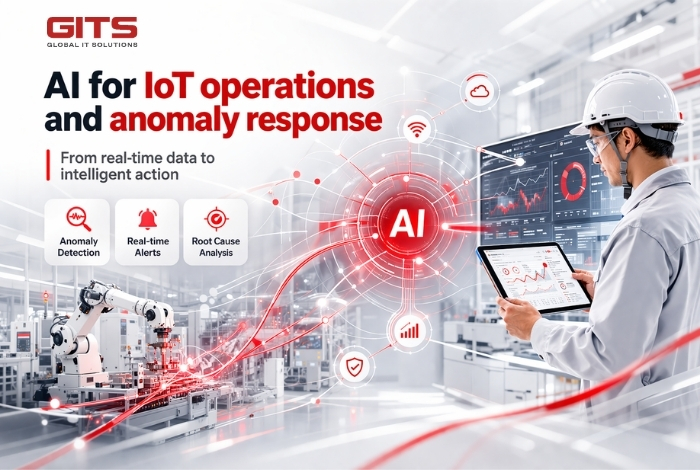
AI for IoT operations and anomaly response is becoming a critical solution for enterprises in Japan and Korea facing increasing system complexity and data overload. While IoT devices continuously generate large volumes of real time data, many organizations still struggle to detect anomalies early and respond effectively. As a result, hidden inefficiencies, unexpected equipment failures, and operational disruptions continue to impact performance and increase costs.
By leveraging AI driven anomaly detection, real time alerts, and root cause analysis, businesses can transform raw IoT data into actionable insights. AI for IoT operations and anomaly response enables enterprises to shift from reactive monitoring to proactive decision making, ensuring higher system reliability, reduced downtime, and optimized operational efficiency in highly demanding industrial environments.
The role of AI for IoT operations and anomaly response
AI for IoT operations and anomaly response plays a pivotal role in modern industrial ecosystems by converting continuous IoT data streams into meaningful and actionable intelligence.
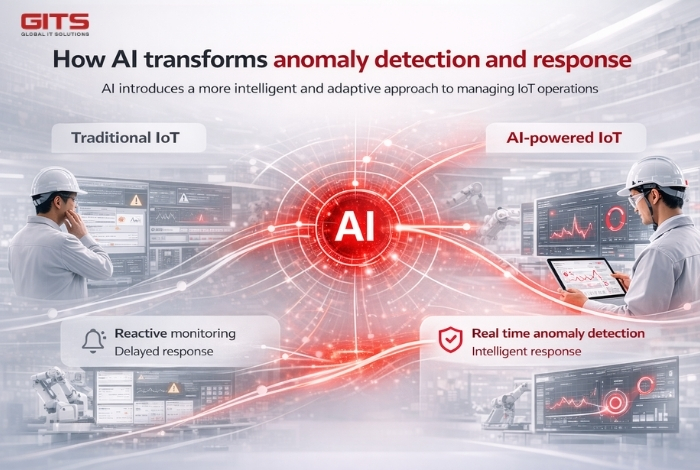
Unlike traditional monitoring systems, AI models learn from historical and real time data patterns to detect anomalies dynamically. This allows enterprises to move beyond static rules and manual observation.
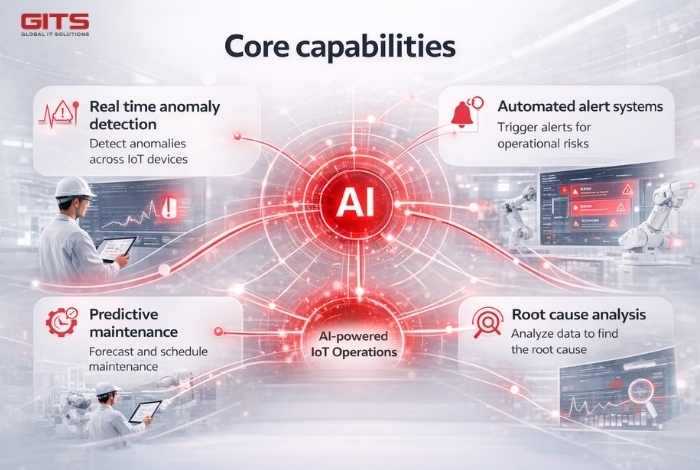
Core capabilities include
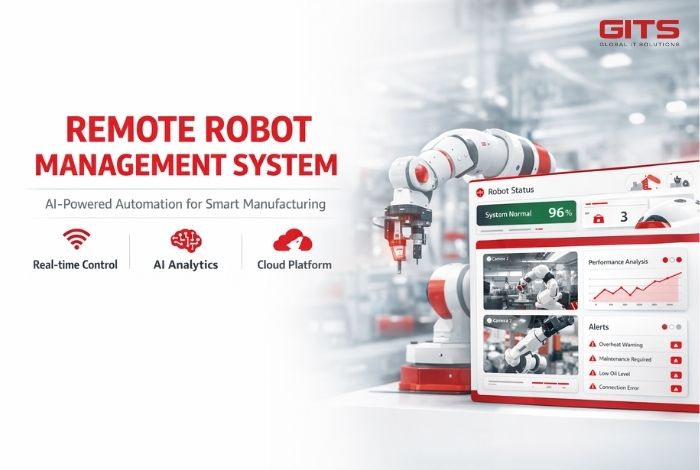
– Real time anomaly detection across IoT devices
– Automated alert systems for operational risks
– Predictive maintenance to minimize downtime
– Root cause analysis for faster issue resolution
For enterprises in Japan and Korea, where operational precision and reliability are essential, these capabilities directly enhance productivity and reduce operational risks.
Challenges in traditional IoT operations
Despite the rapid adoption of IoT technologies, many organizations still face significant operational challenges.
Data overload and limited visibility
IoT systems produce massive amounts of data, but traditional dashboards often fail to deliver actionable insights. This results in delayed decision making and overlooked anomalies.
Reactive monitoring approach
Most legacy systems rely on predefined thresholds. These rule based systems cannot detect complex or unknown anomalies, leading to late responses and higher risks.
Fragmented data ecosystems
In industries such as manufacturing and logistics, data is often distributed across multiple platforms. This fragmentation limits the ability to perform comprehensive analysis.
How AI transforms anomaly detection and response
AI introduces a more intelligent and adaptive approach to managing IoT operations.
AI driven anomaly detection in IoT
AI models continuously learn normal operational behavior and detect deviations in real time. This enables identification of subtle anomalies such as
– Gradual equipment degradation
– Abnormal energy consumption patterns
– Irregular production outputs
Early detection helps prevent critical failures and reduces maintenance costs.
Real time alerts and automated workflows
AI systems provide instant alerts when anomalies are detected. Advanced implementations can trigger automated workflows, allowing organizations to respond immediately.
Examples include
– Adjusting system parameters automatically
– Triggering maintenance processes
– Optimizing logistics operations in real time
This reduces reliance on manual intervention and accelerates response time.
Root cause analysis with AI
AI enhances root cause analysis by correlating data across multiple sources, including sensors, historical records, and system logs.
This enables
– Faster diagnosis of issues
– More accurate identification of root causes
– Reduced downtime and operational disruption
Industry applications across Japan and Korea
AI for IoT operations and anomaly response delivers strong value across multiple industries.
Manufacturing
– Predictive maintenance for industrial equipment
– Quality anomaly detection in production lines
– Energy efficiency optimization
Logistics and transportation
– Real time fleet monitoring and anomaly detection
– Route optimization based on live data
– Warehouse automation and efficiency improvement
Healthcare and smart infrastructure
– Monitoring performance of medical devices
– Detecting anomalies in patient data streams
– Managing smart buildings and utilities
These applications align closely with the high standards of quality, efficiency, and reliability required in Japanese and Korean markets.
Key considerations for implementation
To successfully deploy AI for IoT operations, enterprises should focus on several critical factors.
Data quality and system integration
Reliable and consistent data collection is essential. Seamless integration with existing systems ensures comprehensive analysis.
Scalable AI infrastructure
Organizations should adopt flexible AI architectures that can scale with increasing data volumes and evolving business needs.
Security and regulatory compliance
Data security and compliance are critical, especially in Japan and Korea where strict regulations govern enterprise systems.
Localization and industry adaptation
AI solutions must be tailored to specific industries and operational environments to deliver optimal performance.
>>> See More: Turning AI Into Real Enterprise Value with Vietnam AX Capability
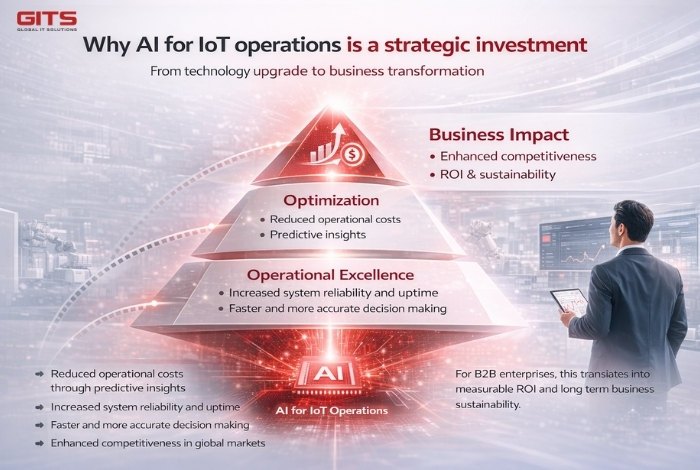
Why AI for IoT operations is a strategic investment
AI for IoT operations and anomaly response is more than a technological upgrade. It is a strategic enabler of autonomous and intelligent operations.
Key benefits include
– Reduced operational costs through predictive insights
– Increased system reliability and uptime
– Faster and more accurate decision making
– Enhanced competitiveness in global markets
For B2B enterprises, this translates into measurable ROI and long term business sustainability.
From anomaly detection to autonomous operations
AI for IoT operations and anomaly response is redefining how enterprises manage complex systems in real time. By enabling intelligent anomaly detection, automated alerts, and precise root cause analysis, organizations can move beyond reactive operations and achieve true operational excellence.
For businesses in Japan and Korea, adopting this approach is no longer optional. It is a strategic necessity to build resilient, data driven systems that can adapt to future challenges.
At GITS, we deliver advanced AI and IoT solutions tailored for enterprise environments, helping organizations accelerate their digital transformation journey. Discover how our expertise in Vietnam IT outsourcing can support your business in building scalable, high performance AI systems for IoT operations.