





In today’s highly dynamic retail environment, demand forecasting is no longer a supporting function—it is a core driver of profitability and operational efficiency. A Japanese retail enterprise faced increasing challenges due to fragmented data, manual planning processes, and low forecast accuracy.
To address these issues, GITS implemented a SALE DEMAND FORECASTING SYSTEM powered by AI agents and cloud-based analytics. This transformation enabled data-driven decision-making and significantly improved forecasting performance across the organization.
Customer Background
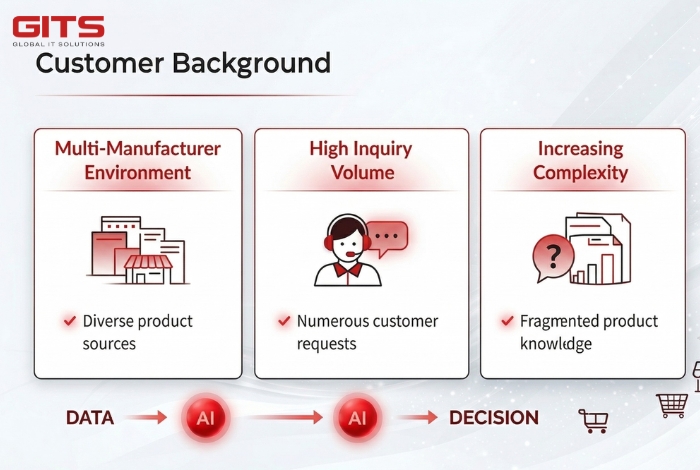
The customer is a mid-sized retail company in Japan operating across multiple product categories, including seasonal goods and fast-moving consumer products.
With growing business complexity and increasing competition, the company aimed to modernize its demand planning capabilities to maintain operational efficiency and market responsiveness.
Key business objectives included:
– Improving demand forecast accuracy across all product lines
– Reducing excess inventory and minimizing stockouts
– Supporting new product launches with reliable data insights
– Transitioning toward a data-driven decision-making model
Despite having multiple IT systems in place, the organization lacked a unified forecasting mechanism capable of adapting to rapidly changing market conditions.
Technical Challenges
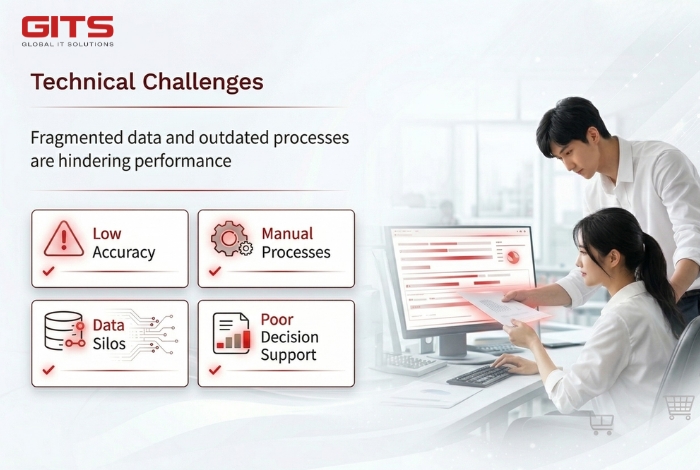
The company faced several critical operational and technical challenges:
Fragmented Data Environment
Data was scattered across ERP, POS, and inventory systems, making it difficult to consolidate and analyze information in real time.
Low Forecast Accuracy
Traditional forecasting relied heavily on historical data, failing to account for external factors such as seasonality, promotions, and shifting consumer behavior.
Ineffective New Product Forecasting
The absence of historical data for new products resulted in unreliable predictions and increased inventory risks.
Manual and Experience-Based Processes
Demand planning depended on individual expertise, leading to inconsistent outcomes and limited scalability.
Lack of Decision Support
Existing systems did not provide actionable insights, making it difficult for management to optimize operations effectively.
These limitations highlighted the need for a more advanced solution leveraging AI agents and modern AI services.
Solution Implementation
GITS designed and implemented a scalable SALE DEMAND FORECASTING SYSTEM that integrates AI, cloud infrastructure, and enterprise data systems to enable intelligent forecasting.
Overview of the Solution
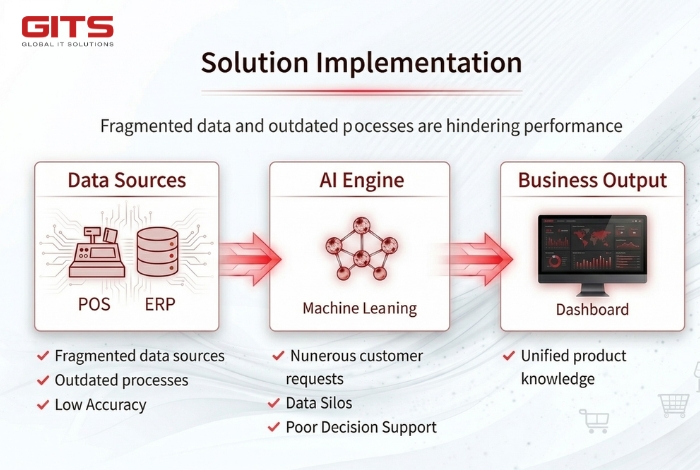
The solution is built on three core pillars:
– Data integration and normalization
– AI-driven forecasting models
– Continuous learning through feedback loops
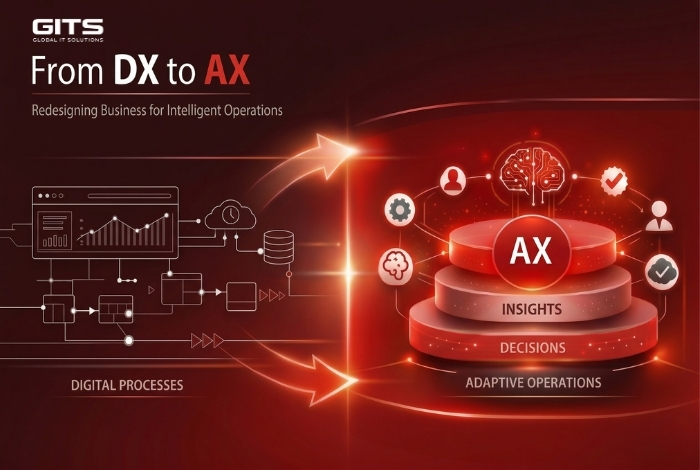
This approach aligns with AX (AI Transformation), enabling organizations to move beyond static forecasting toward adaptive, intelligent systems.
System Architecture
The system follows a modular, cloud-native architecture:
– Data Integration Layer
Aggregates and standardizes data from ERP, POS, and inventory systems
– AI Forecasting Engine
Uses machine learning models to analyze trends, patterns, and external variables
– Feedback Loop Mechanism
Continuously retrains models based on the gap between forecasted and actual outcomes
– Cloud Infrastructure
Ensures scalability, real-time processing, and high system reliability
– Business Dashboard
Provides intuitive visualization and actionable insights for decision-makers
Key Features
– Multi-model demand forecasting for higher accuracy
– Customer-level demand prediction
– Optimal order quantity recommendations
– Forecasting support for new products
– Scenario-based simulation for decision-making
Deployment Approach
GITS adopted a phased implementation strategy:
1, Data assessment and preparation
2, AI model development and training
3, Integration with existing enterprise systems
4, Pilot deployment and validation
5, Full-scale rollout and optimization
Through its IT Outsourcing capabilities, GITS ensured efficient implementation while minimizing the client’s internal resource burden.
Measurable Results
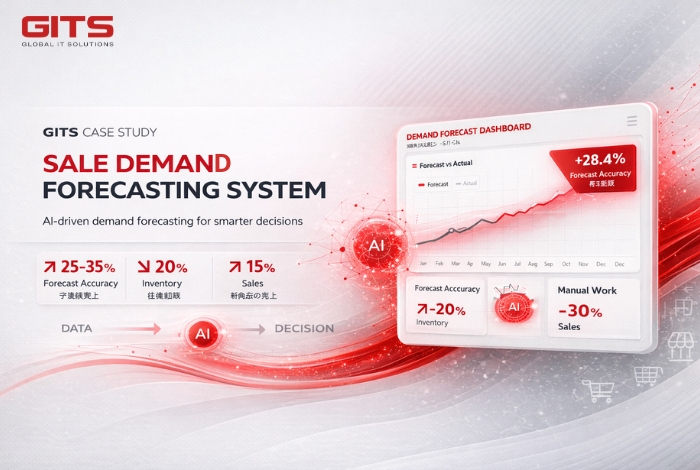
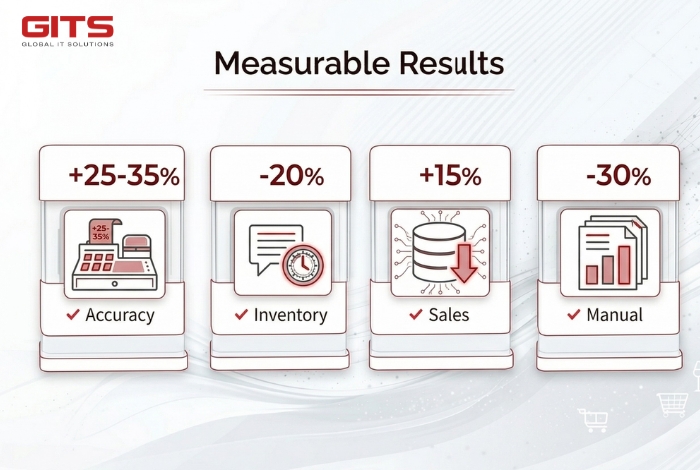
The deployment of the SALE DEMAND FORECASTING SYSTEM delivered clear, measurable outcomes:
– 25–35% improvement in forecast accuracy
– 20% reduction in excess inventory
– 15% increase in new product sales
– 30% reduction in manual planning workload
Operational Impact
– Improved alignment between sales, procurement, and supply chain teams
– Faster, real-time decision-making capabilities
– Reduced reliance on individual expertise
Business Outcomes
– Increased profitability through optimized inventory management
– Enhanced customer satisfaction due to improved product availability
– Stronger adaptability to market fluctuations
Project Scope and Timeline
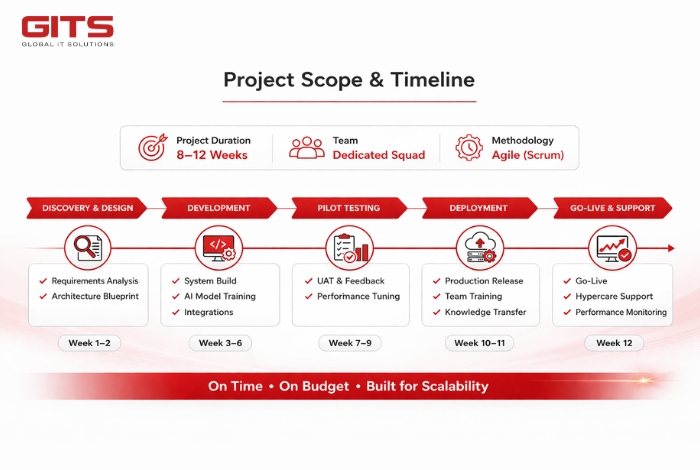
Project Scope
– Team size: 6 engineers (AI, backend, frontend, data specialists)
– Systems involved: ERP, POS, inventory management, cloud platform
– Stakeholders: business managers, supply chain teams, executives
Timeline
– Design Phase: 2–3 weeks
– Development & Integration: 6–8 weeks
– Pilot Testing & Optimization: 3–4 weeks
– Deployment & Training: 2 weeks
Key Milestones
– Completion of data integration framework
– Deployment of AI forecasting models
– Successful pilot validation
– Organization-wide system rollout
>>> See More: AI Chat Bot For Call Center Efficiency
From Forecasting to Intelligent Growth: A New Standard for AX-Driven Enterprises
This case study demonstrates that a SALE DEMAND FORECASTING SYSTEM is not merely a forecasting tool, but a strategic capability that transforms how enterprises make decisions.
By leveraging AI agents, cloud technologies, and continuous learning models, GITS enabled the client to shift from reactive planning to proactive, data-driven operations.
This transformation not only delivered immediate performance improvements but also established a scalable foundation for long-term AX transformation.
GITS continues to position itself as a trusted technology partner, delivering practical and measurable solutions tailored to enterprise needs.
Explore how GITS delivers scalable enterprise solutions tailored to your business needs—empowering smarter, data-driven operations with AI and IT Outsourcing.