







Artificial Intelligence is reshaping industries worldwide, but many enterprises still struggle to move beyond successful AI pilots. While organizations invest heavily in AI models, the real challenge lies in building an Enterprise AI Infrastructure capable of supporting continuous innovation, evolving technologies, and long-term business growth.
According to industry research from Gartner and McKinsey, many AI initiatives fail to scale because of fragmented data, legacy systems, weak governance, and poor integration rather than limitations in AI models themselves. For enterprises across Japan, South Korea, Vietnam, and global markets, the question is no longer whether to adopt AI, but whether their infrastructure is ready for the next generation of AI.
What Is Enterprise AI Infrastructure?
Enterprise AI Infrastructure is the integrated technology foundation that enables organizations to develop, deploy, secure, and manage AI applications at scale. It combines enterprise data, computing resources, AI platforms, security, governance, and business systems into a unified ecosystem.
Unlike traditional IT infrastructure, a future-ready AI architecture continuously adapts to emerging technologies such as Large Language Models (LLMs), AI Agents, Retrieval-Augmented Generation (RAG), and intelligent automation without requiring major system redesign.
Why Many AI Projects Fail to Scale
Many organizations begin with promising AI proof-of-concepts but encounter significant obstacles when expanding AI across departments.
The most common challenges include:
– Data isolated across ERP, CRM, MES, WMS, and legacy systems
– Infrastructure that cannot support growing AI workloads
– Complex integration between business applications
– Security, compliance, and AI governance concerns
– Shortage of experienced AI engineers and solution architects
These issues often delay AI Transformation (AX), increase implementation costs, and prevent organizations from realizing measurable business value.

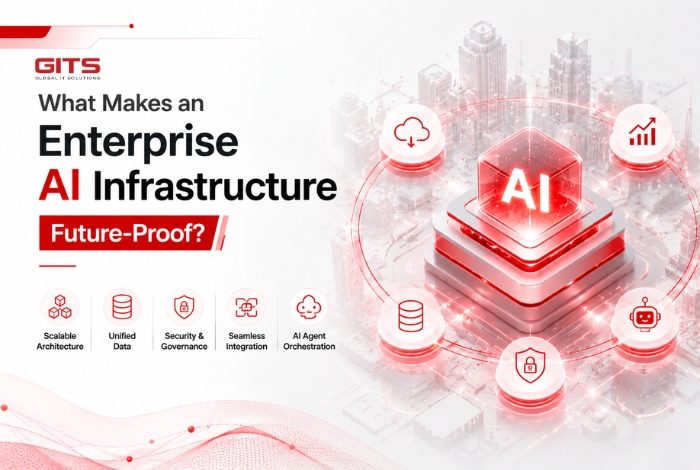
What Makes an Enterprise AI Infrastructure Future-Proof?
A future-proof infrastructure is not defined by today’s AI models. Instead, it is designed to support tomorrow’s technologies with minimal disruption.
Enterprise AI Infrastructure Built for Scalability
AI adoption rarely remains within a single department. Infrastructure should support increasing data volumes, additional AI models, and expanding business operations without rebuilding the underlying architecture.
Cloud-native deployment, modular architecture, and API-first design enable organizations to scale AI efficiently while maintaining operational flexibility.
Unified Enterprise Data Integration
Successful AI depends on trusted, connected data.
Future-ready organizations integrate structured and unstructured information across enterprise systems, creating a single source of truth for AI-driven decision-making. This improves prediction accuracy, reduces duplicate processes, and enables real-time business intelligence.
Security and AI Governance by Design
As AI becomes responsible for business-critical decisions, governance must be embedded from the beginning.
A resilient infrastructure includes:
– Identity and access management
– Data encryption
– AI model monitoring
– Regulatory compliance
– Explainable AI
– Risk management and auditability
Strong governance not only protects enterprise data but also builds confidence in AI-generated outcomes.
Seamless Integration Across Business Systems
Modern AI should enhance existing operations instead of replacing them.
An effective Enterprise AI Infrastructure integrates AI Services with ERP, CRM, WMS, MES, TMS, and customer platforms, allowing employees to access AI capabilities directly within familiar workflows.
AI Agent Orchestration
The next evolution of enterprise AI is intelligent collaboration between multiple AI Agents.
Rather than supporting a single chatbot, future-proof infrastructure orchestrates AI Agents that retrieve enterprise knowledge, automate workflows, coordinate business processes, and assist employees across departments.
This capability is becoming a critical differentiator for organizations pursuing large-scale AI Transformation.
Business Value Beyond Technology
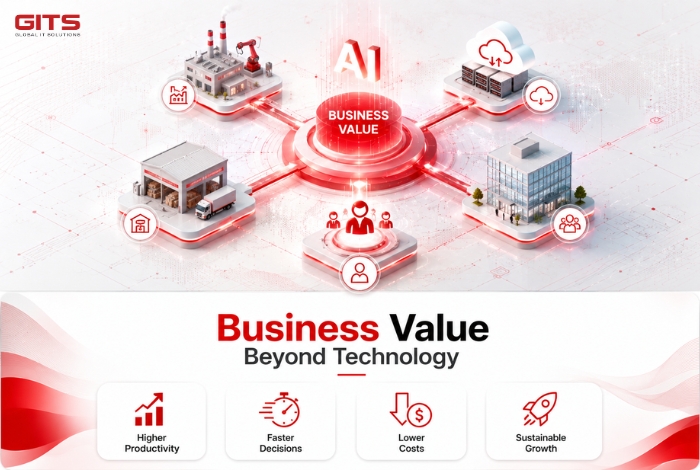
A future-proof infrastructure creates long-term business value rather than short-term technical improvements.
Organizations can expect to:
– Accelerate AI deployment across business units
– Reduce infrastructure and integration costs
– Improve operational efficiency through intelligent automation
– Strengthen compliance and enterprise security
– Adapt quickly to emerging AI technologies without rebuilding existing systems
Instead of repeatedly investing in isolated AI projects, enterprises establish a reusable foundation that supports continuous innovation.
Why Many Enterprises Choose AI Services Partners
Building an enterprise-grade AI ecosystem requires expertise across data engineering, AI architecture, MLOps, security, integration, and governance.
However, recruiting and retaining specialized AI talent remains a significant challenge for many organizations.
Partnering with an experienced AI Services provider enables enterprises to accelerate implementation, reduce project risk, optimize investment costs, and gain access to proven Technical Solution expertise without building an entire AI team internally.
For organizations beginning their AI Transformation journey, working with the right technology partner often becomes the fastest path from AI experimentation to measurable business outcomes.
FAQ
What is Enterprise AI Infrastructure?
Enterprise AI Infrastructure is the technology foundation that enables organizations to securely develop, deploy, integrate, and scale AI applications across the business.
Why is Enterprise AI Infrastructure important?
It helps organizations reduce deployment complexity, improve AI governance, integrate enterprise data, and scale AI initiatives efficiently while supporting long-term digital transformation.
How is Enterprise AI Infrastructure different from traditional IT infrastructure?
Traditional IT infrastructure primarily supports business applications, while Enterprise AI Infrastructure is purpose-built for AI workloads, including data pipelines, AI models, AI Agents, governance, and intelligent automation.
Can enterprises build AI infrastructure without an in-house AI team?
Yes. Many organizations accelerate AI adoption by partnering with experienced AI Services providers that offer enterprise architecture, integration expertise, governance frameworks, and end-to-end implementation support.
>> See More: AI-First Development: The Foundation of Enterprise AI Success
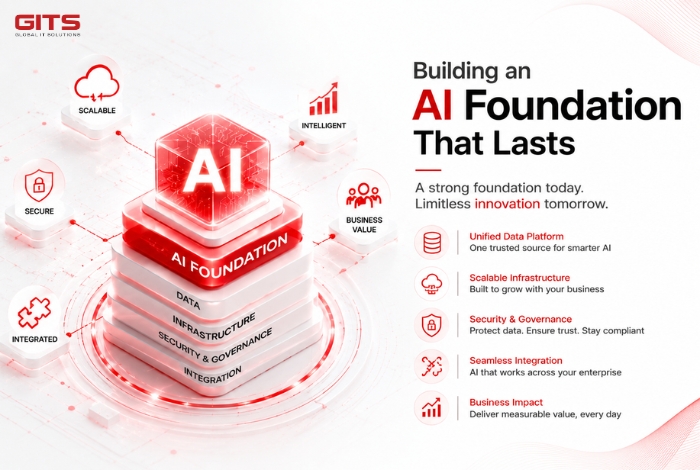
Building an AI Foundation That Lasts
The companies leading tomorrow’s AI economy are not simply deploying more AI models. They are investing in an Enterprise AI Infrastructure that is scalable, secure, flexible, and designed for continuous innovation.
As AI Agents, generative AI, and intelligent automation become standard across industries, enterprises need infrastructure capable of evolving alongside technology rather than being replaced by it. Organizations that build this foundation today will be better positioned to accelerate AI Transformation, maximize ROI, and maintain a sustainable competitive advantage in the years ahead.