






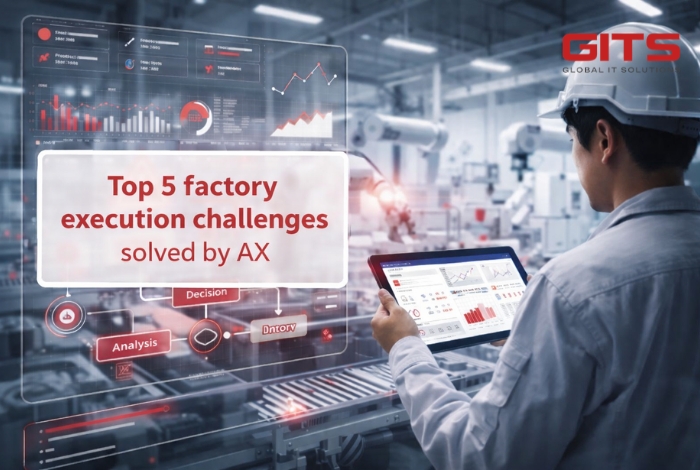
Most manufacturing operations do not fail because of strategy. They fail because of execution gaps that remain invisible until they impact delivery, quality, and cost. Across Japan and South Korea, manufacturers are under increasing pressure to maintain precision, reduce waste, and respond faster to market changes. Yet many factories still struggle with fragmented systems, delayed issue resolution, and manual processes that limit scalability. These factory execution challenges are not new. What is changing is the way leading enterprises solve them.
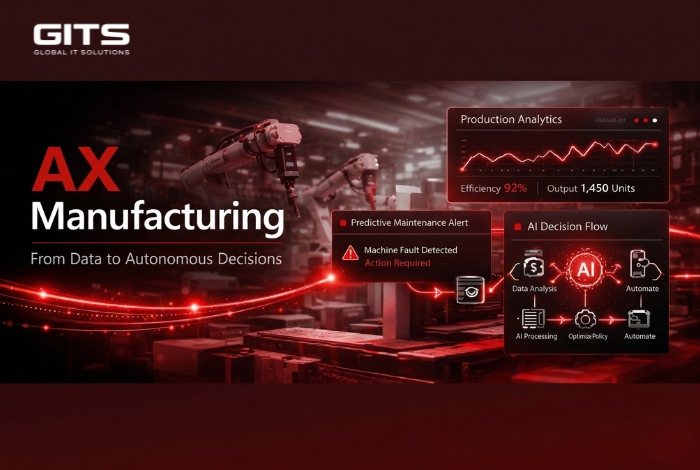
Agentic Execution, or AX, introduces a new operational layer where systems do not just monitor but actively detect, decide, and act in real time. This enables factories to move from reactive management to autonomous execution.
Top factory execution challenges solved by AX
Lack of real time visibility across operations
One of the most common factory execution challenges is the absence of a unified operational view. Data is often siloed across ERP, MES, and shop floor systems, making it difficult to understand what is actually happening in real time.
In high precision environments such as Japanese and Korean manufacturing, even small delays in visibility can lead to significant downstream impact.
AX creates a continuous data intelligence layer that connects and interprets signals across the entire production environment. Instead of static dashboards, decision makers gain dynamic, contextual insights.
This enables faster detection of abnormalities and supports proactive decision making before issues escalate.
Delayed orders caused by slow issue resolution
Production delays rarely originate from a single major failure. They are typically the result of multiple small issues that remain unresolved for too long.
Traditional workflows depend on manual reporting and escalation, which slows down response time and increases operational risk.
AX addresses this by automatically detecting anomalies such as machine downtime, material shortages, or workflow disruptions. It then triggers immediate actions or recommends optimized solutions based on predefined logic and real time data.
As a result, factories can significantly reduce lead time and improve on time delivery performance.
High error rates in manual operations
Manual processes continue to be a major source of inefficiency in manufacturing execution. Errors in data entry, reporting, and task handling can directly impact product quality and operational consistency.
AX reduces reliance on manual intervention by automating repetitive processes and validating data in real time.
Instead of waiting for human input, the system continuously monitors execution conditions and initiates corrective actions when deviations occur.
This ensures higher accuracy, improved quality control, and more stable production outcomes.
Inefficient exception handling and escalation
Exception handling is often one of the weakest points in factory execution. Issues are typically escalated through multiple layers, leading to delays and lack of accountability.
AX transforms exception handling into a structured and intelligent process. When an issue occurs, the system identifies root causes, evaluates impact, and assigns resolution actions automatically.
This creates a closed loop execution model where problems are not only detected but resolved efficiently and consistently.
For enterprises in Japan and South Korea, this approach aligns with strong operational discipline and continuous improvement practices.
Limited scalability in complex production environments
As manufacturing operations grow, complexity increases across production lines, supply chains, and coordination processes.
Traditional systems often struggle to scale due to rigid architecture and limited adaptability.
AX is designed to operate in dynamic environments. It continuously learns from historical and real time data, enabling it to adapt to new production conditions and optimize workflows accordingly.
This allows manufacturers to scale operations without sacrificing efficiency, quality, or control.
Business impact of solving factory execution challenges with AX
Adopting AX is not only a technological upgrade. It delivers measurable business outcomes that directly impact competitiveness.
Organizations implementing AX in manufacturing environments typically achieve:
– Faster issue resolution and reduced downtime
– Improved order fulfillment and delivery reliability
– Lower operational costs through process optimization
– Enhanced visibility across the entire production lifecycle
– Increased scalability without proportional resource growth
These outcomes are particularly critical in Japan and South Korea, where operational excellence and reliability are key differentiators.
Why traditional systems are no longer sufficient
Many factories rely on MES and dashboard based systems that provide visibility but lack execution capability.
These systems are designed to inform, not to act. As a result, there is always a gap between insight and execution.
AX closes this gap by enabling systems to take action autonomously. It transforms data into decisions and decisions into execution without delay.
This shift is essential for manufacturers aiming to compete in an increasingly complex and fast moving global market.
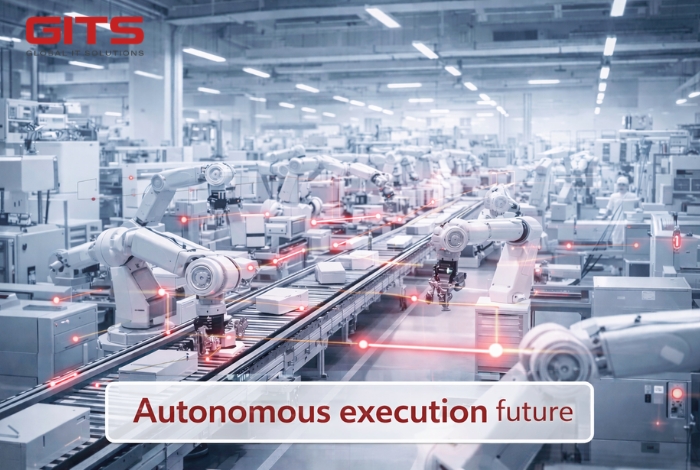
How AX enables autonomous factory execution
AX introduces a new execution model where systems function as active participants in operations.
Instead of waiting for human instructions, AX continuously monitors, analyzes, and responds to production conditions.
This enables:
– Real time orchestration of workflows
– Automated decision making based on contextual data
– Continuous optimization of production performance
For manufacturers in Japan and South Korea, this represents a natural evolution toward smarter, more resilient operations.
>>> See More: AX Manufacturing: Driving Intelligent Factory Operations
From execution challenges to autonomous manufacturing advantage
Factory execution challenges such as delayed orders, errors, and lack of visibility are no longer inevitable constraints. With AX, they become opportunities to build a more intelligent and responsive production system.
By shifting from reactive management to autonomous execution, manufacturers can achieve higher efficiency, greater reliability, and stronger competitive positioning in global markets.
At GITS, we help enterprises accelerate this transformation through advanced AX solutions tailored for manufacturing. With deep expertise in Vietnam IT outsourcing, we deliver scalable, high quality systems that align with the rigorous standards of Japanese and Korean businesses.
If your organization is looking to move beyond traditional execution models and unlock real time operational intelligence, GITS is your trusted partner in building the next generation of factory execution systems.