





In today’s business landscape, technology is evolving faster than many organizations can structurally adapt. Artificial intelligence, automation, real-time data systems, cloud-native platforms, and intelligent agents are no longer future concepts. They are already reshaping how enterprises operate, compete, and create value.
In this environment, the real question is no longer whether businesses should use AI. The more important question is this: how should a business operate when intelligence becomes embedded in every decision, workflow, and operational layer?
That is where AX becomes highly relevant.
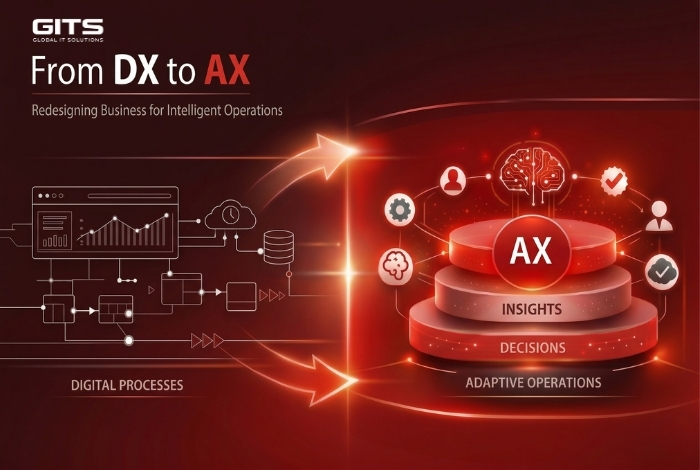
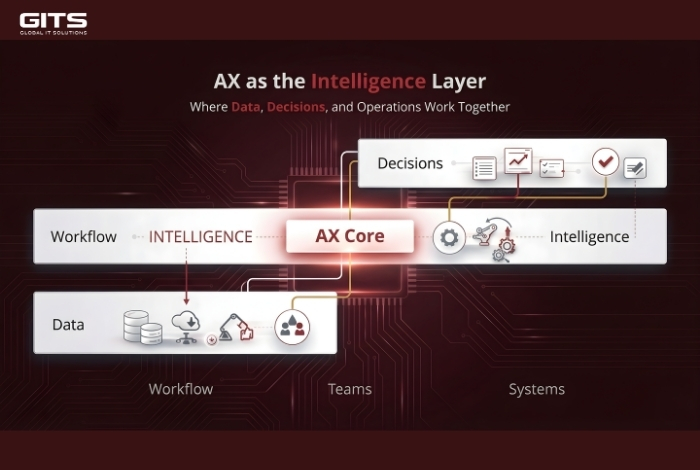
While digital transformation helped organizations digitize processes and modernize systems, AX, or AI Transformation, goes a step further. It focuses on redesigning how businesses work by integrating AI into operations, decision-making, and value creation in a practical and scalable way.
For enterprise leaders, especially in highly operational and quality-driven markets such as Japan and Korea, AX is not just a new technology topic. It is becoming a strategic response to real business pressures, including labor shortages, rising operational complexity, slower decision cycles, and the growing need to improve efficiency without increasing risk.
What is AX?
AX stands for AI Transformation. It refers to the process of rethinking and redesigning business operations so that AI becomes a meaningful part of how the organization functions.
This does not simply mean adding an AI chatbot, an AI analytics tool, or a few automation features into existing systems. AX is much broader than tool adoption.
At its core, AX asks several critical questions:
– Where can AI create measurable impact across the business?
– How should data be structured so that AI can generate useful outcomes?
– Which workflows need to be redesigned to benefit from intelligent support?
– How should people and AI work together to improve speed, accuracy, and decision quality?
In other words, AX is not about layering AI on top of old operating models. It is about building a more intelligent operating model for the future.
AX vs. digital transformation: what is the difference?
To understand why AX matters now, it is important to distinguish it from traditional digital transformation.
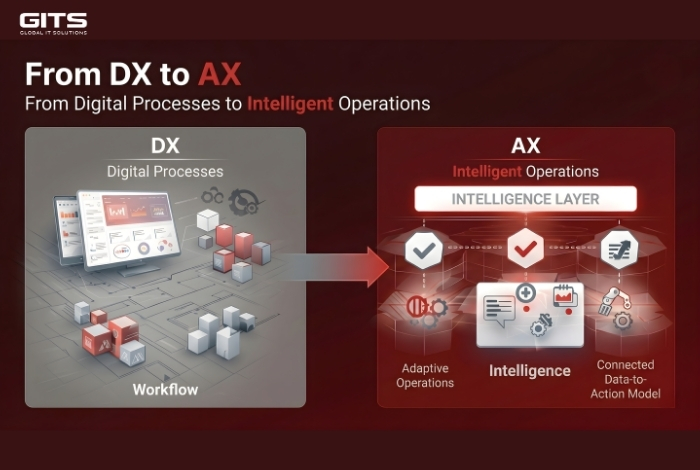
Digital transformation focused on digitization
Digital transformation helped businesses move away from manual, paper-based, or disconnected processes. It improved system integration, data visibility, and process efficiency. For many enterprises, this was an essential first step toward modernization.
However, digitization alone does not automatically make an organization intelligent.
AX focuses on intelligent operations
AX builds on the digital foundation but introduces a deeper level of change. Instead of asking how to digitize processes, AX asks how to make operations more adaptive, predictive, and context-aware through AI.
With the right AX approach, AI can help businesses:
– Analyze large volumes of operational data in real time
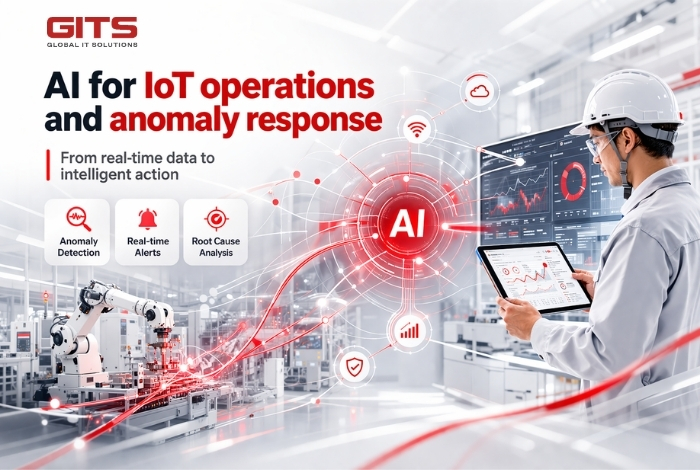
– Identify anomalies and hidden patterns
– Support faster, better-informed decision-making
– Recommend next-best actions
– Reduce repetitive workload across business functions
– Improve responsiveness across operations
That is why AX should not be seen as separate from digital transformation. It is the next stage of operational maturity.
Why AX matters in a fast-changing technology era
The speed of technological change is creating both opportunity and pressure. Enterprises are expected to innovate faster, improve efficiency, and remain competitive, all while maintaining service quality, governance, and business continuity.
This is exactly why AX is becoming more important.
AI is evolving faster than many organizations can absorb
New AI tools, large language models, intelligent agents, and automation platforms are emerging at an extraordinary pace. Yet many enterprises still struggle to translate these innovations into real operational value.
Without a structured AX strategy, AI can easily become fragmented, overhyped, or disconnected from business priorities.
Business operations are under increasing pressure
Across manufacturing, logistics, retail, healthcare, and finance, organizations are facing the same reality: they need to do more with limited resources.
Labor shortages, rising cost pressures, operational complexity, and demand for faster response times are forcing businesses to rethink how work gets done. AX offers a way to make operations more intelligent without simply adding more manual effort or more disconnected software.
Enterprises need clearer ROI from technology investments
In many enterprise environments, technology budgets are under greater scrutiny. AI initiatives are expected to show measurable value, not just innovation potential.
This is particularly relevant for companies in Japan and Korea, where business leaders often prioritize reliability, practical implementation, long-term sustainability, and controlled risk. AX provides a more grounded framework for aligning AI with operational and commercial outcomes.
The business value of AX
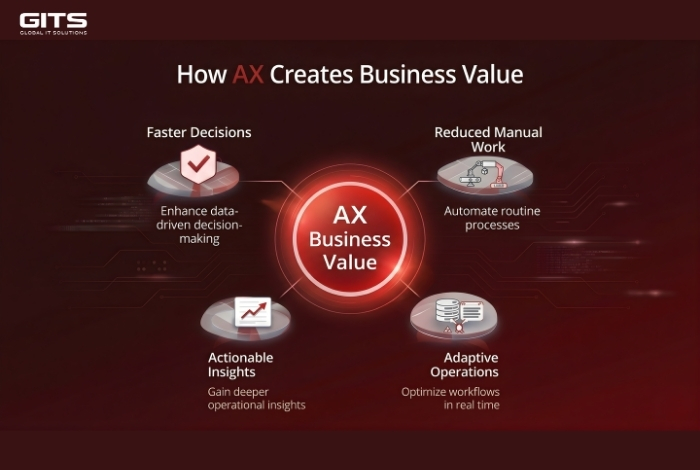
When implemented properly, AX can create measurable value across multiple layers of the organization.
Faster and better decision-making
AI can support decision-making by processing large amounts of data faster than traditional reporting models. Instead of waiting for delayed analysis, business teams can receive real-time insights, alerts, and recommendations that improve reaction speed and strategic clarity.
Reduced manual workload
Many enterprises still rely on teams to perform repetitive administrative and operational tasks such as document classification, status tracking, inquiry handling, reporting, and data validation. AX helps reduce this burden so employees can focus on higher-value work.
More actionable use of business data
A common problem in enterprise environments is not lack of data, but lack of useful action derived from it. AX helps connect data to operational context, so information becomes usable, timely, and decision-oriented.
More adaptive operating models
As markets shift faster, businesses need operating models that are both efficient and resilient. AX helps organizations become more responsive by embedding intelligence into workflows, rather than relying only on static rules or historical reports.
How should enterprises start with AX?
One of the most common mistakes businesses make is starting with AI technology instead of starting with a real business problem.
A more effective AX journey usually begins with operational priorities.
Identify a clear use case
The best starting points are often business challenges with visible impact, such as:
– Reducing response time in customer operations
– Improving demand forecasting
– Optimizing maintenance planning
– Detecting operational risks earlier
– Accelerating internal knowledge access
– Reducing manual processing in high-volume workflows
Assess data and workflow readiness
AI is only as useful as the data and process environment around it. Before scaling AX, enterprises should evaluate whether their data is available, structured, connected, and relevant enough to support intelligent workflows.
Start small, then scale
AX should not be treated as a one-time transformation project. A more practical approach is to begin with high-value, measurable use cases, validate results, and expand gradually. This reduces risk and creates stronger internal alignment.
Combine technical capability with business understanding
AX succeeds when technology is aligned with business reality. That is why enterprises increasingly look for partners who understand both engineering and domain-level operational challenges.
This is one reason why Vietnam IT outsourcing is gaining more attention in the global B2B market.
Why Vietnam IT outsourcing matters in the AX era
As businesses move from digital transformation into AX, many need flexible access to technology talent, scalable delivery models, and experienced engineering partners.
This is where Vietnam IT outsourcing has become a strong strategic option.
Vietnam is increasingly recognized as a reliable destination for software development, AI engineering, cloud integration, enterprise platforms, and digital product delivery. For companies in Japan, Korea, and other global markets, Vietnam IT outsourcing offers several practical advantages:
– Access to skilled engineering talent
– Cost-effective development without compromising quality
– Strong adaptability across industries
– Experience in enterprise system integration
– Growing capability in AI, automation, and cloud-based solutions
– Flexible collaboration models for both project-based and long-term partnerships
More importantly, the role of a modern outsourcing partner is also changing. Businesses no longer only need a vendor that writes code. They need a technology partner that can contribute to solution design, business understanding, and long-term operational improvement.
In the AX era, Vietnam IT outsourcing can support enterprises not only in development execution, but also in building scalable and practical AI-driven solutions.
AX is not a short-term trend
AI will continue to evolve. New tools will emerge. Enterprise architectures will keep changing. But the businesses that create sustainable advantage will not necessarily be those that adopt the most AI tools the fastest.
They will be the ones that integrate AI with the most clarity, purpose, and operational fit.
That is the real meaning of AX.
AX is not about creating the appearance of innovation. It is about redesigning how businesses work so intelligence can support performance, resilience, and future growth.
>>> See More: AI Agent Enabling Intelligent Operations Across Industries
AX is not the future — it is the next step
As enterprises move beyond basic digitization, AX is becoming a necessary strategic shift rather than an optional innovation theme. In a fast-changing technology environment, organizations need more than digital systems. They need smarter operations, better decisions, and a more adaptive way of working.
That is what AX enables.
For businesses looking to move from fragmented AI experiments to meaningful operational transformation, AX offers a more structured and value-driven path forward.
At the same time, the success of AX often depends on choosing the right implementation model and the right technology partner. For many enterprises, Vietnam IT outsourcing is emerging as a practical and scalable approach to accelerate AI Transformation with the right balance of quality, technical expertise, and business alignment.
At GITS, we believe AX should begin with real business challenges, not with technology hype. When AI is integrated with the right strategy, the result is not only better efficiency, but a stronger foundation for long-term enterprise growth.