





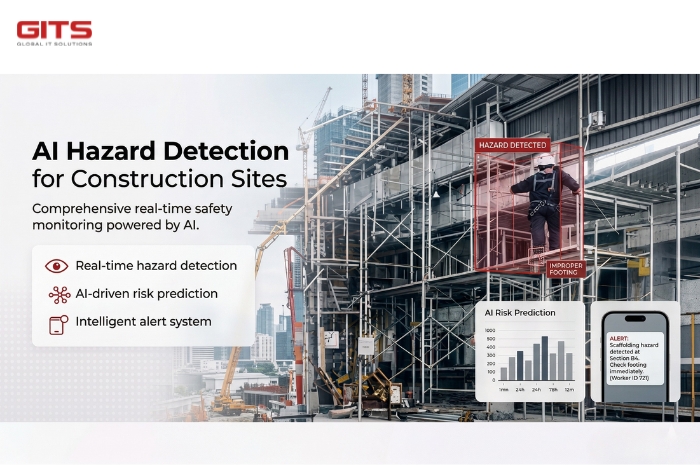
In high-risk environments such as construction sites, ensuring worker safety remains a critical operational priority. Traditional monitoring methods often fail to detect hazards in real time, leading to preventable incidents and compliance risks. This case study explores how hazard detection at construction sites was enhanced through an AI-powered system developed by GITS. By combining computer vision, IoT data, and real-time analytics, the solution enables proactive risk management and significantly improves site safety outcomes.
Customer Background
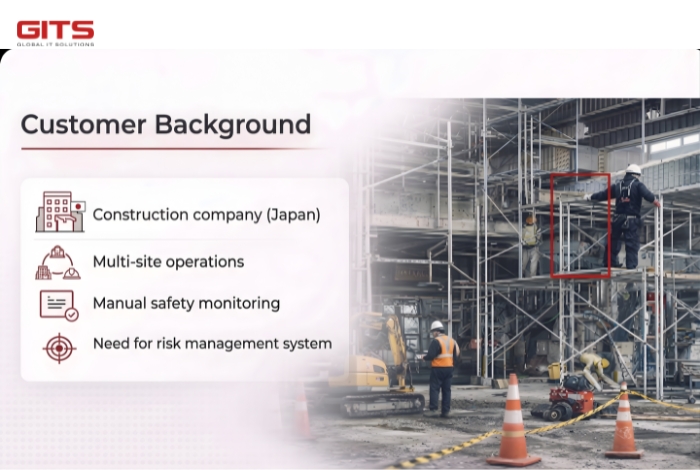
The customer is a mid-to-large Japanese construction company operating across multiple infrastructure and urban development projects. With increasing project complexity and workforce scale, maintaining consistent safety standards across sites became a strategic challenge.
Key context includes:
– Multiple concurrent construction sites with varying risk levels
– Heavy reliance on manual inspections and human supervision
– Increasing regulatory pressure on workplace safety compliance
– Growing need for digital transformation in site operations
The company’s primary objective was to implement a scalable hazard detection system capable of improving on-site visibility, reducing incidents, and supporting proactive safety management.
Technical Challenges
Despite having established safety protocols, the customer faced several operational and technical limitations:
Limited Real-Time Visibility
Manual inspections were periodic and reactive, leaving gaps in continuous monitoring. Hazardous situations such as unsafe climbing, improper equipment use, or fire risks could go undetected.
Fragmented Data Systems
Safety data was collected across different tools and formats, making it difficult to analyze trends or predict risks effectively.
High Dependency on Human Supervision
Supervisors were required to monitor multiple zones simultaneously, increasing the likelihood of oversight and delayed response.
Lack of Predictive Risk Capabilities
Existing systems focused on reporting incidents rather than preventing them. There was no mechanism to assess risk levels dynamically or predict potential hazards.
Compliance and Reporting Challenges
Generating safety reports required manual effort, often resulting in delayed or incomplete documentation.
Solution Implementation
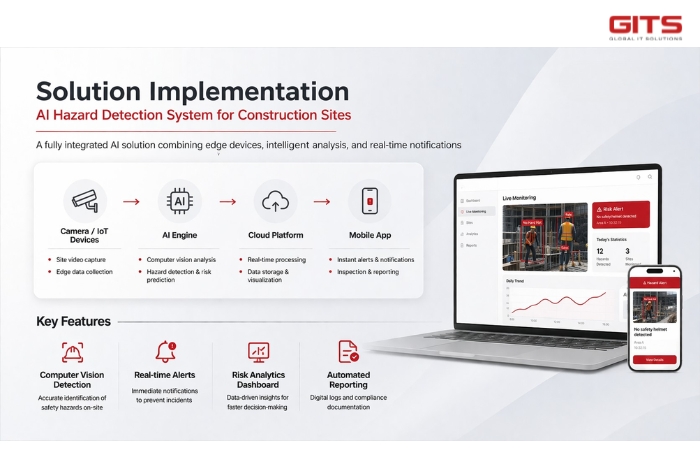
GITS designed and deployed an AI-driven hazard detection and warning system tailored to construction environments. The solution integrates computer vision, IoT inputs, and cloud-based analytics to deliver real-time safety monitoring and predictive insights.
System Architecture Overview
The solution was built using a modular and scalable architecture:
– Frontend: Mobile application (Flutter) for supervisors and safety managers
– Backend: AI-powered microservices for image processing and risk analysis
– AI Engine: Computer vision models trained to detect unsafe behaviors and hazardous conditions
– Cloud Platform: AWS infrastructure for scalability, data processing, and storage
– Data Layer: Real-time data streaming and caching for instant alerts
Key Features
AI-Based Visual Inspection
Using CCTV and camera feeds, the system automatically detects:
– Unsafe climbing on scaffolding
– Missing safety gear (helmets, harnesses)
– Fire or electrical hazards
– Restricted area violations
Real-Time Alerting System
When a hazard is detected:
– Instant notifications are sent to supervisors via mobile app
– Alerts are categorized by severity (Safe, Warning, Danger)
– Visual evidence is attached for quick verification
Risk Assessment and Prediction
The system continuously analyzes historical and real-time data to:
– Identify recurring risk patterns
– Predict high-risk zones or activities
– Recommend preventive actions
Centralized Monitoring Dashboard
A unified dashboard provides:
– Site-wide visibility across multiple locations
– Real-time incident tracking
– Safety performance analytics
Automated Reporting
Reports are generated automatically, supporting:
– Compliance requirements
– Audit preparation
– Management decision-making
Deployment Approach
The implementation followed a phased rollout strategy:
– Pilot Phase:
Deployment at one construction site to validate AI model accuracy and system performance
– Optimization Phase:
Fine-tuning detection models based on real-world conditions and feedback
– Scaling Phase:
Expansion across multiple sites with centralized monitoring
– Operational Integration:
Training teams and integrating workflows into daily operations
Measurable Results
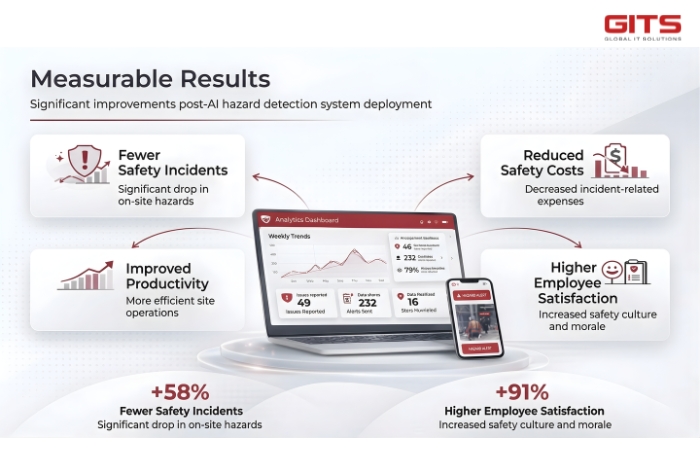
The deployment of the AI-powered hazard detection system delivered significant business and operational improvements:
– 30–40% reduction in safety incidents within the first 6 months
– 50% faster response time to on-site hazards
– 60% decrease in manual inspection workload
– Improved compliance reporting accuracy with automated documentation
– Enhanced worker awareness and safety behavior through continuous monitoring
Operational impact:
– Reduced downtime caused by safety incidents
– Increased trust from stakeholders and regulatory bodies
– Improved efficiency of safety management teams
>> See More: Delivery Management System for Scalable Last-Mile Ops
Project Scope and Timeline
Project Scope
– Team size: 6–8 engineers (AI, backend, frontend, DevOps)
– Systems involved: AI detection engine, mobile app, cloud infrastructure
– Stakeholders: Site managers, safety officers, IT teams
Timeline
– Phase 1 (4 weeks): Requirement analysis and system design
– Phase 2 (8 weeks): Development of AI models and platform
– Phase 3 (4 weeks): Pilot deployment and testing
– Phase 4 (6 weeks): Scaling and optimization across sites
Key Milestones
– Successful AI detection accuracy above 90%
– Real-time alert system operational
– Multi-site deployment completed
Driving Safer Construction Through AI-Powered Hazard Detection
This case study demonstrates how AI-driven hazard detection at construction sites can transform safety management from a reactive process into a proactive, data-driven operation. By leveraging computer vision, cloud platforms, and real-time analytics, GITS enabled the customer to significantly reduce risks, improve operational efficiency, and enhance compliance.
Beyond technology implementation, the project highlights the importance of aligning digital solutions with real-world operational needs—particularly in high-risk industries such as construction.
Explore how GITS delivers scalable enterprise solutions through strategic IT Outsourcing—helping your business achieve safer, smarter, and more efficient operations at scale.