





Artificial Intelligence has become one of the highest-priority investment areas for enterprises across Japan, Korea, Vietnam, and global markets. Companies are actively exploring AI-driven transformation to improve productivity, optimize operations, reduce costs, and build competitive advantages. From predictive analytics to intelligent automation and advanced AI Agents, organizations are racing to integrate AI into their business models.
Yet despite the growing momentum, one uncomfortable truth remains consistent across industries: most AI initiatives fail after the Proof of Concept stage.
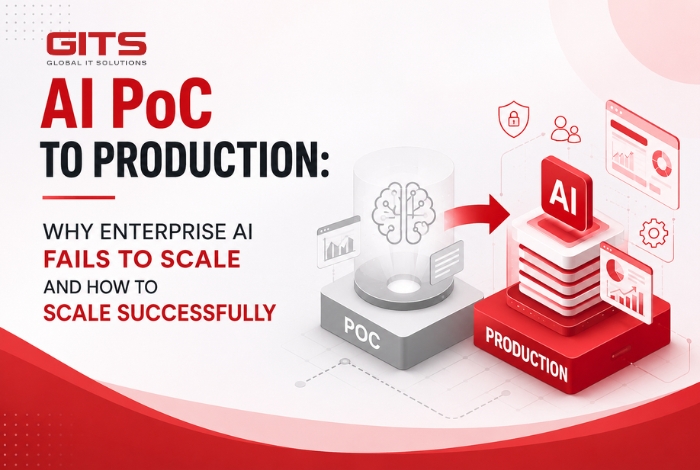
This is the critical gap between AI PoC to production.
A Proof of Concept may demonstrate technical feasibility, but it does not guarantee operational scalability. Many enterprises successfully build AI prototypes, validate use cases, and gain internal excitement, only to face unexpected failures when trying to deploy AI into real business environments.
This challenge has become one of the most significant barriers in enterprise AI adoption today.
The issue is not whether AI works. The issue is whether AI can scale.
Understanding why this gap exists is essential for any organization planning long-term AI transformation (AX).
What Does AI PoC to Production Actually Mean?
Before understanding why AI projects fail, it is important to define what AI PoC to production really means.
A Proof of Concept (PoC) is a small-scale experiment designed to validate whether an AI model can solve a specific problem. It is often isolated from the complexities of live systems, using limited datasets, simplified workflows, and controlled business conditions.
Production, however, is fundamentally different.
Production means deploying AI into live business operations where systems must process real-time data, integrate with enterprise infrastructure, maintain reliability, comply with regulations, and continuously adapt to changing environments.
The transition from PoC to production is not simply a deployment step. It is a complete operational transformation.
This is where many organizations underestimate the complexity of enterprise AI.
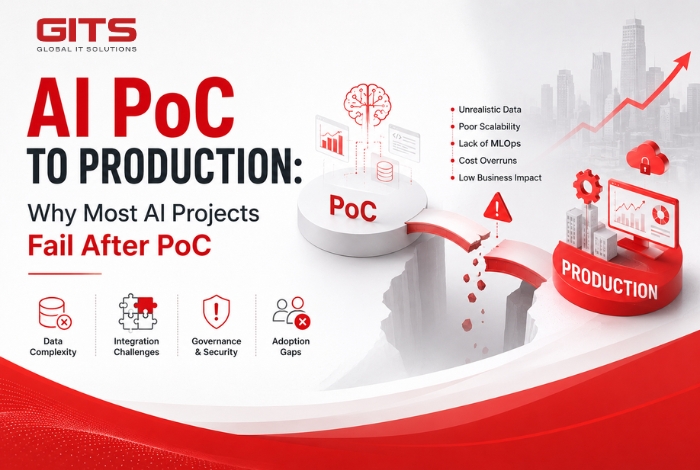
Why Most AI Projects Fail After PoC
The biggest misconception in AI implementation is assuming that a successful prototype automatically leads to business success. In reality, the gap between experimentation and operational deployment introduces multiple layers of complexity that many organizations are not prepared for.
PoC Environments Are Artificially Simplified
A PoC environment is designed for speed and validation. It uses cleaner datasets, narrower use cases, and limited user interactions. These conditions create a controlled environment where AI can perform well.
Once deployed into production, those controlled variables disappear.
Real business environments introduce inconsistent data quality, unpredictable human behavior, system failures, changing business rules, and integration dependencies. An AI model that performs at 92% accuracy in a PoC may drop significantly when exposed to production variability.
This is one of the most common reasons AI PoC to production initiatives fail.
The challenge is not model quality. It is environmental complexity.
Lack of MLOps and LLMOps Infrastructure
One of the biggest technical reasons AI projects fail to scale is the absence of operational infrastructure.
Building an AI model is only one layer of enterprise deployment.
To move into production, organizations need:
– Model versioning
– Continuous deployment pipelines
– Monitoring and observability
– Prompt version control
– Vector database management
– Evaluation frameworks
– Security and access governance
For traditional machine learning, this layer is known as MLOps. For Generative AI systems and AI Agents, this evolves into LLMOps.
Without these systems, AI becomes unstable, difficult to maintain, and nearly impossible to improve over time.
This is where many companies realize that their AI solution was never designed for scale.
Business Ownership Is Often Missing
A surprising number of AI initiatives are still owned only by technical or innovation teams. This creates a major disconnect between the AI model and the actual business process it is supposed to improve.
When operational teams are not involved early, adoption becomes weak. Users do not trust the output. Managers do not change workflows. Leadership does not see measurable ROI.
This is especially common in large enterprises across Japan and Korea, where decision-making structures are more layered and transformation cycles tend to be slower.
AI needs business ownership, not just technical ownership.
ROI Pressure Kills AI Momentum
For C-level executives, AI is no longer judged by innovation alone.
The question has shifted from:
Can AI work?
to:
Can AI reduce cost, improve speed, or increase revenue?
This shift is critical.
If AI cannot demonstrate measurable business value within a realistic timeframe, executive sponsorship weakens. Budgets shrink. Projects stall.
This is one of the most overlooked barriers in enterprise AI deployment.
Without clear ROI visibility, scaling becomes politically difficult.
The Hidden Technical Risks of Scaling AI
Moving from PoC to production introduces risks that many enterprises fail to plan for.
Traditional machine learning systems face challenges like data drift, model degradation, and retraining complexity.
Generative AI systems introduce new risks such as hallucination, prompt inconsistency, token cost management, and knowledge freshness.
AI Agents add another layer of complexity.
Because AI Agents operate autonomously across multiple systems, they face orchestration failures, tool dependency errors, permission risks, and decision-chain instability.
This is why scaling Agentic AI requires stronger governance than traditional automation.
Without proper control layers, enterprise AI becomes a liability rather than an advantage.

AI PoC to Production Requires an Operational Mindset
The biggest mindset shift in AI scaling is moving beyond model-centric thinking.
Successful organizations do not ask whether the model works.
They ask whether the operational system around the model is ready.
This means shifting focus toward:
– Process redesign
– System integration
– Governance
– Change management
– Business KPI alignment
This is the foundation of real AI transformation (AX).
AI should not be treated as a separate innovation initiative.
It should become part of how the business operates.
>>> See More: AI Transformation Roadmap 2026 for Enterprise
Why AI Agents Are Becoming the Fastest Path to Scale
The evolution of enterprise AI is increasingly moving toward AI Agents. Unlike traditional AI systems that mainly analyze or predict, AI Agents can take action. They can interpret information, make decisions, trigger workflows, and coordinate across multiple systems. This makes them significantly more scalable in production environments.
In logistics, AI Agents can optimize delivery routing based on real-time traffic, weather, and warehouse availability. In manufacturing, they can monitor machine health, predict downtime, and automatically schedule maintenance. In retail, they can synchronize inventory, pricing, and order fulfillment across multiple channels. In healthcare, they can automate patient triage, appointment scheduling, and administrative workflows.
This operational capability is why AI Agents are reducing the gap between AI PoC to production faster than previous AI architectures. They are built for execution, not just intelligence.
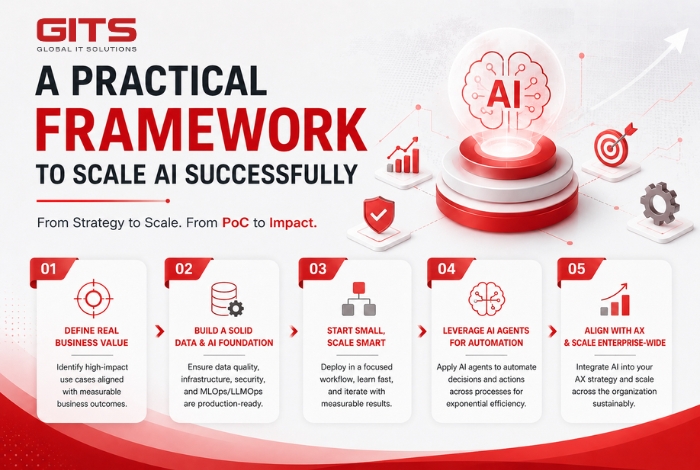
A Practical Framework to Scale AI Successfully
For enterprises planning to scale AI, a structured deployment roadmap is essential.
Phase 1: Validate Real Business Value
Do not build PoCs based on technical curiosity alone.
Focus on measurable operational pain points.
The best AI opportunities are usually tied to repetitive decisions, cost inefficiencies, process bottlenecks, or human dependency.
Validation should focus on business KPIs, not model accuracy alone.
Phase 2: Build Production-Ready Infrastructure
Before scaling, enterprises need to strengthen the foundation.
This includes data pipelines, API architecture, security controls, governance frameworks, and MLOps or LLMOps systems.
Without infrastructure, AI cannot scale sustainably.
Infrastructure is not optional.
It is the backbone of AI production.
Phase 3: Start with Narrow Operational Workflows
Instead of scaling broadly too early, successful organizations deploy AI into one specific workflow first.
This allows teams to measure impact, improve reliability, and build internal trust before expanding.
This incremental model reduces risk and increases adoption speed.
Phase 4: Deploy AI Agents Strategically
AI Agents should be introduced where autonomous decision-making creates the highest operational value.
This includes areas like customer support, supply chain orchestration, production planning, and predictive operations.
Strategic deployment creates faster ROI.
Phase 5: Align AI with Enterprise AX Strategy
AI must connect directly with long-term business transformation goals.
This is where AI becomes more than technology.
It becomes strategy.
Organizations that integrate AI into their broader AX roadmap create stronger resilience, faster innovation cycles, and long-term market leadership.
The Future of Enterprise AI Is Not Experimentation
The next era of AI belongs to organizations that can operationalize intelligence at scale. The competitive advantage will not come from having access to AI models; it will come from deploying them effectively. The companies that win will be the ones that understand the transition from AI PoC to production, build strong AI infrastructure, adopt AI Agents strategically, and align technology with business transformation.
In the coming years, the gap between companies that scale AI and those that remain stuck in experimentation will grow dramatically, and that gap will define industry leaders.
Scaling AI Is the Real Measure of Success
AI success is no longer defined by how innovative your prototype looks. It is defined by how effectively your organization can deploy, govern, and scale AI in real operations. The journey from AI PoC to production is where the real business value is unlocked. For enterprises across Japan, Korea, Vietnam, and global markets, this is no longer an optional capability. It is a strategic necessity.
The future belongs to organizations that can move beyond experimentation, build production-ready AI systems, and turn AI Agents into operational intelligence. Because in the end, AI does not create competitive advantage by existing. It creates competitive advantage by scaling.