





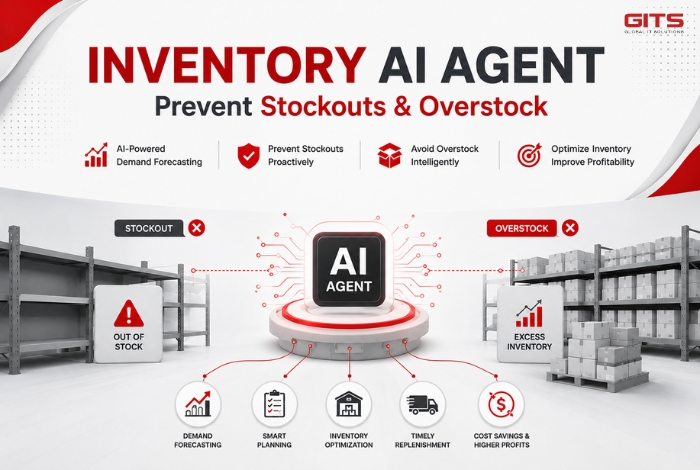
Inventory planning is no longer simply about knowing how much stock is available. For modern manufacturers, retailers, distributors, and logistics enterprises, the real challenge is knowing what to stock, when to replenish, and how much to order before demand changes.
A stockout can mean lost sales, production delays, and damaged customer trust. Overstock, meanwhile, ties up working capital, increases storage costs, and creates obsolete inventory.
This is where an Inventory AI Agent can transform inventory planning from a reactive process into a proactive, continuously optimized operation.
Why Traditional Inventory Planning Is No Longer Enough
Traditional inventory planning often depends on historical sales, fixed reorder points, spreadsheets, and manually adjusted safety stock levels. These methods can work when demand is relatively stable, but become less effective when businesses face seasonal fluctuations, promotions, supplier delays, changing customer behavior, or volatile markets.
For enterprises operating across Japan, Korea, Vietnam, and global markets, the challenge becomes even greater when multiple warehouses, stores, suppliers, channels, and SKUs must be coordinated simultaneously.
The result is a familiar dilemma:
Order too little → stockout.
Order too much → overstock.
The problem is not simply a lack of data. It is the inability to turn continuously changing data into timely decisions.

How Inventory AI Agent Changes Inventory Planning
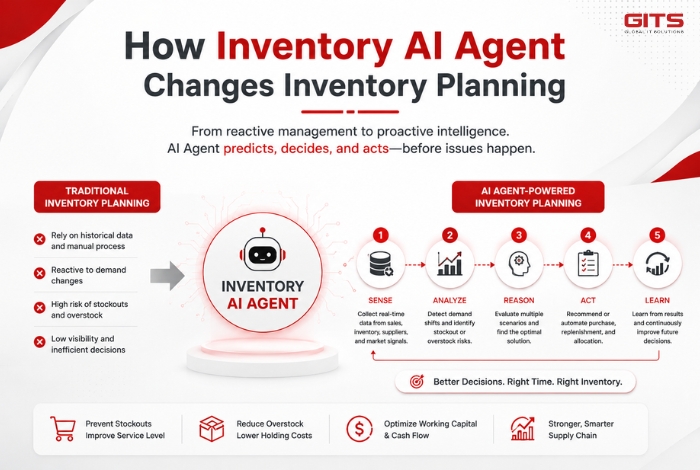
An Inventory AI Agent goes beyond conventional automation. Instead of following fixed rules, it can continuously analyze inventory positions, demand signals, lead times, sales patterns, and supply conditions to identify risks and recommend or trigger actions.
A typical Agentic AI workflow can:
- Sense: Monitor sales, inventory, purchase orders, lead times, promotions, and external demand signals.
- Analyze: Detect demand changes and identify SKUs with increasing stockout or overstock risk.
- Reason: Evaluate different replenishment scenarios against service levels, inventory costs, and operational constraints.
- Act: Recommend purchase quantities, adjust replenishment priorities, or trigger approved workflows.
- Learn: Use new operational data and outcomes to continuously improve future decisions.
This creates a shift from “check inventory and react” to “predict risk and act before it happens.”
Key Capabilities of an Inventory AI Agent
AI Demand Forecasting for More Accurate Stock Planning
The foundation of intelligent inventory planning is demand forecasting.
AI models can analyze historical demand together with seasonality, product trends, promotions, and other relevant signals. Instead of relying on a single static forecast, an AI Agent can continuously reassess demand as new information becomes available.
This enables supply chain teams to identify potential demand spikes or slow-moving products earlier and adjust inventory plans accordingly.
Dynamic Safety Stock and Replenishment
Static safety stock policies can create unnecessary inventory when demand is low or insufficient protection when demand suddenly increases.
An Inventory AI Agent can dynamically evaluate demand uncertainty, lead-time variability, service-level requirements, and current inventory positions to support more responsive safety stock decisions.
The goal is not simply to increase inventory availability, but to maintain the right inventory level at the right location at the right time.
Early Stockout and Overstock Detection
Instead of waiting for inventory KPIs to deteriorate, AI Agents can continuously monitor risk indicators.
For example, the system can identify:
– SKUs approaching stockout based on forecasted demand
– Excess inventory with declining demand
– Purchase orders at risk because of supplier delays
– Inventory imbalance between warehouses or sales channels
– Products requiring accelerated replenishment or redistribution
This gives planners a prioritized list of actions instead of forcing them to manually investigate hundreds or thousands of SKUs.
>>> See More: AI Warehouse Agent: Autonomous Replenishment & Purchasing
From Inventory Optimization to Autonomous Supply Chain
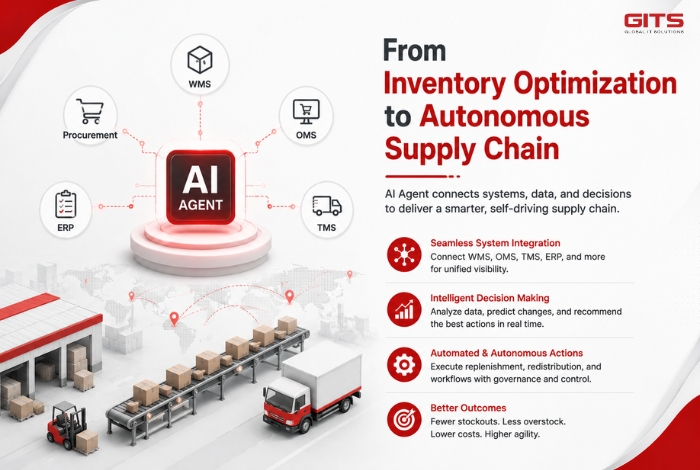
The real value of Agentic AI emerges when inventory planning connects with other enterprise systems.
An Inventory AI Agent can work alongside WMS, OMS, TMS, ERP, procurement systems, and warehouse data to create a connected decision-making layer.
For example, when demand for a product increases, the Agent can identify the inventory gap, check warehouse availability, evaluate supplier lead times, calculate replenishment requirements, and recommend the optimal response.
With appropriate governance and approval thresholds, some decisions can eventually move from recommendation to controlled autonomous execution.
This is an important step toward AI Transformation and AX, where AI does not merely automate individual tasks but helps enterprises redesign how operational decisions are made.
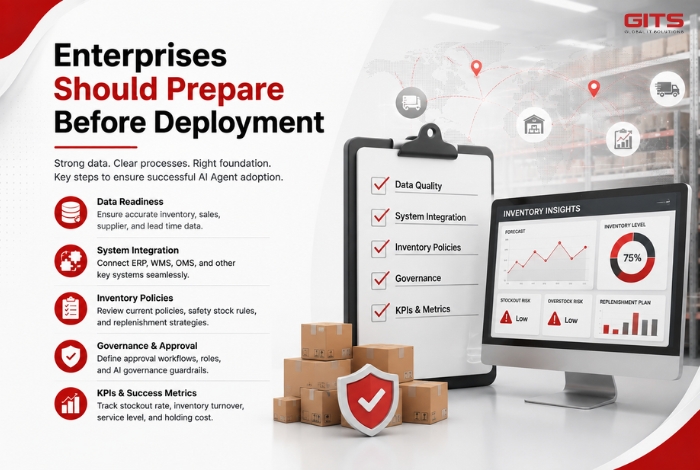
What Enterprises Should Prepare Before Deployment
AI inventory optimization does not begin with the AI model. It begins with data and operational readiness.
Enterprises should evaluate:
– Inventory and SKU data quality
– Sales and demand history
– Supplier and lead-time data
– ERP/WMS/OMS integration
– Existing inventory policies
– Human approval and governance rules
– KPIs such as stockout rate, inventory turnover, service level, and carrying cost
A practical approach is to start with a focused use case, such as stockout prediction or replenishment optimization for high-value SKUs, validate business impact, and then expand toward a broader multi-agent supply chain architecture.
GITS – AI & Digital Transformation Partner for Supply Chain Intelligence
GITS is a technology partner specializing in AI transformation (AX), enterprise system integration, and intelligent automation for supply chain and operations. In the context of Inventory AI Agent adoption, GITS plays a key role in helping enterprises move from concept to real-world execution.
With experience in ERP, WMS, OMS integration and data-driven system modernization, GITS supports organizations in building the foundational data architecture required for AI-powered inventory optimization. This includes connecting fragmented inventory data across systems, improving data quality, and enabling real-time visibility across multi-warehouse and multi-channel operations.
Beyond infrastructure, GITS also helps enterprises design and implement AI Agent-based workflows, where inventory decisions such as demand forecasting, replenishment planning, and stockout prevention can be progressively automated under controlled governance.
By combining domain understanding in supply chain operations with AI engineering capabilities, GITS enables companies in Japan, Vietnam, Korea, and global markets to transition toward a more predictive and autonomous inventory management model—where decisions are not only faster, but also smarter and continuously improving.

Turn Inventory Planning Into a Predictive Advantage
The future of inventory management is not about holding more stock or cutting inventory at all costs. It is about making better decisions earlier.
An Inventory AI Agent enables enterprises to move beyond static forecasts and manual inventory reviews toward continuous sensing, intelligent reasoning, and proactive action.
For manufacturers, retailers, logistics providers, and distributors, this creates a new opportunity: prevent stockouts, reduce overstock, optimize working capital, and build a more resilient supply chain with AI.
The next competitive advantage may not come from having more inventory data.
It may come from having an AI Agent that knows what to do with it.