






Inventory shortages rarely happen because companies lack data. The real problem is what happens after an inventory alert appears.
A warehouse may detect that stock has fallen below its reorder point, yet teams still need to check demand, forecast future consumption, review supplier lead times, compare purchase constraints, create purchase orders, and follow up with vendors.
For enterprises operating multiple warehouses, stores, suppliers, or sales channels, these decisions quickly become too complex to manage manually.
This is where AI Warehouse Agents are changing the model: moving inventory replenishment from reactive alerts toward intelligent, increasingly autonomous purchasing decisions.
Why Traditional Inventory Replenishment Is No Longer Enough
Traditional replenishment often relies on fixed reorder points, historical averages, spreadsheets, and periodic manual reviews. These approaches can work when demand and supply conditions are stable.
Modern supply chains are different.
Demand changes rapidly. Supplier lead times fluctuate. Promotions create unexpected spikes. Omnichannel orders shift inventory between locations. Meanwhile, businesses must balance two expensive risks: stockouts that impact revenue and customer satisfaction, and excess inventory that locks up working capital. Current AI replenishment platforms increasingly address these variables together rather than treating replenishment as a static rule.
For warehouse and procurement teams, the challenge is no longer simply knowing what is running low.
The real question is:
What should we purchase, when should we purchase it, from whom, and in what quantity?
From Inventory Alerts to Autonomous Decisions
An AI Warehouse Agent goes beyond monitoring inventory levels.
Instead of simply notifying a planner that SKU A has reached its reorder point, an agent can connect inventory data with demand forecasts, sales patterns, supplier information, lead times, open purchase orders, safety stock, and operational constraints.
The decision flow can evolve from:
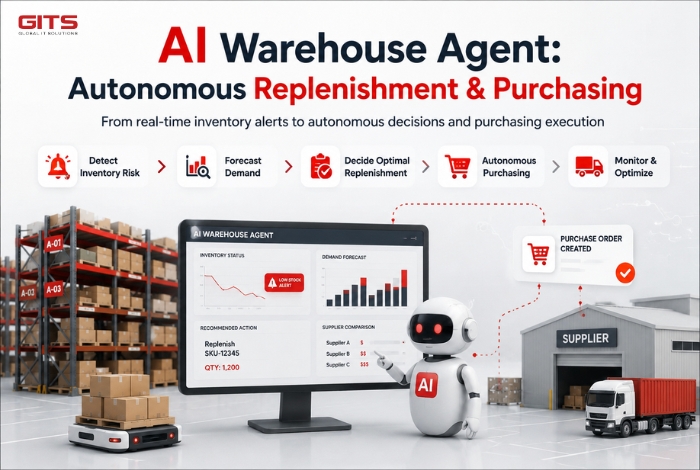
Inventory Alert → Human Review → Forecast → Supplier Check → Purchase Order
to: Detect → Reason → Recommend → Execute → Monitor → Adapt
This distinction is fundamental.
AI Agents are designed to interpret changing conditions, reason across multiple data sources, and trigger actions through connected enterprise systems. Research into agentic AI for inventory replenishment similarly explores continuous inventory monitoring, supplier selection, purchase initiation, demand forecasting, and multi-agent coordination.
How an AI Warehouse Agent Automates Replenishment
1. Detect Inventory Risk Before Stockouts
The agent continuously monitors inventory positions across warehouses, stores, and channels.
It can identify:
– Low-stock and projected stockout risks
– Abnormal demand increases
– Slow-moving and excess inventory
– Supplier lead-time changes
– Inventory imbalance across locations
– Upcoming promotional or seasonal demand
This transforms inventory management from reactive monitoring into proactive intervention.
2. Forecast What the Warehouse Will Need
An AI Warehouse Agent does not make replenishment decisions based only on current stock.
It evaluates demand signals such as historical sales, seasonality, promotions, product trends, lead times, and current commitments to estimate future inventory requirements.
Modern AI replenishment systems increasingly combine forecasting with safety stock, minimum order quantities, lead times, budgets, and open commitments when calculating supply plans.
3. Determine the Optimal Replenishment Strategy
Once a shortage risk is identified, the agent evaluates the best response.
It may determine:
– How much inventory should be replenished
– When the purchase should be initiated
– Which warehouse should receive the stock
– Whether inventory should be transferred instead of purchased
– Which supplier best meets cost, lead-time, and availability requirements
This is where Agentic AI creates a major advantage over traditional rule-based automation: the system can evaluate context rather than simply execute a predefined threshold.
4. Move Toward Autonomous Purchasing
The next step is connecting the agent to procurement workflows.
Based on predefined business policies and approval thresholds, an AI agent can prepare or initiate purchase requests, evaluate supplier options, check PO status, and coordinate follow-up activities.
However, autonomy should not mean removing humans from the process.
A practical enterprise model is human-in-the-loop AI, where routine, low-risk purchasing can be automated while high-value or exceptional decisions are routed to managers for approval. Recent research on AI agents for inventory control also suggests that AI, operations research, and human decision-makers can complement one another rather than operate as isolated alternatives.
AI Warehouse Agent vs Traditional Automation
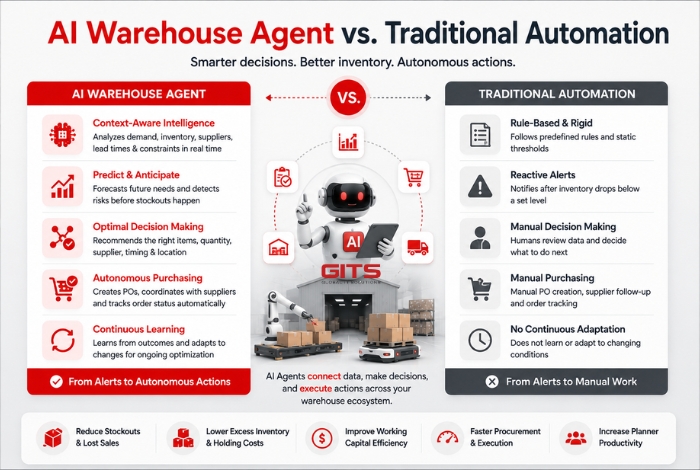
The difference is not simply “AI versus software.”
Traditional automation generally follows predefined rules:
IF inventory < threshold → create alert.
An AI Agent can reason through a broader operational context:
Inventory is declining + demand is accelerating + supplier lead time increased + another warehouse has excess stock → transfer inventory first, then adjust the next purchase quantity.
This makes AI Agents particularly valuable in complex warehouse environments where conditions change continuously.
The result is a shift from task automation to decision automation.
Business Benefits Across Modern Supply Chains
For manufacturers, distributors, retailers, and e-commerce businesses, AI-powered replenishment can create measurable operational value:
– Lower stockout risk: Identify potential shortages earlier and respond before service levels are affected.
– Reduced excess inventory: Align replenishment quantities with actual and forecasted demand rather than static assumptions.
– Lower working capital pressure: Avoid unnecessarily holding inventory that could remain idle.
– Faster procurement: Reduce repetitive analysis and manual purchase preparation.
– Higher planner productivity: Allow supply chain teams to focus on exceptions, supplier strategy, and business decisions.
– Better scalability: Support growing SKU counts, warehouses, suppliers, and sales channels without increasing manual workload at the same rate.
These capabilities align with the broader shift toward AI-driven supply chain operations, where forecasting, inventory optimization, procurement, and workflow orchestration are becoming interconnected decision systems.
Building the Next Generation of Autonomous Warehouse Operations
For enterprises in Japan, Korea, Vietnam, and global markets, the opportunity is not simply to add another AI tool to the warehouse.
The bigger opportunity is to build an intelligent layer connecting WMS, ERP, OMS, TMS, procurement platforms, supplier data, and real-time operational signals.
A mature AI Warehouse Agent ecosystem can work as part of a broader AI Solution and AX strategy, enabling enterprises to move progressively from:
Visibility → Prediction → Recommendation → Assisted Execution → Autonomous Operations
This approach is especially important for enterprises that need to modernize existing infrastructure without replacing core systems.
>>> See More: AI Agents in Logistics: From Automation to Autonomous Systems
How GITS Enables AI-Powered Warehouse Replenishment
GITS approaches AI transformation from an enterprise integration perspective.
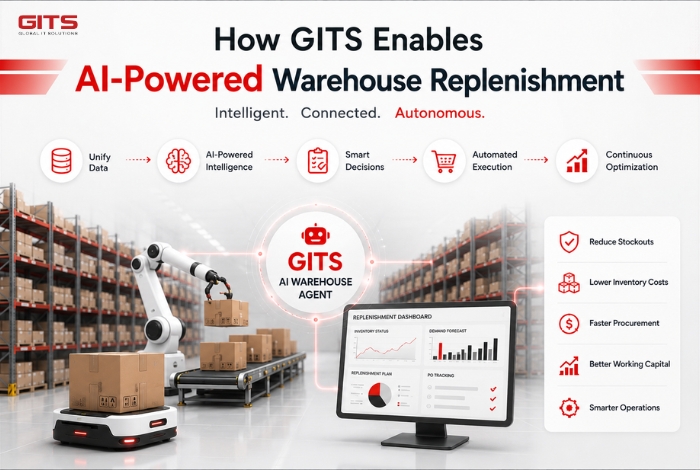
Rather than treating AI Agents as isolated chatbots, GITS can design intelligent workflows that connect AI Agents with WMS, OMS, TMS, ERP, data platforms, and existing enterprise applications.
For warehouse replenishment, this architecture can support a connected workflow in which AI analyzes inventory and demand signals, identifies replenishment risks, evaluates purchasing scenarios, recommends actions, and triggers the appropriate workflow under defined business rules.
This creates a practical path toward Agentic AI-powered warehouse operations while maintaining enterprise governance, security, and human oversight.
The Future of Inventory Management Is Autonomous
The next generation of warehouse management will not be defined by how quickly companies can react to inventory alerts.
It will be defined by how intelligently their systems can anticipate demand, understand supply constraints, make replenishment decisions, and execute the next action.
An AI Warehouse Agent represents this transition from passive visibility to proactive intelligence and ultimately autonomous purchasing.
For enterprises looking to improve inventory efficiency, reduce operational friction, and build a scalable AX strategy, the journey begins by transforming one simple question:
“Are we running out of stock?” into a much more valuable one:
“What should we do next—and can AI do it for us?”