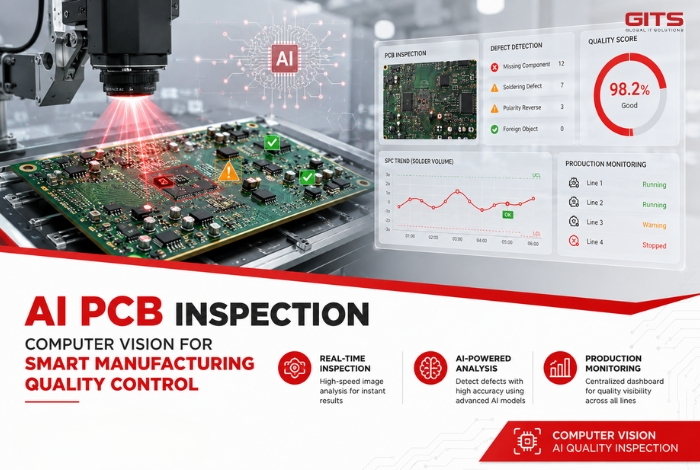






Manufacturing quality inspection is entering a new phase.
For years, factories have used manual inspection, rule-based machine vision, and automated optical inspection (AOI) to identify product defects. These technologies have improved production quality, but they still face a fundamental limitation: They can detect problems, but they do not always understand what to do next.
As manufacturers in Japan, Korea, Vietnam, and global markets face labor shortages, higher quality standards, and increasingly complex production processes, simply detecting defects is no longer enough.
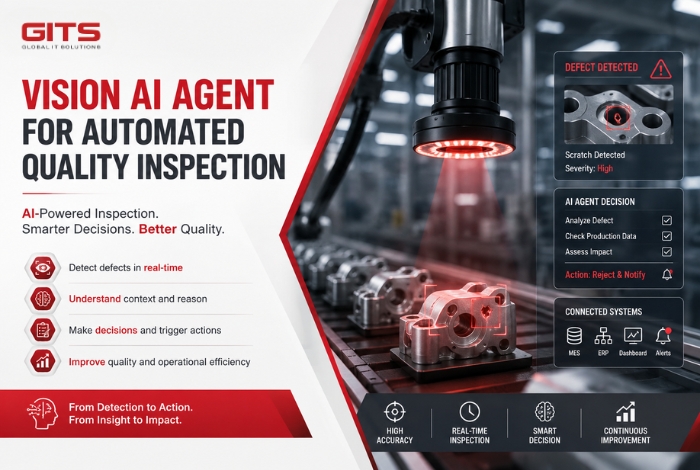
The next step is Vision AI Agent: an intelligent system that combines computer vision with Agentic AI to see, understand, reason, and initiate actions across the quality inspection workflow.
Why Traditional Quality Inspection Is No Longer Enough
Quality inspection is one of the most critical processes in manufacturing. A small defect that escapes inspection can result in rework, material waste, production delays, warranty costs, or even customer complaints.
Manual inspection remains common, particularly for products requiring visual judgment. However, human inspectors can experience fatigue, inconsistent judgment, and difficulty maintaining accuracy during high-volume production.
Traditional machine vision solves part of this problem by automating image analysis. Yet conventional systems often depend on predefined rules, fixed parameters, and narrowly defined inspection scenarios.
This creates challenges when manufacturers need to handle:
– New product variants and changing production conditions
– Subtle or previously unseen defects
– High-speed production lines
– Multiple inspection criteria
– Large volumes of inspection data
– Quality decisions that require production context
The challenge is therefore shifting from “Can AI detect the defect?” to “Can AI understand the defect and determine the appropriate next action?”
That is where Vision AI Agents become valuable.
What Is a Vision AI Agent?
A Vision AI Agent is an AI-powered quality inspection system that combines Computer Vision, multimodal AI, Agentic AI, and manufacturing data to move beyond simple image classification.
A conventional vision system typically follows a fixed workflow:
Capture → Analyze → Classify → Pass/Fail
A Vision AI Agent can extend this workflow:
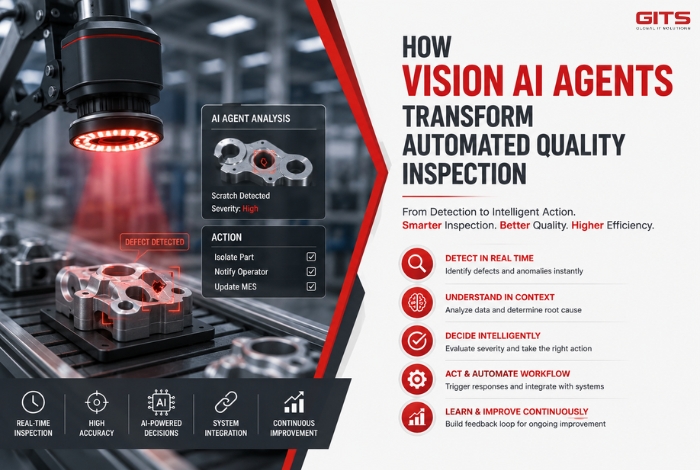
See → Understand → Reason → Decide → Act → Learn
For example, when a camera detects an abnormal surface on a component, the Vision AI Agent can analyze the image, compare the anomaly with quality standards, examine relevant production information, determine its severity, and trigger the appropriate workflow.
Depending on the use case, the agent can:
– Detect scratches, cracks, dents, contamination, and surface anomalies
– Verify component presence, orientation, and assembly accuracy
– Perform OCR for labels, serial numbers, and product codes
– Classify defects based on severity and quality criteria
– Compare current defects with historical inspection data
– Generate inspection records and quality reports
– Alert operators when human intervention is required
– Connect inspection results with MES, ERP, WMS, or other enterprise systems
This transforms visual inspection from an isolated detection task into an intelligent quality decision workflow.
Vision AI Agent vs. Traditional Machine Vision
The distinction is important for manufacturers evaluating an AI Solution.
Traditional machine vision is highly effective when inspection conditions are stable and requirements can be clearly defined in advance. However, complex manufacturing environments often require contextual understanding and flexible decision-making.
| Capability | Traditional Machine Vision | Vision AI Agent |
|---|---|---|
| Image inspection | ✓ | ✓ |
| Defect detection | ✓ | ✓ |
| Rule-based decisions | ✓ | ✓ |
| Contextual reasoning | Limited | ✓ |
| Multi-source data analysis | Limited | ✓ |
| Dynamic workflow execution | Limited | ✓ |
| Natural-language interaction | Limited | ✓ |
| Continuous improvement | Limited | ✓ |
| Enterprise system orchestration | Limited | ✓ |
The key difference is agency.
A traditional vision system primarily provides an inspection result. A Vision AI Agent can interpret that result within a broader operational context and determine what should happen next.
How Vision AI Agents Transform Automated Quality Inspection
1. Detect Defects in Real Time
Vision AI Agents continuously analyze images or video captured from production lines to identify abnormal conditions.
Instead of waiting until final inspection, manufacturers can identify defects closer to the point where they occur.
This enables faster intervention and helps prevent the same quality issue from propagating across an entire production batch.
2. Understand Defects in Context
A defect is not always meaningful by itself.
A small variation may be acceptable for one product but unacceptable for another. The severity of an anomaly may also depend on the production stage, product specification, batch, or customer requirement.
Vision AI Agents can combine visual information with manufacturing context to support more intelligent quality decisions.
For example:
Vision data + Product specification + Production data + Historical quality records → Context-aware quality decision
This is where Agentic AI creates a significant advantage over conventional visual inspection.
3. Move From Detection to Action
Identifying a defect is only the first step.
A Vision AI Agent can orchestrate the next actions based on inspection results.
For example:
Defect detected → Severity analyzed → Product isolated → Operator alerted → Quality record created → Production data updated
This reduces manual intervention and enables a more responsive quality-control workflow.
4. Build a Continuous Quality Feedback Loop
The most valuable AI systems do not simply inspect products. They continuously generate operational intelligence.
Inspection data can be connected with machine parameters, production batches, environmental conditions, and historical defect patterns.
The resulting feedback loop becomes:
Inspect → Detect → Analyze → Decide → Act → Learn
Over time, this can help manufacturers identify recurring quality patterns and improve production processes rather than simply reacting to defects after they occur.
Business Benefits of AI-Powered Quality Inspection
For manufacturing enterprises, the value of Vision AI Agents extends beyond inspection accuracy.
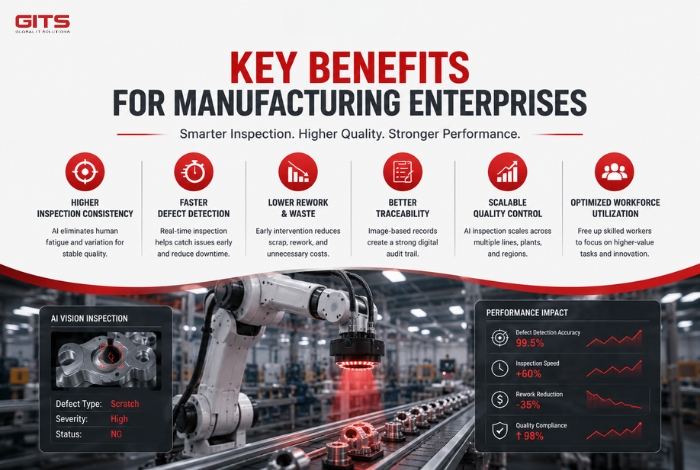
Higher inspection consistency
Automated visual inspection reduces variability caused by fatigue and repetitive manual work.
Faster quality decisions
Real-time defect detection enables production teams to respond earlier to abnormal conditions.
Lower rework and material waste
Early detection can prevent defective products from moving further through the production process.
Improved traceability
Digital inspection records provide a structured history of quality decisions and detected anomalies.
Scalable quality operations
AI inspection can support multiple production lines and facilities without increasing manual inspection workloads at the same rate.
Better use of skilled workers
Instead of spending time on repetitive visual checks, quality engineers can focus on complex analysis, root-cause investigation, and process optimization.
Why Vision AI Agents Matter for Japan, Korea, and Vietnam
The business case differs slightly across manufacturing markets, but the underlying pressure is similar: higher quality expectations with fewer available skilled workers.
For Japanese manufacturers, Vision AI Agents can support quality standardization, operational stability, and knowledge preservation while reducing dependence on repetitive manual inspection.
For Korean manufacturers, particularly high-volume and technology-intensive production environments, AI-powered inspection can help accelerate quality decisions and support highly automated production workflows.
For Vietnamese manufacturers, Vision AI provides an opportunity to accelerate Smart Factory and AI Transformation initiatives while improving quality consistency and workforce scalability.
For global manufacturers, the larger opportunity is to integrate Computer Vision with Agentic AI, industrial IoT, robotics, edge computing, and enterprise systems to create increasingly autonomous manufacturing operations.
From Automated Inspection to Autonomous Quality Operations
The future of manufacturing quality inspection is not simply about building a more accurate camera system.
It is about creating an intelligent quality operation that can perceive, understand, reason, decide, and act.
This represents an important transition:
Traditional Inspection → AI Visual Inspection → Agentic Quality Inspection → Autonomous Quality Operations
With Vision AI Agents, manufacturers can move from detecting defects after they happen toward continuously understanding production conditions and responding to quality risks.
This makes Vision AI Agent technology an important component of Smart Manufacturing, AI Transformation, and AX strategies.
>>> See More: Predictive Maintenance Agent: From Alerts to Autonomous Repairs
How GITS Approaches Vision AI Agent Solutions
At GITS, we approach Vision AI Agents as part of a broader AI Solution and Technical Solution architecture, rather than as a standalone computer vision product.
A manufacturing AI ecosystem can connect: Cameras & Sensors → Vision AI → AI Agents → Manufacturing Data → Enterprise Systems → Human Operators
This architecture allows visual inspection to work together with existing MES, ERP, WMS, production systems, and operational workflows.
The goal is not simply to build a system that can see defects.
The goal is to build an AI-powered manufacturing operation that can see, understand, decide, and act.
Vision AI Agents Are Redefining Quality Inspection
Manufacturing quality inspection is evolving from manual checking and rule-based machine vision toward intelligent, context-aware automation.
Vision AI Agents combine Computer Vision with Agentic AI, manufacturing data, and workflow orchestration to create a new generation of automated quality inspection.
For manufacturers facing labor shortages, rising quality standards, complex production environments, and increasing pressure for operational efficiency, this technology offers a path toward more consistent, scalable, and intelligent quality operations.
The next generation of factories will not simply use AI to inspect products.
They will use AI to understand quality, make decisions, and continuously improve production.