







Unexpected equipment failures remain one of the biggest operational risks for manufacturers, logistics providers, and industrial enterprises worldwide. A single machine breakdown can interrupt production, delay deliveries, increase maintenance costs, and damage customer trust.
Traditional predictive maintenance systems have improved fault detection, but they still rely heavily on human intervention to analyze alerts, prioritize incidents, and coordinate repairs. As industrial operations become more complex, alerts alone are no longer enough.
The emergence of the Predictive Maintenance Agent marks the next stage of industrial AI. Powered by AI Agents, Agentic AI, and autonomous decision-making, these intelligent systems not only predict failures but also recommend, coordinate, and increasingly execute corrective actions with minimal human involvement.
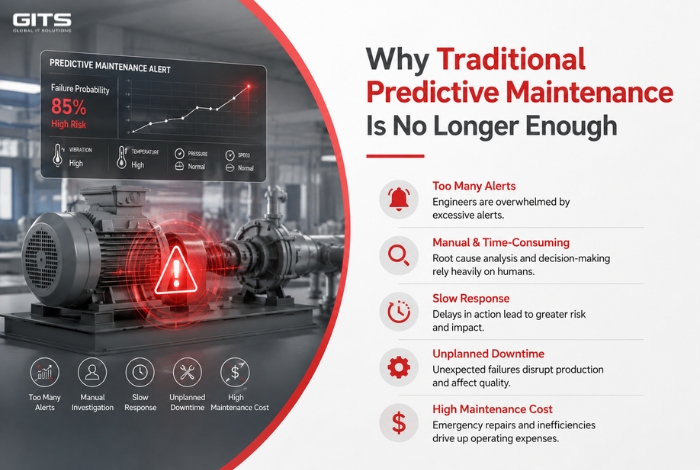
Why Traditional Predictive Maintenance Is No Longer Enough
Most predictive maintenance platforms collect data from IoT sensors, SCADA systems, ERP, or MES platforms to forecast equipment failures. While this reduces unexpected downtime, many organizations still face several operational challenges.
Maintenance teams often receive thousands of alerts every day without clear prioritization. Engineers must manually investigate root causes, schedule inspections, assign technicians, and verify spare parts availability before repairs can begin.
This creates several business problems:
– Alert fatigue reduces response efficiency.
– Critical failures may be overlooked.
– Maintenance resources are not optimally allocated.
– Repair decisions vary depending on individual experience.
– Downtime remains longer than expected.
The real challenge today is not detecting failures but responding intelligently and automatically.
What Is a Predictive Maintenance Agent?
A Predictive Maintenance Agent is an autonomous AI system capable of continuously monitoring industrial assets, analyzing operational conditions, making maintenance decisions, and initiating corrective actions without waiting for manual instructions.
Unlike conventional AI models that generate predictions, Agentic AI systems operate as intelligent digital workers capable of planning, reasoning, and collaborating across enterprise systems.
Typical capabilities include:
– Monitoring real-time equipment health
– Predicting component degradation
– Identifying root causes
– Prioritizing maintenance tasks
– Creating work orders automatically
– Coordinating spare parts inventory
– Scheduling technicians
– Learning continuously from maintenance outcomes
Instead of sending another notification, the agent actively manages the maintenance workflow from beginning to end.
How Predictive Maintenance Agents Work
Continuous Industrial Data Intelligence
The agent collects information from multiple sources, including IoT sensors, vibration analysis, temperature monitoring, production equipment, ERP systems, and maintenance histories.
By combining operational data with historical maintenance records, the AI develops a complete understanding of asset behavior.
AI-Based Failure Prediction
Using machine learning models and advanced analytics, the Predictive Maintenance Agent identifies abnormal patterns that indicate early-stage equipment degradation.
Rather than reacting to threshold violations, it predicts the probability, timing, and business impact of potential failures.
Autonomous Decision Making
This is where Agentic AI creates significant value.
The agent evaluates multiple maintenance strategies based on:
– Production schedules
– Equipment criticality
– Spare parts availability
– Technician expertise
– Operational risks
– Cost optimization
It then selects the most effective maintenance action automatically.
Coordinated Repair Execution
Instead of waiting for maintenance managers to assign tasks manually, the agent can:
– Generate maintenance tickets
– Reserve replacement parts
– Notify responsible teams
– Update ERP and CMMS systems
– Recommend optimized repair schedules
– Track repair completion
Future AI Services may allow robotic systems or automated machinery to execute certain repair procedures with minimal human supervision.
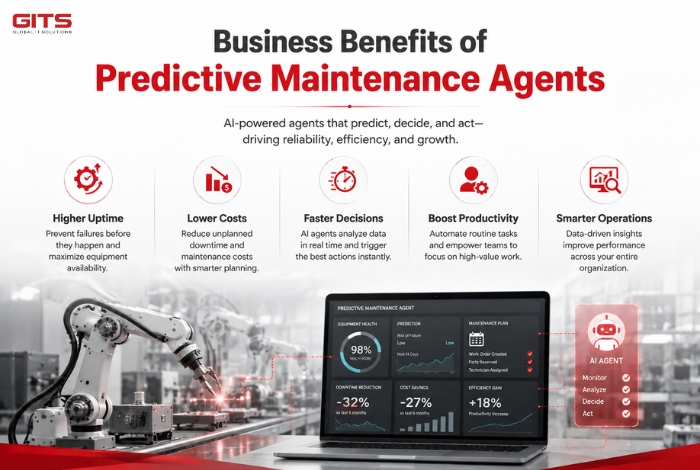
Business Benefits of Predictive Maintenance Agents
Organizations adopting autonomous maintenance gain advantages beyond reduced downtime.
Higher Equipment Availability
Early intervention prevents catastrophic failures and extends equipment lifespan, resulting in higher production capacity and greater operational stability.
Lower Maintenance Costs
Predictive maintenance reduces unnecessary inspections while preventing expensive emergency repairs. Maintenance budgets become more predictable and resource allocation improves.
Faster Decision Making
Instead of waiting for engineers to review multiple dashboards, AI Agents analyze operational conditions continuously and recommend the best actions in seconds.
Improved Workforce Productivity
Maintenance professionals spend less time investigating alarms and more time focusing on high-value engineering tasks that require human expertise.
Enterprise-Wide Operational Intelligence
Integrated with AI Solutions, ERP, MES, and digital factory platforms, Predictive Maintenance Agents provide a unified view of operational health across multiple facilities.
Industry Applications
Predictive Maintenance Agents are transforming industries where equipment reliability directly affects business performance.
Manufacturing companies use autonomous agents to optimize production lines, robotic systems, CNC machines, and assembly equipment.
Logistics operators monitor warehouse automation systems, conveyor belts, AGVs, and material handling equipment to minimize disruptions.
Energy providers predict failures in turbines, transformers, and power generation assets before service interruptions occur.
Healthcare organizations monitor critical medical equipment to improve patient safety while reducing unexpected maintenance downtime.
As enterprises accelerate AX (AI Transformation) initiatives, autonomous maintenance is becoming a strategic capability rather than simply an operational improvement.
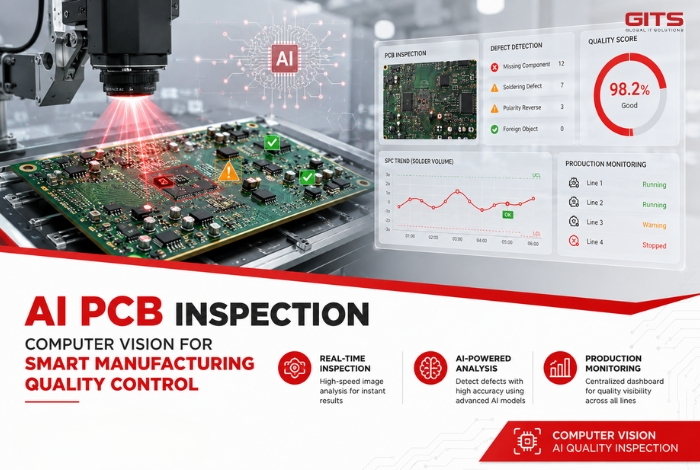
>>> See More: AI PCB Inspection: Computer Vision for Smart Manufacturing Quality Control
The Future: From Predictive Maintenance to Autonomous Operations
The next evolution of industrial AI is not simply better predictions but autonomous execution.
As Agentic AI, digital twins, robotics, and intelligent automation continue to mature, Predictive Maintenance Agents will evolve into collaborative AI systems capable of managing entire maintenance ecosystems with minimal human intervention.
Rather than responding to failures, enterprises will operate in environments where intelligent agents continuously optimize asset performance, coordinate maintenance activities, and improve operational resilience in real time.
Organizations that embrace this shift today will build smarter, more adaptive operations capable of competing in the era of intelligent manufacturing.

Predictive Maintenance Agents Are Redefining Industrial Reliability
The evolution from predictive alerts to autonomous repairs represents a major milestone in industrial AI.
A Predictive Maintenance Agent goes far beyond identifying potential failures. It combines AI Agents, Agentic AI, AI Services, and enterprise AI Solutions to automate maintenance decisions, optimize operational efficiency, and reduce business risk.
For manufacturers, logistics providers, and industrial enterprises across Japan, South Korea, Vietnam, and global markets, adopting intelligent maintenance agents is no longer just a technology upgrade. It is a strategic investment that enables resilient operations, lower costs, and sustainable growth in the age of AI-driven transformation.