







Enterprise AI investment is accelerating worldwide, yet many organizations still struggle to answer one critical question: Is AI creating measurable business value?
For executives across Japan, South Korea, Vietnam, and global markets, AI is no longer an experimental technology. It has become a strategic investment expected to improve productivity, optimize operations, and support long-term growth. However, without a structured AI ROI framework, even successful AI initiatives can be difficult to justify, scale, or prioritize.
The organizations achieving the greatest success treat AI ROI as a business metric—not simply a technology metric.
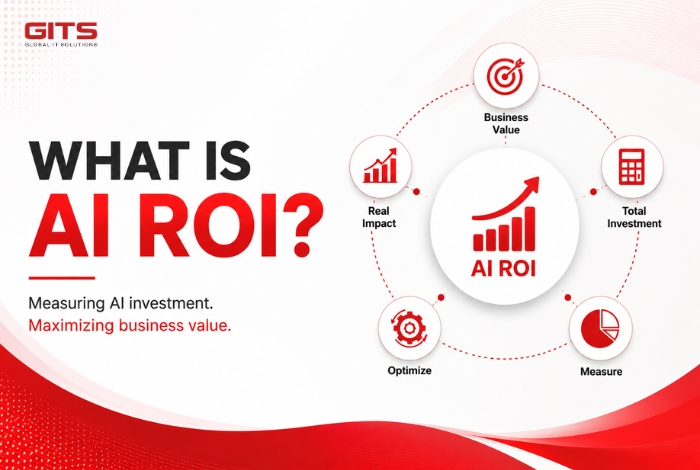
What Is AI ROI?
AI ROI (Artificial Intelligence Return on Investment) measures the financial and operational value generated by AI compared with the total investment required to deploy, operate, and continuously improve AI solutions.
A practical formula is:
AI ROI (%) = ((Business Value Generated − Total AI Investment) ÷ Total AI Investment) × 100
While the formula is straightforward, accurately measuring business value requires looking beyond labor savings. Modern AI initiatives create value through productivity gains, faster decision-making, improved customer experiences, and reduced operational risk.
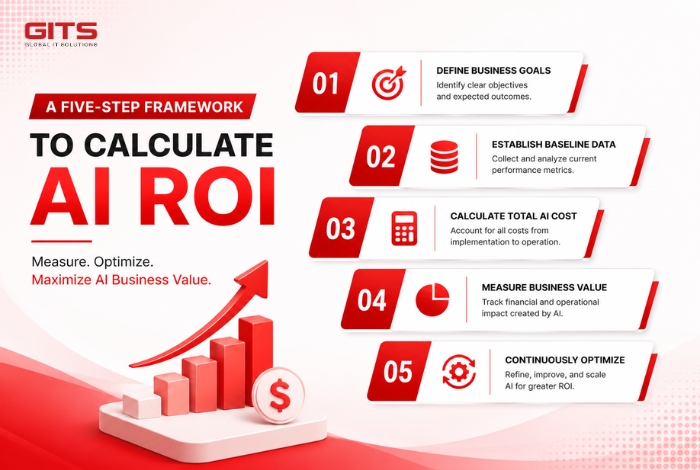
A Five-Step Framework to Calculate AI ROI
Successful enterprises follow a structured methodology rather than evaluating results after deployment.
1. Define measurable business objectives
Start with a business problem, not a technology goal. Examples include reducing warehouse operating costs, shortening customer response times, improving production efficiency, or increasing sales conversion.
2. Establish baseline performance
Record current KPIs before implementation, such as processing time, operational cost, error rate, customer satisfaction, or revenue per employee. Without baseline data, AI improvements cannot be quantified.
3. Measure total AI investment
Include all implementation costs, including software, infrastructure, AI Agent development, integration, employee training, governance, security, and ongoing optimization.
4. Quantify business value
Evaluate measurable improvements across cost savings, productivity, revenue growth, risk reduction, and customer experience.
5. Optimize continuously
AI is not a one-time deployment. Continuous monitoring and optimization increase long-term ROI as models, workflows, and business requirements evolve.
The KPIs That Best Reflect AI ROI
High-performing organizations evaluate AI using both financial and operational indicators.
| Business Area | KPI |
|---|---|
| Financial | Operating cost reduction, revenue growth, payback period |
| Operations | Processing time, workflow efficiency, error reduction |
| Workforce | Productivity, employee utilization, time saved |
| Customer | CSAT, NPS, response time, retention rate |
| Strategic | Decision speed, forecasting accuracy, business agility |
Together, these metrics provide a comprehensive view of how AI contributes to enterprise performance.
Why AI Agents Deliver Higher ROI
Unlike traditional automation, AI Agents can understand objectives, retrieve enterprise knowledge, reason through tasks, interact with business systems, and execute multi-step workflows autonomously.
For example:
– A customer service AI Agent can resolve routine inquiries, retrieve internal knowledge, and escalate only complex cases, reducing response time and support costs.
– A logistics AI Agent can analyze inventory, predict disruptions, and recommend procurement decisions, improving supply chain efficiency.
– A manufacturing AI Agent can monitor equipment, predict maintenance requirements, and minimize production downtime.
The greatest ROI comes not from replacing employees but from enabling people to focus on higher-value work while AI handles repetitive operational processes.

Common Mistakes That Reduce AI ROI
Many AI initiatives fail to demonstrate value because organizations measure technology performance instead of business outcomes.
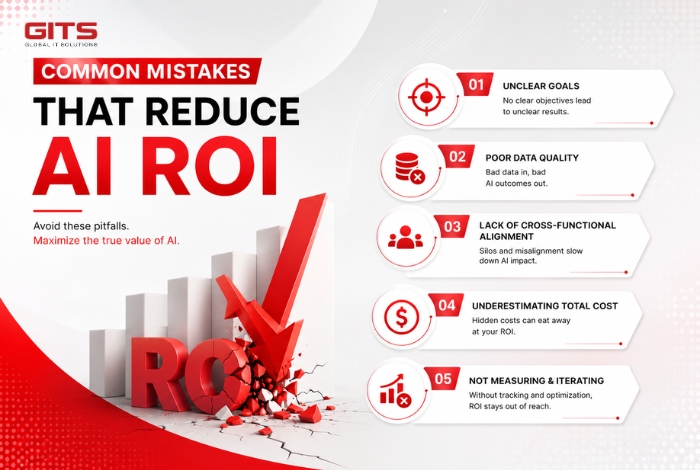
Common pitfalls include:
– Starting AI projects without clear business objectives.
– Ignoring implementation and maintenance costs.
– Measuring only short-term cost savings.
– Failing to establish baseline KPIs.
– Treating AI as a standalone tool rather than integrating it into enterprise workflows.
– Overlooking governance, data quality, and employee adoption.
Avoiding these issues significantly increases the likelihood of achieving sustainable AI ROI.
A Practical Enterprise Example
Consider a manufacturing company deploying AI Agents for predictive maintenance.
Before implementation, unplanned equipment downtime averaged 20 hours per month. After deployment, downtime decreased to 8 hours, maintenance costs dropped by 25%, and production efficiency increased by 18%.
Although the initial AI investment was substantial, the organization achieved payback within the first year through lower operational costs and higher production capacity.
This illustrates an important principle: AI ROI should be measured by business impact rather than technology adoption alone.
>>> See More: AI AX Power: Scaling Enterprise Intelligence Beyond AI
Frequently Asked Questions
What is AI ROI?
AI ROI measures the financial and operational value generated by AI compared with the total cost of implementation, operation, and optimization.
How long does it take to achieve AI ROI?
Most enterprise AI projects begin delivering measurable operational improvements within three to six months, while broader business ROI is typically realized over 12 to 24 months, depending on project complexity.
Why do AI Agents generate higher ROI than traditional automation?
AI Agents can reason, access enterprise knowledge, and execute end-to-end workflows across multiple systems, enabling greater efficiency and scalability than rule-based automation.
Which industries achieve the highest AI ROI?
Manufacturing, logistics, retail, healthcare, and financial services often realize significant returns because AI directly improves operational efficiency, decision-making, and customer experience.
What is the biggest challenge in measuring AI ROI?
The biggest challenge is linking AI performance to business outcomes. Organizations should define baseline KPIs and track operational, financial, and customer metrics throughout the AI lifecycle.
AI ROI Is the Foundation of Successful AI Transformation
As organizations expand their AI Transformation (AX) strategies, measuring ROI becomes essential for scaling investment with confidence.
The most successful enterprises combine clear business objectives, reliable KPI measurement, and intelligent AI Agents to create measurable operational improvements. Rather than viewing AI as a standalone technology project, they embed it into everyday business processes to generate continuous value.
Organizations that adopt a structured AI ROI framework are better positioned to justify investment, accelerate enterprise AI adoption, and build a sustainable competitive advantage in an increasingly AI-driven economy.