





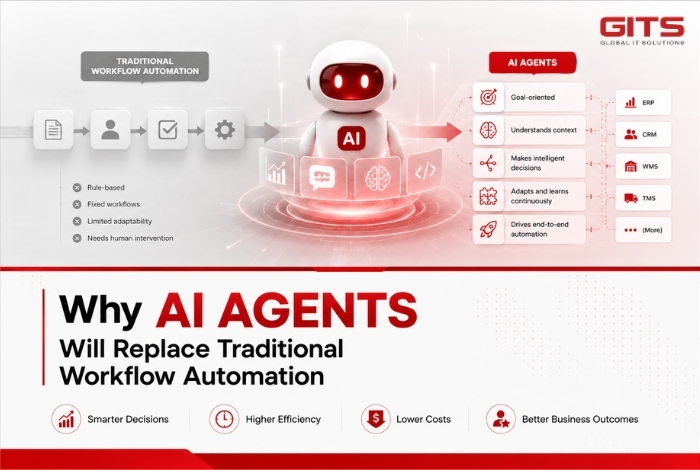
AI Agents are intelligent software systems that can understand business goals, reason through complex situations, make autonomous decisions, and execute tasks across multiple enterprise applications. Unlike traditional workflow automation, which follows predefined rules, AI Agents continuously adapt to changing conditions, enabling organizations to automate not only repetitive tasks but also complex business operations.
As enterprises accelerate AI Transformation (AX), the question is no longer whether AI Agents will impact business automation—it is how quickly organizations can adopt them to remain competitive.
Why Traditional Workflow Automation Is Reaching Its Limits
For years, workflow automation has helped businesses improve productivity by automating repetitive processes such as approvals, notifications, and data entry. However, today’s business environment has become far more dynamic than rule-based systems were designed to handle.
Modern enterprises face several challenges:
– Rapidly changing customer demands
– Complex supply chains and global operations
– Large volumes of structured and unstructured data
– Cross-functional business processes
– Frequent operational exceptions
Traditional workflow automation executes predefined instructions effectively, but when unexpected situations occur, human intervention is often required.
As organizations pursue greater agility and operational resilience, they need automation that can understand context, evaluate alternatives, and make intelligent decisions instead of simply following rules.
This is where AI Agents fundamentally change enterprise automation.
What Makes AI Agents Different?
The biggest difference between traditional automation and AI Agents is not speed—it is intelligence.
Rather than executing a fixed workflow, AI Agents work toward a business objective. They combine several advanced AI capabilities to determine the most effective path for achieving that objective.
Key capabilities include:
– Context awareness to understand business situations instead of isolated tasks.
– Reasoning and decision-making to evaluate multiple options before taking action.
– Planning to break complex objectives into executable steps.
– Enterprise integration through APIs and business applications such as ERP, CRM, WMS, and TMS.
– Continuous learning to improve future decisions based on previous outcomes.
These capabilities transform automation from a task executor into an intelligent digital workforce capable of supporting enterprise-wide operations.

AI Agents vs Traditional Workflow Automation
Although both technologies aim to improve efficiency, their operating models are fundamentally different.
| Traditional Workflow Automation | AI Agents |
|---|---|
| Executes predefined rules | Works toward business goals |
| Follows fixed workflows | Adapts dynamically to changing conditions |
| Handles repetitive tasks | Solves complex business problems |
| Requires manual updates | Continuously improves through learning |
| Reacts to events | Proactively recommends and executes actions |
| Automates individual processes | Optimizes end-to-end business operations |
Rather than replacing existing automation platforms, AI Agents enhance them by adding intelligence, adaptability, and decision-making capabilities where traditional workflows reach their limits.

Why Enterprises Are Accelerating AI Agent Adoption
Organizations across manufacturing, logistics, retail, healthcare, and financial services are increasingly adopting AI Agents because they deliver measurable business value beyond process automation.
Instead of automating isolated activities, AI Agents connect people, data, and enterprise systems to optimize complete business workflows.
This enables organizations to:
– Reduce repetitive manual work
– Improve operational efficiency
– Accelerate business decision-making
– Increase employee productivity
– Enhance customer experience
– Respond faster to unexpected business changes
For industries where operational speed and accuracy directly impact competitiveness, AI Agents are becoming a strategic investment rather than an experimental technology.
Enterprise Use Cases: Where AI Agents Deliver the Greatest Value
AI Agents are already creating measurable business impact across industries by enabling faster decisions, greater operational visibility, and more intelligent automation.
In manufacturing, AI Agents optimize production schedules, predict equipment failures, and coordinate supply chain activities to reduce downtime and improve productivity.
In logistics and warehousing, they monitor inventory in real time, recommend replenishment strategies, optimize transportation routes, and proactively respond to delivery disruptions. When integrated with Warehouse Management Systems (WMS) and Transportation Management Systems (TMS), AI Agents help build smarter and more resilient supply chains.
In retail and e-commerce, AI Agents analyze customer behavior, personalize shopping experiences, automate order management, and improve demand forecasting.
In healthcare, they streamline administrative workflows, support clinical documentation, and assist healthcare professionals by delivering timely, data-driven insights.
Across every industry, the common advantage is the same: AI Agents enable organizations to move beyond automating tasks toward optimizing end-to-end business operations.
AI Agents Are Driving the Next Phase of AI Transformation (AX)
Digital Transformation focused on digitizing business processes. AI Transformation (AX) goes further by embedding intelligence into every stage of enterprise operations.
AI Agents serve as the execution layer of AX, connecting data, enterprise applications, and human expertise into a unified operating model. Rather than simply executing instructions, they continuously analyze business conditions, recommend actions, and adapt as circumstances change.
For business leaders, this translates into tangible outcomes:
– Faster and more informed decision-making
– Higher operational efficiency and productivity
– Reduced operational costs through intelligent automation
– Improved customer experience with proactive service
– Greater organizational agility in rapidly changing markets
Organizations that invest in AI Agents today are not only improving current operations but also building the foundation for a more adaptive, AI-driven enterprise.

The Future of Enterprise Automation Belongs to AI Agents
Enterprise automation is entering a new era.
Traditional workflow automation will continue to play an important role in handling repetitive, rule-based processes. However, as business environments become increasingly dynamic, organizations need systems that can understand context, make decisions, and continuously optimize performance.
This is why AI Agents are rapidly evolving from standalone productivity tools into intelligent digital coworkers capable of collaborating across departments and enterprise systems.
As technologies such as Agentic AI, enterprise AI platforms, and intelligent orchestration continue to mature, AI Agents will become the central layer connecting people, processes, data, and business applications. Organizations that embrace this shift early will be better positioned to innovate faster, respond to market changes, and maintain a sustainable competitive advantage.
>>> See More: AI-First Development: The Foundation of Enterprise AI Success
AI Agents Are Redefining Business Automation
Traditional workflow automation helped enterprises streamline repetitive work. AI Agents represent the next evolution by bringing intelligence, adaptability, and autonomous decision-making into everyday business operations.
Rather than replacing existing systems, AI Agents enhance enterprise technology by enabling organizations to automate more complex workflows, improve operational resilience, and accelerate AI Transformation.
For companies seeking long-term growth and operational excellence, adopting AI Agents is no longer simply a technology upgrade—it is a strategic business decision that will shape the future of enterprise competitiveness.