






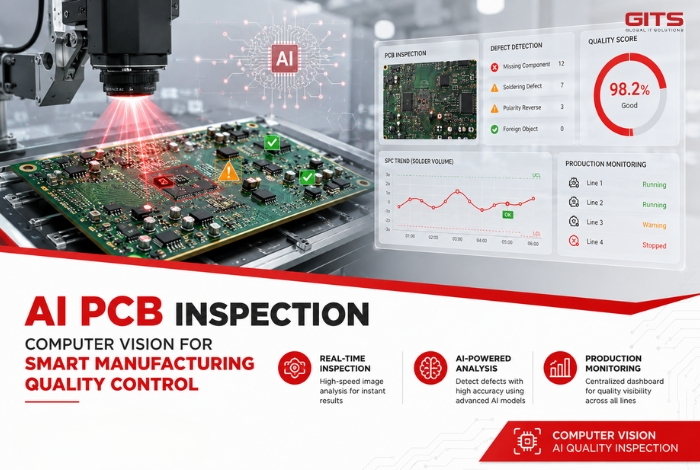
In today’s electronics manufacturing industry, every defective PCB that reaches the next production stage can trigger expensive rework, production downtime, delayed deliveries, and even product recalls. As PCB designs become increasingly compact and complex, manufacturers can no longer rely solely on manual inspection or isolated inspection equipment to maintain consistent product quality.
To remain competitive, leading manufacturers are embracing AI PCB Inspection and Computer Vision technologies to automate quality inspection, monitor production performance in real time, and transform manufacturing data into actionable insights. Rather than functioning as a standalone inspection tool, modern AI inspection platforms have become an essential component of Smart Factory initiatives, enabling continuous quality improvement across the entire production process.
This case study demonstrates how GITS developed an intelligent PCB quality inspection platform that combines image analysis, centralized monitoring, and Statistical Process Control (SPC) to help a leading Korean electronics solution provider optimize manufacturing quality.
Why PCB Inspection Is Critical in Modern Electronics Manufacturing
Printed Circuit Boards (PCBs) are the foundation of every electronic device, from consumer electronics and automotive systems to medical equipment, telecommunications infrastructure, and semiconductor manufacturing. As component density continues to increase, even microscopic defects can significantly impact product reliability and manufacturing yield.
Traditional inspection methods face several challenges:
– Manual inspection cannot consistently detect micro-defects at high production speeds.
– Inspection data is often scattered across multiple AOI machines and production lines.
– Factory managers lack real-time visibility into overall production quality.
– Root cause analysis becomes slow and reactive instead of preventive.
Manufacturers are therefore shifting from isolated inspection processes to integrated Computer Vision-based quality management systems capable of delivering real-time operational intelligence.
Customer Background
The customer is one of South Korea’s leading suppliers of industrial inspection equipment and measurement solutions, serving industries including automotive electronics, smart devices, telecommunications, defense, healthcare, and semiconductor manufacturing.
As production capacity expanded across multiple SMT lines, the company required a centralized platform capable of visualizing production quality, consolidating inspection data, and supporting data-driven manufacturing decisions. The objective was not only to inspect PCB defects more efficiently but also to establish complete visibility across manufacturing operations.

Technical Challenges
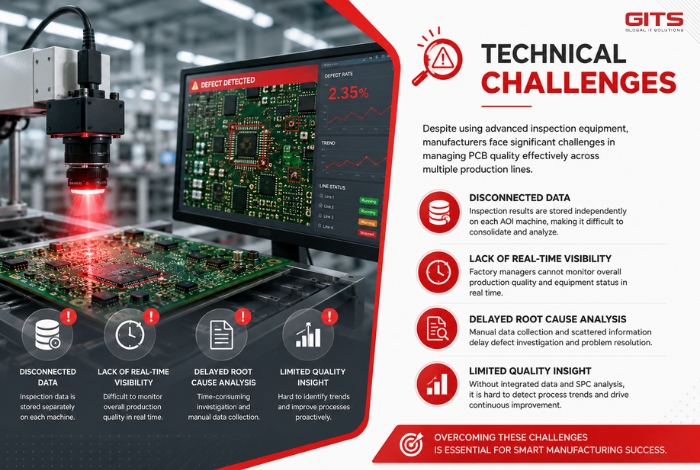
The customer encountered several operational challenges that limited production efficiency and quality management.
Inspection images generated by production equipment were analyzed independently without centralized monitoring, making it difficult to evaluate factory-wide performance. Quality engineers also lacked a unified dashboard for monitoring production trends and identifying recurring process issues.
Furthermore, manufacturing teams needed a solution capable of combining inspection results with Statistical Process Control (SPC) to proactively improve production processes rather than simply detecting defects after they occurred.
AI PCB Inspection Solution
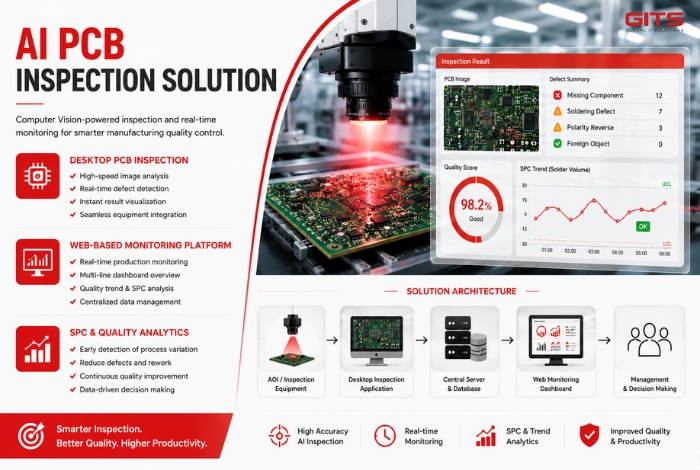
To address these challenges, GITS developed an integrated solution consisting of two core components that work together throughout the inspection and manufacturing process.
Desktop PCB Inspection Application
The desktop application receives PCB images captured during production and performs high-speed image analysis to identify quality defects. Inspection results are immediately visualized for operators before being transmitted to the central server for enterprise-wide monitoring.
The solution provides:
– Automated PCB image analysis
– Real-time defect visualization
– Centralized inspection data management
– Seamless integration with factory inspection equipment
Although the original system focuses on advanced image analysis, its architecture provides a strong foundation for future integration with AI-powered Computer Vision models for automated defect classification and predictive quality analysis.
Web-Based Production Monitoring Platform
The second component is a web-based monitoring platform that enables manufacturers to visualize production quality across multiple SMT lines in real time.
Instead of reviewing isolated inspection reports, production managers gain a centralized dashboard displaying manufacturing performance, inspection results, production trends, and equipment status across the entire factory.
This unified monitoring environment allows engineering teams to identify abnormalities earlier and respond more quickly to production issues.
Statistical Process Control for Continuous Quality Improvement
A key advantage of the solution is its integration with Statistical Process Control (SPC).
Rather than simply displaying inspection results, SPC continuously analyzes production measurements to detect process variation before defects become widespread.
By combining Computer Vision inspection with SPC analytics, manufacturers can:
– Detect abnormal production trends earlier.
– Improve manufacturing process stability.
– Reduce repetitive quality issues.
– Support data-driven production optimization.
– Enhance overall manufacturing consistency.
This enables quality management to evolve from reactive inspection toward continuous process improvement.
Technologies Used
The solution was developed using enterprise technologies suitable for industrial manufacturing environments.
Web Platform
– Java
– Spring Framework
– AngularJS
Desktop Application
– C#
– .NET
– WPF
– C/C++
This architecture ensures reliable integration with industrial inspection equipment while supporting scalable factory monitoring and enterprise-level system management.
Business Outcomes
Following deployment, the customer established a centralized PCB quality management platform capable of supporting multiple production lines within a unified monitoring environment.
The solution enabled the organization to:
– Centralize PCB inspection management across manufacturing facilities.
– Improve visibility into production quality through real-time dashboards.
– Accelerate defect investigation and root cause analysis.
– Support continuous quality improvement using SPC analytics.
– Enable faster and more informed production decision-making.
– Build a scalable foundation for future AI-driven Smart Factory initiatives.
Rather than functioning as a standalone inspection application, the platform became a critical component of the customer’s digital manufacturing strategy.

The Future of AI PCB Inspection
As electronics manufacturing continues to evolve, inspection systems are becoming intelligent manufacturing platforms rather than simple defect detection tools.
The next generation of AI PCB Inspection will combine Computer Vision, Edge AI, Industrial IoT, and AI-powered analytics to deliver predictive quality management, autonomous inspection, and real-time production optimization.
Manufacturers that invest in intelligent inspection technologies today will be better positioned to improve product quality, increase operational resilience, and accelerate their Industry 4.0 transformation.
>>> See More: AI Hospital Inventory Management for Smarter Healthcare Operations
High-quality PCB inspection is no longer defined solely by the ability to identify defective boards. Modern manufacturers require intelligent systems capable of transforming inspection data into actionable manufacturing intelligence.
By integrating Computer Vision, real-time production monitoring, and Statistical Process Control, GITS delivers a comprehensive quality management solution that enables manufacturers to improve production visibility, optimize manufacturing processes, and establish a scalable foundation for Smart Factory transformation.
For electronics manufacturers pursuing digital manufacturing excellence, AI-powered PCB inspection is no longer an optional investment—it is becoming a strategic capability for achieving sustainable quality, operational efficiency, and long-term competitiveness.