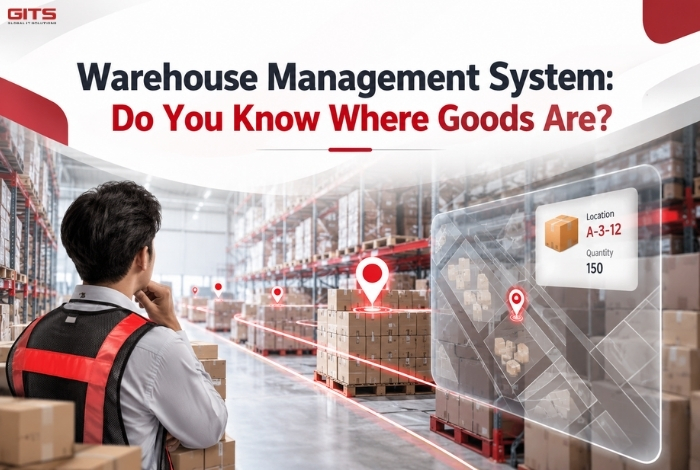








As businesses expand across e-commerce, marketplaces, physical stores, distributors and B2B sales channels, managing orders is no longer simply about processing transactions. Orders must be synchronized with inventory, warehouses, stores, logistics providers and customer service in real time.
This is where an Order Management System (OMS) becomes a critical part of modern commerce infrastructure. Instead of allowing each sales channel to operate independently, an OMS creates a centralized orchestration layer that connects orders, inventory and fulfillment across the entire operation.
For businesses in Japan, Korea, Vietnam and global markets, this capability is increasingly important as customers expect accurate stock information, flexible delivery options and faster fulfillment while companies face rising operational complexity and labor constraints.
What Is an Order Management System?
An order management system is a software platform that captures, validates, processes, coordinates and tracks orders throughout their lifecycle.
Rather than replacing every existing system, an OMS typically works as an orchestration layer connecting platforms such as:
• E-commerce websites and marketplaces
• POS and physical stores
• ERP and CRM systems
• WMS and warehouse operations
• TMS and logistics providers
• Payment and customer service platforms
The core value of an OMS is not simply storing order information. It determines what should happen to an order, where it should be fulfilled and how the fulfillment process should be coordinated.
Modern OMS platforms increasingly combine real-time data, automation and AI to make these decisions more intelligent and responsive.
Why Traditional Order Management Struggles at Scale
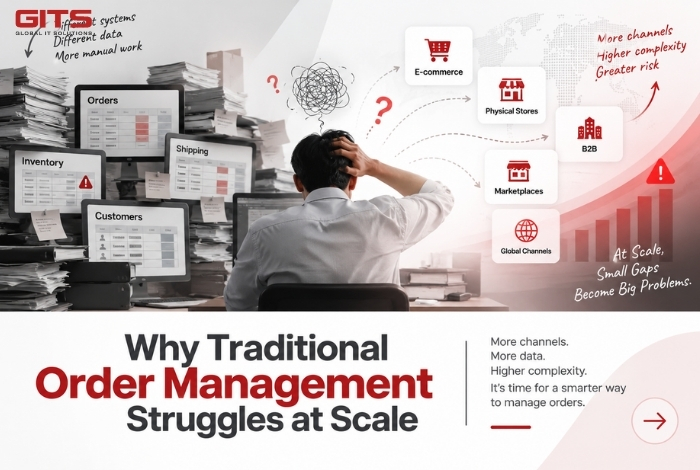
Many companies begin with separate systems for each sales channel. A website has one order flow, marketplaces have another, stores maintain their own inventory and warehouses operate through a WMS.
This structure may work when order volume is small. As the business grows, however, disconnected systems create operational friction.
A customer may see an item as available online while the actual stock has already been allocated elsewhere. An order may arrive from multiple marketplaces but require manual consolidation. Fulfillment teams may also spend significant time deciding which warehouse or store should ship each order.
These problems create more than administrative work. They can result in overselling, delayed shipments, inaccurate inventory, higher fulfillment costs and inconsistent customer experiences.
For businesses operating across Japan, Korea and global markets, where multi-channel commerce and high service expectations are becoming increasingly important, fragmented order processes can quickly become a scalability constraint.
How an Order Management System Connects Orders, Inventory and Fulfillment
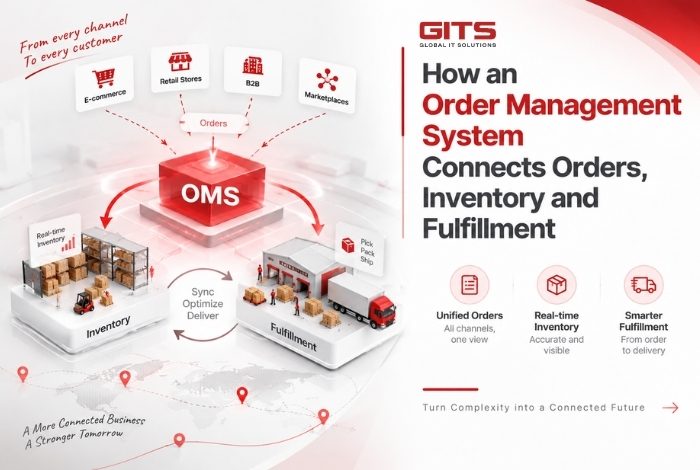
The fundamental role of an OMS is to connect three operational layers: orders, inventory and fulfillment.
1. Centralize Orders Across Every Channel
An OMS collects orders from websites, marketplaces, mobile applications, stores and other sales channels into a unified operational view.
Instead of asking teams to monitor multiple systems, the organization can manage the complete order lifecycle from a centralized orchestration layer.
This creates a consistent flow from order capture and validation to allocation, shipment, delivery and returns.
2. Create Real-Time Inventory Visibility
Order processing is only as reliable as the inventory data behind it.
An OMS connects inventory information across warehouses, stores, distribution centers and other fulfillment locations. This gives the business a more consistent view of available inventory and helps prevent situations where different channels display conflicting stock information.
Real-time inventory visibility is particularly important for omnichannel models such as ship-from-store, click-and-collect and marketplace fulfillment. Industry solutions increasingly position inventory visibility and order orchestration as fundamental capabilities of modern OMS platforms.
3. Orchestrate the Best Fulfillment Option
Once an order is received, the next question is simple but operationally complex:
Where should this order be fulfilled from?
An OMS can evaluate factors such as inventory availability, customer location, warehouse capacity, delivery requirements and fulfillment rules before assigning the order.
For example, an online order in Tokyo could potentially be fulfilled from a nearby store rather than a distant distribution center if the required inventory is available.
This transforms fulfillment from a fixed workflow into a dynamic decision-making process.
From Rule-Based OMS to AI-Powered Order Management
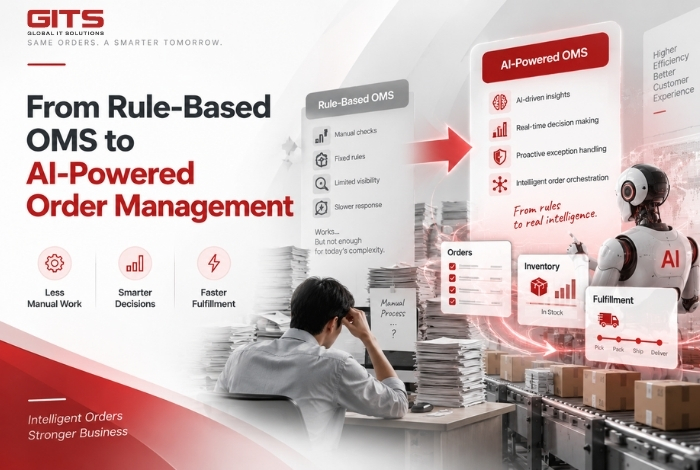
Traditional OMS platforms primarily depend on predefined business rules. These rules remain valuable, but increasingly complex operations require systems that can interpret changing conditions rather than simply execute static instructions.
This is where AI order management and Agentic AI introduce a new layer of intelligence.
AI can analyze order patterns, inventory signals, fulfillment constraints and operational events to identify potential problems and recommend or execute the next appropriate action.
For example, an AI-powered OMS could detect that a fulfillment location is running low on inventory and evaluate alternative locations before the order becomes delayed.
AI Agents can further extend this capability by continuously monitoring operational signals and supporting tasks such as:
• Detecting fulfillment exceptions
• Recommending alternative inventory locations
• Supporting intelligent order routing
• Identifying potential delivery risks
• Summarizing operational issues
• Triggering predefined corrective workflows
Modern enterprise solutions are already moving toward AI-assisted order management, with AI agents being used to analyze orders, inventory and fulfillment signals and recommend next actions.
The important shift is from “automating a process” to “intelligently orchestrating the process.”
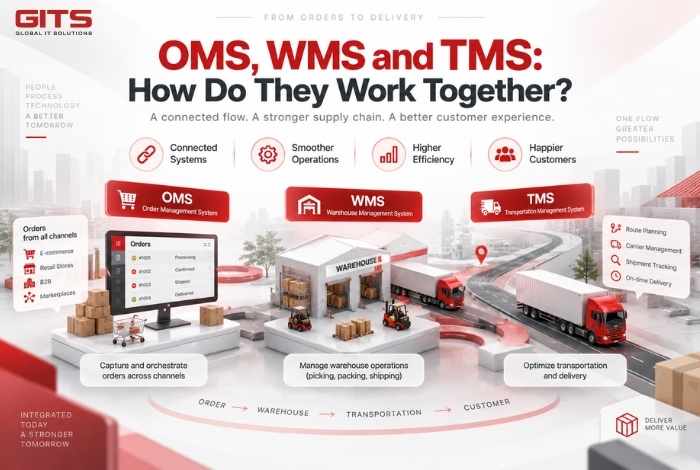
OMS, WMS and TMS: How Do They Work Together?
An OMS should not be viewed as a replacement for every operational system.
Instead, each platform has a different role.
– OMS decides how orders should be orchestrated across channels and fulfillment nodes.
– WMS manages physical warehouse execution, including receiving, picking, packing and dispatch.
– TMS manages transportation planning, carrier coordination, routing and shipment execution.
Together, these systems create a connected operational flow:
Customer Order → OMS → Inventory Allocation → WMS → TMS → Delivery → Customer
This architecture allows companies to connect commercial demand with physical execution while maintaining visibility throughout the order lifecycle.
What Businesses Gain from Intelligent Order Management
A modern order management system can help organizations move from fragmented order processing toward connected and data-driven operations.
Key benefits include:
Higher inventory accuracy: A unified view helps reduce discrepancies between sales channels and fulfillment locations.
Faster fulfillment decisions: Orders can be routed according to real-time operational conditions rather than manual decisions.
Lower operational workload: Automation reduces repetitive order handling, status checking and exception management.
Better customer experience: Customers receive more accurate availability, fulfillment status and delivery information.
Scalable omnichannel operations: Businesses can add channels and fulfillment locations without creating entirely separate order workflows.
These capabilities are particularly relevant as companies seek AX (AI Transformation) initiatives that improve existing operations without requiring a complete replacement of their technology ecosystem.
>>> See More: AI Agents in Logistics: How Intelligent Automation Will Transform Supply Chains by 2030
What Should Businesses Look for in an OMS?
Choosing an OMS should go beyond the number of features listed on a product page. The platform should fit the company’s existing architecture and future operating model.
Key considerations include:
• Real-time inventory synchronization
• Omnichannel order orchestration
• ERP, WMS and TMS integration
• Flexible fulfillment rules
• Exception management
• API and integration capabilities
• AI and automation readiness
• Scalability across markets and channels
• Data visibility and operational analytics
For companies considering AI adoption, another important question is whether AI is simply connected as an additional feature or deeply integrated into the operational workflow.

Build an Intelligent Order Orchestration Layer
As commerce becomes increasingly omnichannel, the challenge is no longer simply processing more orders. Businesses need to coordinate orders, inventory and fulfillment as one connected operation.
An order management system provides the orchestration layer that connects these processes, while AI Agents and Agentic AI can take the next step by making order decisions more adaptive, proactive and intelligent.
For retailers, manufacturers, distributors and logistics-driven businesses in Japan, Korea, Vietnam and global markets, an intelligent OMS can become an important foundation for scalable AI Solution, AI Services and AX initiatives.
The future of order management is not just automation. It is intelligent orchestration across every order, every inventory location and every fulfillment channel.