





For enterprises managing hundreds or thousands of deliveries every day, transportation is no longer simply an execution function. It directly impacts operating costs, customer experience, delivery reliability, and overall supply chain performance.
Yet many companies still manage transportation through disconnected systems, spreadsheets, emails, phone calls, and manually updated shipment information. The result is familiar: rising freight costs, inefficient routes, poor vehicle utilization, delayed deliveries, and limited visibility into what is actually happening across the transportation network.
A modern Transportation Management System (TMS) addresses this challenge by connecting transportation planning, execution, tracking, cost management, and analytics within one digital environment. When combined with AI and Agentic AI, TMS can go further by transforming transportation from a reactive operation into an intelligent, continuously optimized process.
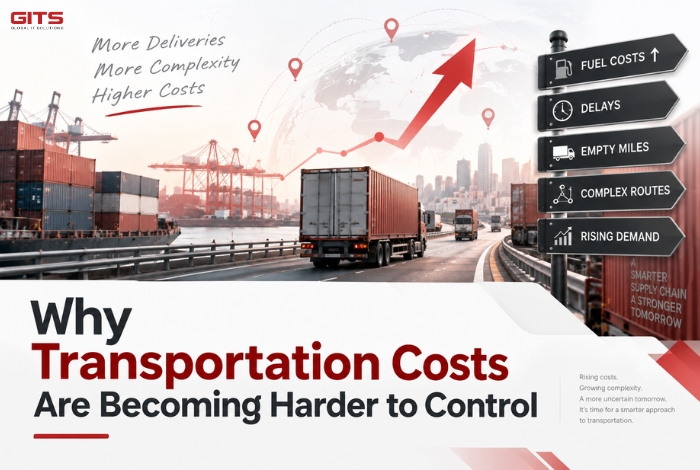
Why Transportation Costs Are Becoming Harder to Control
Transportation costs are influenced by far more than fuel prices or carrier rates. Poor route planning, empty miles, low vehicle utilization, fragmented carrier management, delivery failures, detention fees, and inefficient shipment consolidation can quietly increase the total cost of every order.
The problem becomes more complex as enterprises expand across regions and transportation modes.
A manufacturer may need to coordinate inbound materials with outbound distribution. An e-commerce company may manage thousands of last-mile deliveries. A retailer may operate multiple distribution centers and carrier networks. Meanwhile, logistics providers must coordinate different customers, routes, vehicles, service levels, and delivery commitments simultaneously.
Without centralized transportation intelligence, decision-makers often see the cost after it occurs rather than understanding the factors driving it in real time.
This is where a transportation management system becomes strategically important.
What Is a Transportation Management System?
A Transportation Management System is software designed to manage and optimize the planning, execution, monitoring, and settlement of transportation activities.
Modern TMS platforms typically cover several core capabilities:
– Transportation planning and route optimization
– Carrier selection and transportation procurement
– Load consolidation and shipment planning
– Dispatch and transportation execution
– Real-time shipment tracking
– Freight cost management and settlement
– Performance analytics and reporting
– Exception management and delivery alerts
Gartner describes TMS as software supporting multimodal sourcing, planning, and execution of physical transportation, with visibility, analytics, procurement, planning, execution, and settlement among its key capabilities.
The real value, however, is not simply having more transportation data. It is connecting that data so enterprises can make faster and better decisions.
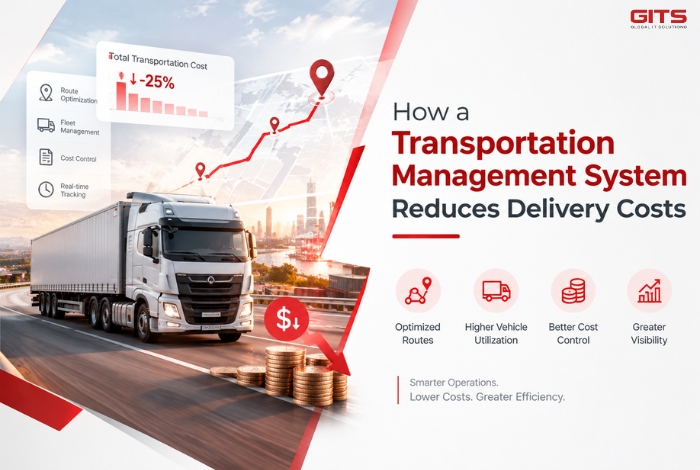
How a Transportation Management System Reduces Delivery Costs
A well-designed TMS creates multiple opportunities for cost optimization throughout the transportation lifecycle.
1. Optimize Routes and Transportation Plans
Instead of relying on fixed routes or manual planning, TMS software can evaluate delivery locations, vehicle capacity, delivery windows, traffic conditions, transportation costs, and operational constraints to create more efficient plans.
This helps reduce unnecessary mileage, improve vehicle utilization, and increase the number of deliveries completed per trip.
For example, Manhattan reports that one customer reduced empty miles by 8% and total miles by 7.7% through optimized transportation scheduling.
2. Improve Load and Capacity Utilization
A vehicle traveling half-empty represents more than unused capacity. It also means transportation costs are distributed across fewer shipments.
A modern TMS can consolidate compatible orders, optimize loading sequences, and match shipment requirements with available transportation capacity.
The result is a more efficient transportation network with fewer empty miles and better asset utilization.
3. Control Freight and Carrier Costs
Transportation spending can become difficult to manage when rate cards, carrier invoices, accessorial charges, and actual delivery data exist across different systems.
A centralized TMS enables enterprises to compare planned versus actual transportation costs, identify discrepancies, evaluate carrier performance, and detect unnecessary expenses.
This gives procurement and logistics teams a clearer basis for carrier negotiations and transportation strategy.
Transportation Visibility: From Tracking to Understanding
Tracking a vehicle’s location is not the same as having transportation visibility.
True transportation visibility means understanding what is happening across the entire delivery process and, more importantly, identifying what is likely to happen next.
A modern TMS can consolidate information from ERP, WMS, GPS, telematics, carrier platforms, customer systems, and other operational sources.
This creates a unified view of:
– Shipment status
– Estimated arrival times
– Delivery delays
– Carrier performance
– Route deviations
– Transportation costs
– Delivery exceptions
– On-time delivery performance
The benefit is significant. Instead of waiting for a customer to report a late shipment, logistics teams can identify potential disruptions earlier and take corrective action.
Gartner identifies track-and-trace visibility, transportation analytics, and settlement as fundamental capabilities of modern TMS platforms.
>>> See More: Transportation Cost Optimization with AI-Powered TMS
How AI Agents Take TMS Beyond Traditional Automation
Traditional TMS platforms are highly effective at collecting information, applying predefined rules, and supporting transportation decisions.
But enterprises increasingly need systems that can understand situations, make recommendations, and execute actions.
This is where AI Agents and Agentic AI can extend the capabilities of a transportation management system.
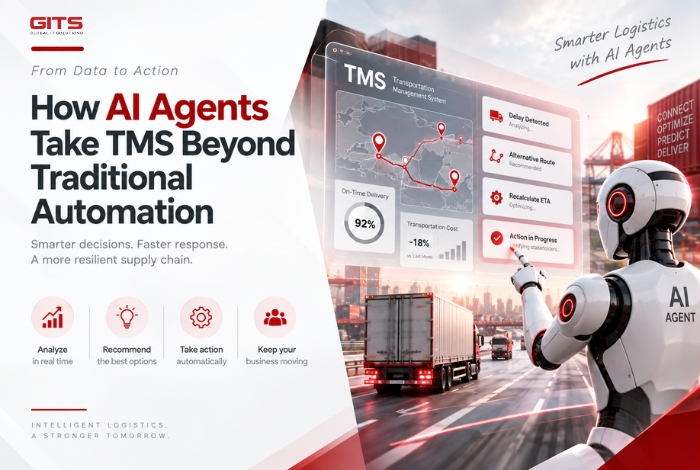
Instead of simply displaying an alert that a shipment is delayed, an AI Agent can analyze the reason for the delay, evaluate alternative routes or carriers, estimate the impact on delivery commitments, and recommend or initiate the appropriate response.
For example:
Delay detected → Analyze traffic and shipment status → Evaluate alternatives → Recalculate ETA → Select the best response → Notify stakeholders → Update the transportation workflow
This changes the role of AI from an analytical assistant into an operational decision layer.
Google Cloud highlights this evolution in logistics, where Agentic AI can combine TMS data with external signals such as traffic, weather, events, and demand patterns to make more context-aware transportation decisions.
AWS similarly describes AI agents that can aggregate data across ERP, TMS, WMS, and customer-facing systems while reducing manual lookup and reconciliation work.
From TMS to Intelligent Transportation Management
The next generation of transportation management is not about replacing TMS. It is about making TMS more intelligent.
An enterprise can combine a core TMS with AI Services, predictive analytics, IoT, optimization algorithms, and AI Agents to create an intelligent transportation ecosystem.
This architecture can enable:
– Predictive visibility: Identify potential delays before they become delivery failures.
– Dynamic optimization: Continuously adjust routes, loads, and transportation plans when conditions change.
– Automated exception management: Allow AI Agents to handle repetitive transportation exceptions while escalating complex decisions to human teams.
– Intelligent customer communication: Automatically generate accurate delivery updates and proactive notifications.
– Operational intelligence: Convert transportation data into actionable recommendations for logistics managers.
This approach aligns closely with the broader shift toward AX, or AI Transformation, where enterprises move beyond isolated automation projects and redesign operational workflows around intelligent systems.
What Enterprises Should Look for in a Modern TMS
Selecting a transportation management system should not be based solely on the number of features.
For enterprise environments, the more important question is whether the solution can integrate with the existing technology ecosystem and evolve with future operational requirements.
Key considerations include:
– Integration with ERP, WMS, OMS, CRM, GPS, telematics, and carrier systems
– Real-time transportation visibility
– AI-powered route and load optimization
– Scalable multi-carrier and multimodal management
– Flexible APIs and enterprise architecture
– Predictive analytics and exception management
– AI Agent integration and workflow orchestration
– Data security, governance, and localization requirements
This is particularly important for companies in Japan and South Korea, where operational reliability, process standardization, data accuracy, and integration with existing enterprise systems are often critical requirements.
Build Transportation as a Competitive Advantage
Transportation should no longer be viewed simply as an unavoidable operating expense.
With the right Transportation Management System, enterprises can connect fragmented transportation data, optimize routes and capacity, control freight spending, and gain real-time visibility across the delivery network.
The next step is making these capabilities intelligent.
By combining TMS with AI Solutions, AI Services, predictive analytics, and Agentic AI, enterprises can move from managing transportation events to orchestrating transportation decisions.
The competitive advantage is not simply knowing where every shipment is.
It is knowing what will happen next, why it will happen, and what the business should do about it before the cost becomes unavoidable.
Turn Transportation Visibility Into Intelligent Control
A modern transportation management system gives enterprises the foundation to control transportation costs and improve delivery visibility. But the greatest opportunity lies in connecting that foundation with AI.
For organizations facing rising logistics costs, increasingly complex delivery networks, and higher customer expectations, the future of transportation management is moving from static planning and reactive monitoring toward predictive, adaptive, and autonomous operations.
The combination of TMS + AI Agents + Agentic AI + enterprise integration can create a transportation environment where every route, shipment, carrier, and exception becomes an opportunity for optimization.
That is the shift from transportation management to intelligent transportation management: fewer unnecessary costs, greater operational visibility, faster decisions, and a transportation network built to continuously improve.