






Vietnam has become an increasingly important destination for companies looking to expand software engineering capacity without carrying the full cost of an in-house team. But when evaluating Vietnam IT outsourcing cost, comparing hourly rates alone can lead to the wrong conclusion.
One provider may quote US$25 per hour, another US$40, while a third offers a fixed project price. The cheaper proposal is not necessarily the lower-cost option once project management, QA, communication, rework, infrastructure, security and technology expertise are included.
For companies in Japan, Korea and global markets, the more important question is not simply “How much does outsourcing to Vietnam cost?” It is “What am I actually paying for, and what business value will I receive?”
Vietnam IT Outsourcing Cost: What Is the Market Range?
In 2026, publicly available market benchmarks generally place Vietnam software outsourcing rates around US$15–70 per hour, depending on role, seniority, technology and engagement model. Common software engineering roles often fall around US$20–40 per hour, while senior, DevOps, Cloud and AI/ML specialists can command higher rates.
A typical benchmark looks like this:
| Role | Indicative hourly range |
|---|---|
| Junior Developer | US$15–30/hour |
| Mid-level Developer | US$25–45/hour |
| Senior Developer | US$30–65/hour |
| DevOps / Cloud Engineer | US$30–65/hour |
| QA Engineer | US$20–45/hour |
| AI/ML Engineer | US$35–70/hour |
| Tech Lead / Architect | US$55–85/hour |
These figures should be used for budgeting rather than treated as fixed market prices. A vendor’s final quotation depends on the project scope, required expertise, delivery model, security requirements and expected business outcomes.
The key point is simple: the hourly rate is only one component of Vietnam IT outsourcing cost.
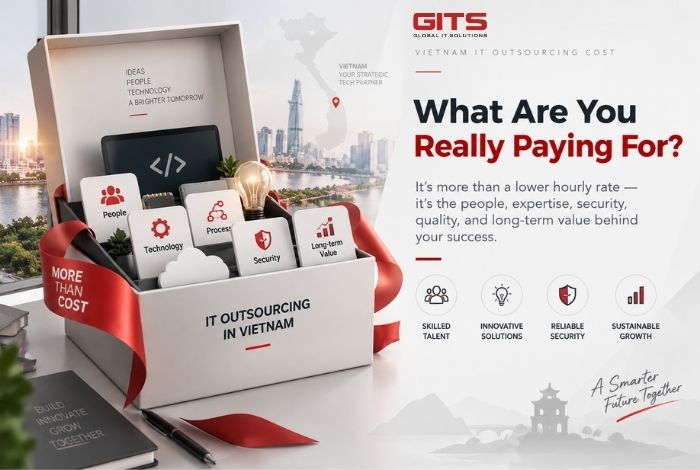
What Are You Really Paying For?
When a company outsources software development, the invoice usually represents much more than developer salaries.
1. Engineering expertise
You are paying for access to developers, QA engineers, DevOps specialists, architects and other technical roles without having to recruit and retain every position internally.
This becomes particularly valuable when the project requires technologies such as Cloud, AI/ML, cybersecurity, data engineering or enterprise system integration. AI and ML roles generally sit at the higher end of Vietnam’s outsourcing rate range because of their specialized expertise.
2. Project management and delivery governance
A successful outsourcing engagement needs more than engineers writing code.
Project managers, technical leads, business analysts and QA teams help coordinate requirements, development cycles, testing, documentation and release management.
For Japanese and Korean enterprises, this layer can be especially important when communication, reporting standards and business processes need to align closely with the headquarters.
3. Quality assurance and security
A low development rate means little if the project generates significant bugs, security issues or rework after deployment.
Enterprise outsourcing costs can include:
– Manual and automated testing
– Code review
– Security testing
– CI/CD management
– Infrastructure monitoring
– Documentation
– Source-code and access management
The objective should therefore be to measure cost per successful outcome, rather than cost per developer hour.
>>> See More: Benefits of IT Outsourcing Vietnam: Why Global Enterprises Choose Vietnam
The Hidden Costs Behind a “Cheap” Outsourcing Quote
The biggest outsourcing mistake is focusing on the initial quotation while ignoring the Total Cost of Ownership (TCO).
A project quoted at US$25/hour can become considerably more expensive if the team requires extensive onboarding, unclear requirements lead to rework, communication delays slow decisions, or additional PM and QA resources are added later.
Several cost factors deserve attention before signing a contract:
– Ramp-up and onboarding: New teams need time to understand business processes, legacy systems and technical architecture.
– Communication overhead: Language, documentation and time-zone differences can increase coordination effort, particularly for complex enterprise projects.
– Rework: Poor requirement analysis or weak QA can turn a low initial rate into a high final project cost.
– Infrastructure and licenses: Cloud services, development environments, monitoring tools and third-party software may or may not be included.
– Management: Dedicated PM, Solution Architect, Business Analyst or Japanese/Korean-speaking Bridge SE resources can affect the final cost.
This is why experienced outsourcing buyers evaluate the complete delivery model, not just the advertised developer rate.

How AI Is Changing Vietnam IT Outsourcing Cost
Traditional outsourcing has largely been measured by the number of engineers and hours delivered. The emergence of AI Services, Agentic AI and AI Agents is changing that model.
AI-assisted development can improve engineering productivity by supporting coding, testing, documentation, data analysis and operational workflows. For enterprises, this creates an opportunity to shift the conversation from “How many developers do we need?” to “How much business output can the technology team deliver?”
For example, an outsourcing partner may combine software engineers with:
– AI coding assistants
– AI testing and QA automation
– AI Agents for repetitive workflows
– Predictive analytics
– Intelligent customer service
– AI-powered knowledge management
This can change the effective cost of delivering a product or digital transformation project, although actual savings depend on the use case, implementation quality and governance.
The next generation of Vietnam IT outsourcing is therefore moving beyond manpower arbitrage toward AI-enabled Technical Solutions and business-oriented AI Solutions.
Which Outsourcing Model Controls Cost Better?
There is no single model that is cheapest for every project.
Project-based outsourcing works well when requirements, scope and deliverables are clearly defined.
Dedicated teams are more suitable for long-term product development, continuous improvement and projects where requirements evolve over time.
Staff augmentation provides flexibility when a company already has strong internal project management but needs additional engineering capacity.
For enterprises considering a Vietnam delivery center, a phased approach can also be considered: start with outsourcing, validate delivery capability, then expand into a dedicated development team or development center as demand increases.
The right model should match the project’s level of uncertainty, required control and expected duration rather than simply minimizing the initial quotation.
What Japanese and Korean Companies Should Evaluate
Cost is important, but enterprises entering Vietnam should evaluate at least five dimensions together:
1. Technical capability – Can the team handle your architecture, technology stack and integration requirements?
2. Communication – Can requirements and issues be managed effectively across languages and cultures?
3. Security and IP protection – Who owns the source code, data and technical assets?
4. Scalability – Can the partner expand the team when project requirements increase?
5. Business understanding – Can the provider connect technology implementation with operational objectives?
Vietnam’s technology ecosystem now covers software development, Cloud, AI, IoT and cybersecurity, allowing outsourcing partnerships to support increasingly complex digital transformation initiatives.
For Japanese and Korean enterprises, this means Vietnam IT outsourcing can be evaluated not only as a cost-saving strategy but also as a way to access scalable engineering capabilities closer to East Asian markets.
How to Calculate the Real Cost of Vietnam IT Outsourcing
A practical calculation should look beyond:
Hourly Rate × Development Hours
Instead, consider:
Total Outsourcing Cost = Engineering + PM + QA + Infrastructure + Communication + Ramp-up + Rework + Security + Management
Then compare this against the expected business outcome.
For example, reducing development cost by 30% has limited value if the project launches six months late. Conversely, paying a higher engineering rate may create better economics if the team reduces rework, accelerates deployment and provides specialized AI or Cloud expertise.
This is the difference between low-cost outsourcing and cost-efficient technology outsourcing.
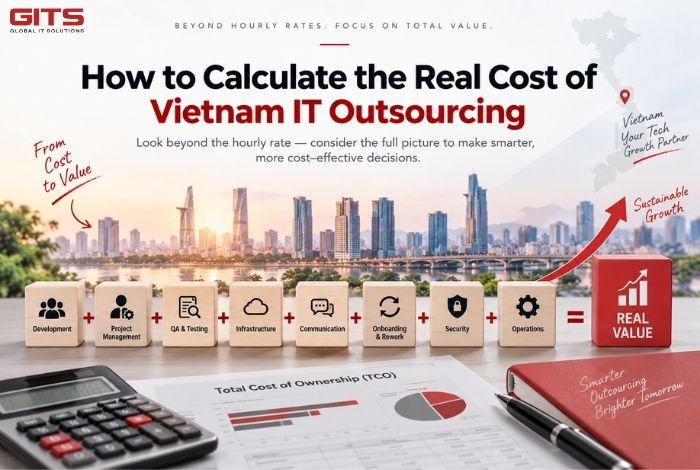
The Real Value Behind Vietnam IT Outsourcing Cost
Vietnam IT outsourcing cost should never be evaluated by hourly rate alone.
The real cost is determined by the entire delivery ecosystem: engineering expertise, project governance, QA, communication, security, infrastructure, scalability and ultimately the business outcome.
For companies in Japan, Korea and global markets, the opportunity is evolving from simply accessing lower-cost developers to building AI-enabled, scalable and outcome-driven technology capabilities.
The right outsourcing partner should therefore answer three questions clearly:
What are we paying for?
What risks are included or excluded?
What measurable business value will the investment create?
When these questions are answered before the contract is signed, Vietnam IT outsourcing becomes more than a way to reduce development expenses. It becomes a strategic model for accessing Technical Solutions, AI Services, Agentic AI and scalable engineering capabilities while maintaining control over quality, security and long-term digital transformation.

Frequently Asked Questions
How much does IT outsourcing cost in Vietnam?
Vietnam IT outsourcing rates commonly range from around US$15 to US$70+ per hour depending on seniority, role, technology and engagement model. AI, Cloud and senior engineering roles generally cost more.
Is Vietnam cheaper than hiring an in-house development team?
It can reduce recruitment, infrastructure and operational costs, but the actual benefit depends on project complexity, management requirements and the outsourcing model. Total cost of ownership is more meaningful than salary comparison alone.
What increases Vietnam IT outsourcing cost?
Specialized expertise, senior engineers, AI/ML development, Cloud architecture, project management, security requirements, communication support and complex integrations can increase the final cost.
Is Vietnam suitable for AI and Agentic AI projects?
Vietnam’s outsourcing ecosystem increasingly covers AI, Cloud, data engineering and other advanced technologies. The suitability of a specific provider depends on its technical expertise, AI delivery experience, security capabilities and ability to integrate AI into enterprise workflows.