





Industrial workplaces are becoming increasingly automated, yet one challenge remains difficult to eliminate: work-related musculoskeletal disorders (MSDs) caused by repetitive movements and improper working postures.
Manufacturers, logistics providers, warehouses, and production facilities across Japan, South Korea, Vietnam, and other global markets continue to experience productivity losses, compensation costs, and workforce shortages due to ergonomic injuries.
Traditional ergonomic assessments rely heavily on manual observation, making them time-consuming, subjective, and difficult to scale across multiple production lines.
Recent advances in AI Computer Vision now enable organizations to continuously monitor workplace posture, automatically evaluate ergonomic risks, and provide real-time feedback before injuries occur.
This case study demonstrates how GITS developed an AI-powered ergonomic assessment system that combines Computer Vision, Pose Estimation, and internationally recognized ergonomic standards to help enterprises improve occupational safety.
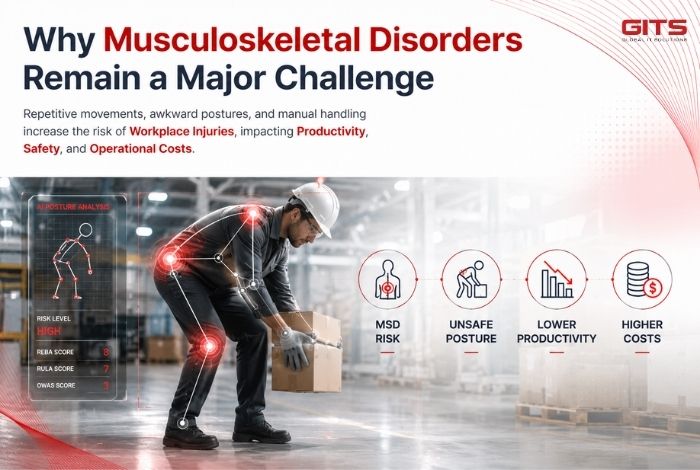
Why Musculoskeletal Disorders Remain a Major Challenge
Musculoskeletal disorders are among the leading causes of workplace injuries worldwide.
Employees working in manufacturing, assembly lines, warehouses, construction sites, and logistics operations often perform repetitive motions or maintain awkward postures for extended periods.
These conditions frequently result in:
– Lower workforce productivity
– Increased absenteeism
– Higher healthcare expenses
– Rising insurance and compensation costs
– Reduced operational efficiency
– Difficulties complying with occupational safety regulations
For organizations operating hundreds or thousands of workstations, manual ergonomic inspections cannot provide continuous monitoring or consistent evaluation.
This creates a strong demand for AI-driven workplace safety solutions capable of operating in real time.
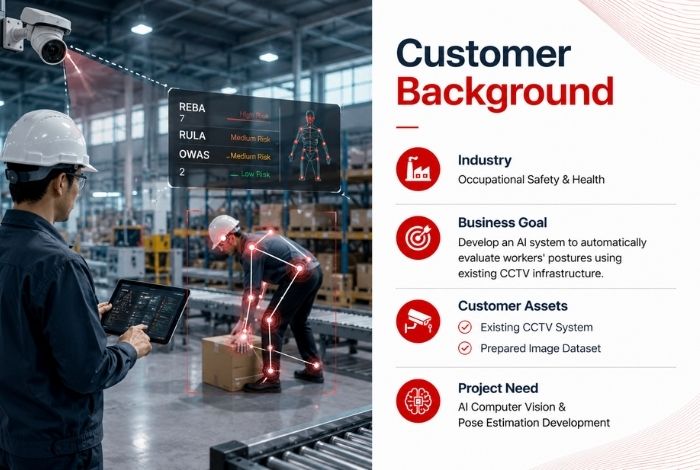
Customer Background
The customer is a South Korean company specializing in occupational safety and industrial health solutions.
Their objective was to build an intelligent system capable of evaluating workers’ postures automatically using existing surveillance cameras.
The organization had already collected image datasets representing various working positions but required an experienced AI development partner to design and implement the complete Computer Vision solution.
The project focused on creating an AI system capable of:
– Detecting human body keypoints
– Evaluating working posture continuously
– Measuring ergonomic risks automatically
– Displaying assessment results in real time
Technical Challenges
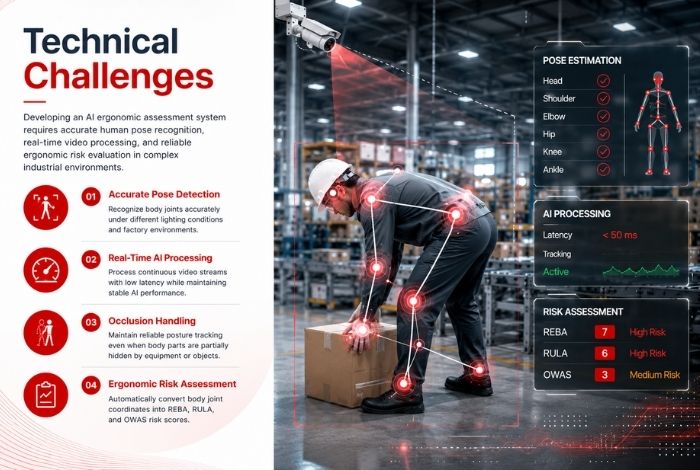
Developing an ergonomic AI system involves much more than detecting a person in an image.
The system must accurately estimate body posture under different working conditions while maintaining high inference speed for real-time operation.
Major technical challenges included:
– Accurate human pose estimation under varying lighting conditions
– Detecting partially occluded body joints
– Processing continuous video streams with low latency
– Converting skeletal coordinates into ergonomic assessment scores
– Supporting multiple international ergonomic evaluation methods
– Maintaining stable AI performance across different worker body types and environments
Meeting these requirements demanded both advanced Computer Vision expertise and deep knowledge of occupational ergonomics.
AI Ergonomic Assessment System Powered by Computer Vision
Human Pose Estimation Using AI
The core of the solution utilizes TensorFlow MoveNet Pose Estimation, enabling the AI model to identify key body joints from live camera feeds.
Instead of simply recognizing a person, the AI continuously tracks skeletal movements, including:
– Head
– Neck
– Shoulders
– Elbows
– Wrists
– Spine
– Hips
– Knees
– Ankles
These skeletal landmarks provide the foundation for ergonomic risk analysis.
AI Ergonomic Assessment System Based on International Standards
Once body joints are detected, the system automatically calculates posture scores using internationally recognized ergonomic methodologies.
Supported assessment standards include:
REBA (Rapid Entire Body Assessment)
Evaluates overall body posture to identify high-risk manual handling activities.
RULA (Rapid Upper Limb Assessment)
Focuses on upper body posture, particularly the neck, shoulders, arms, and wrists.
OWAS (Ovako Working Posture Analysis System)
Analyzes working postures involving the back, arms, legs, and external loads.
Using multiple assessment standards allows organizations to obtain comprehensive ergonomic insights across diverse work environments.
Real-Time Risk Detection
The AI continuously processes live camera streams and immediately identifies unsafe working postures.
The system displays:
– REBA score
– RULA score
– OWAS score
– Joint angles
– Working duration
– Load information
– Overall ergonomic risk level
Supervisors can instantly identify high-risk situations without manually reviewing video footage.
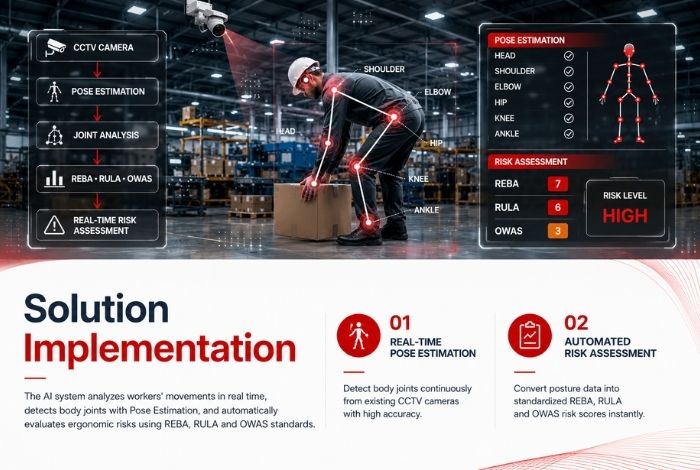
Solution Implementation
The project was delivered through a structured AI development process.
System Design
The development team analyzed customer requirements, workplace conditions, and ergonomic evaluation criteria before designing the AI architecture.
AI Model Development
TensorFlow MoveNet was integrated to perform real-time human pose estimation.
Custom algorithms were then developed to convert body joint coordinates into ergonomic scores based on REBA, RULA, and OWAS methodologies.
User Interface Development
A Flutter-based application was created to visualize:
– Live camera streams
– Human skeletal overlays
– Ergonomic scores
– Risk indicators
– Real-time alerts
This enabled safety managers to monitor workplace conditions through an intuitive interface.
Measurable Business Outcomes
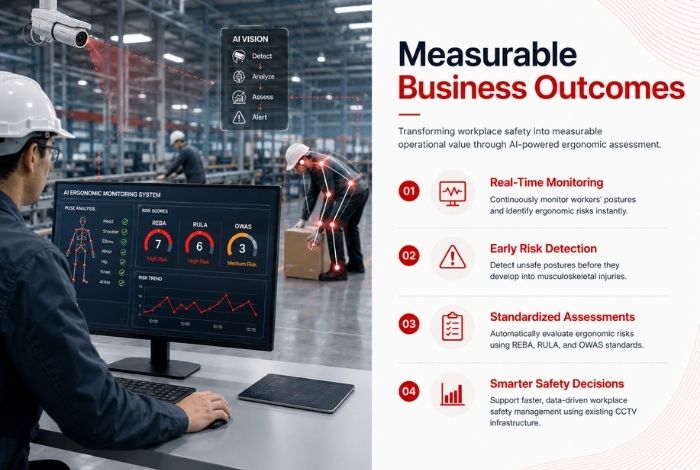
The AI Ergonomic Assessment System provides measurable operational improvements for industrial organizations.
Improved Workplace Safety
Continuous posture monitoring enables early detection of hazardous working behaviors before injuries occur.
Faster Ergonomic Assessments
Manual ergonomic evaluations that previously required specialists can now be completed automatically in real time.
Standardized Risk Evaluation
All workers are assessed consistently using internationally accepted ergonomic standards.
Better Regulatory Compliance
Organizations gain objective ergonomic data that supports occupational safety documentation and compliance initiatives.
Scalable Deployment
The solution can be integrated into existing CCTV infrastructure, making deployment feasible across factories, warehouses, and production facilities without significant hardware investments.
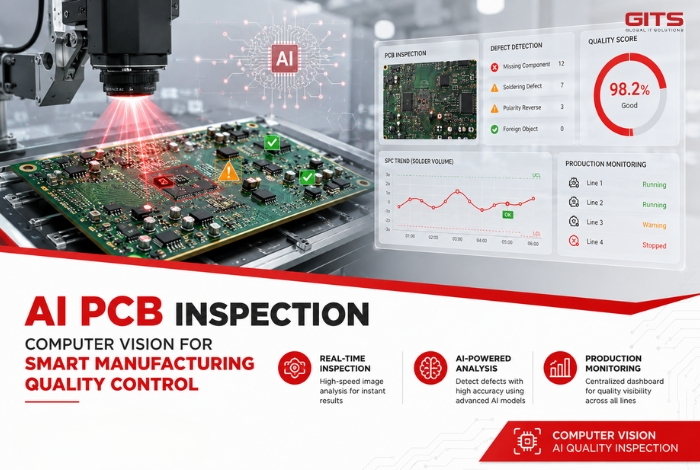
>>> See More: AI PCB Inspection: Computer Vision for Smart Manufacturing Quality Control
Project Scope and Timeline
The project followed a structured implementation roadmap.
Development Process
– Planning
– System Design
– AI Development
– Testing
Project Duration
Planning: 3 months
Testing: 1 month
Technology Stack
– TensorFlow
– MoveNet Pose Estimation
– Computer Vision
– Flutter
– AI Vision
Industries That Benefit from AI Ergonomic Assessment
This solution is particularly valuable for organizations with repetitive manual operations, including:
– Manufacturing
– Automotive
– Electronics Assembly
– Warehousing
– Logistics
– Construction
– Healthcare
– Food Processing
– Heavy Industry
For enterprises facing labor shortages and increasing workplace safety requirements, AI-powered ergonomic monitoring provides a scalable approach to improving worker wellbeing while enhancing operational efficiency.
AI is transforming how businesses manage workplace safety
As workplace safety becomes a strategic priority across Japan, South Korea, Vietnam, and global manufacturing markets, AI Ergonomic Assessment System represents a significant advancement in occupational health management.
By combining Computer Vision, Pose Estimation, and internationally recognized ergonomic assessment standards such as REBA, RULA, and OWAS, organizations can transform manual workplace inspections into an intelligent, real-time monitoring system.
Beyond reducing the risk of musculoskeletal disorders, AI-driven ergonomic assessment empowers enterprises to improve productivity, strengthen compliance, and build safer, smarter industrial workplaces.