






“Where is my order?” may sound like a simple customer question. For logistics, eCommerce and retail enterprises, however, it can become one of the largest sources of repetitive customer support workload.
WISMO, short for “Where Is My Order?”, refers to customer inquiries about order status, shipment tracking, delivery delays and expected arrival times. Current industry sources consistently identify WISMO as one of the most frequent eCommerce support requests, with some estimates placing it at 18% to 50% of inbound support volume depending on the business and peak period.
This is where a WISMO AI Agent can transform customer service from reactive ticket handling into intelligent, automated logistics support.
Why WISMO Becomes a Costly Problem for Enterprises
Traditional customer support often requires an agent to repeat the same workflow:
Customer asks about an order → support identifies the order → checks the OMS → opens carrier tracking → interprets the status → writes a response.
The information already exists. The problem is that it is fragmented across OMS, WMS, TMS, ERP, eCommerce platforms and carrier systems.
During promotional campaigns, seasonal peaks or unexpected delivery disruptions, this repetitive workload can grow rapidly. Support teams spend valuable time answering routine questions instead of handling exceptions, customer complaints and high-value relationship management.
For businesses operating across Japan, Korea and global markets, the challenge becomes even more complex because customers expect fast responses across multiple channels and languages.
What Is a WISMO AI Agent?
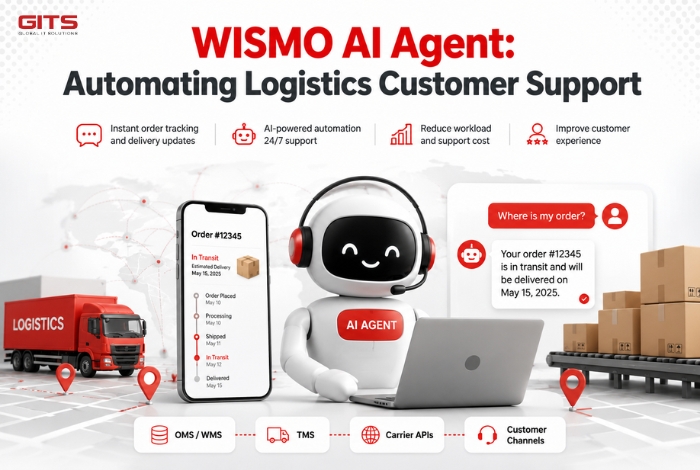
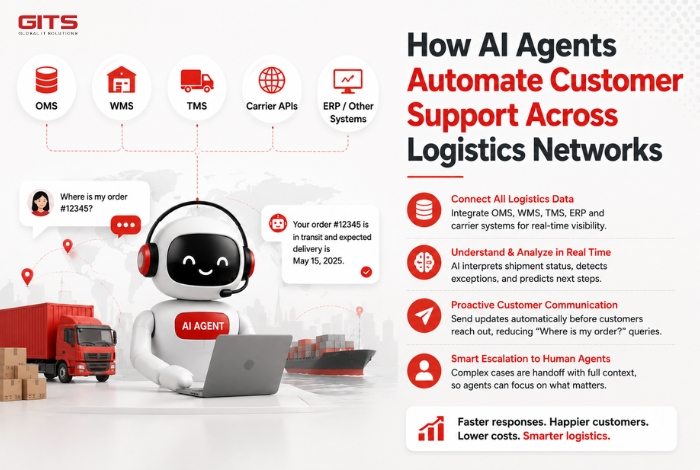
A WISMO AI Agent is an AI-powered customer service agent designed to autonomously understand order-status inquiries, retrieve real-time logistics information and provide a contextual response.
Unlike a conventional chatbot that simply displays a tracking link, an AI Agent can connect business systems and perform a multi-step reasoning workflow.
For example:
- Identify the customer and relevant order.
- Retrieve real-time order and shipment information.
- Check carrier and logistics events.
- Interpret whether the shipment is progressing normally or experiencing an exception.
- Generate a personalized response.
- Escalate the case when human judgment is required.
Modern implementations demonstrate this approach by connecting AI Agents with OMS and carrier APIs to resolve WISMO inquiries while routing genuine exceptions to human teams.
The key difference is simple: the AI Agent does not only answer the question. It understands the operational context behind the question.
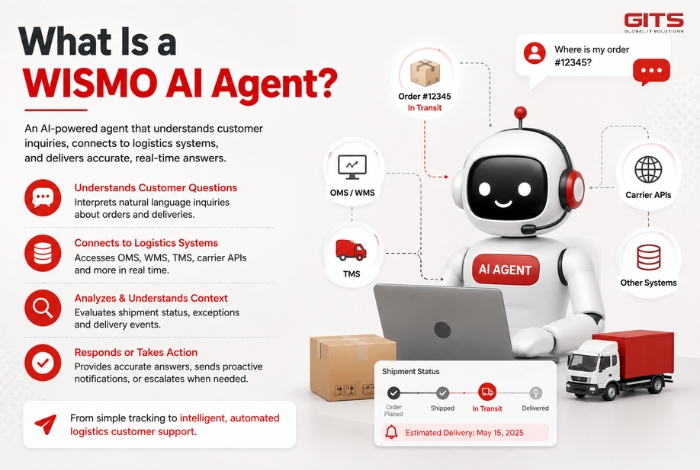
How AI Agents Automate Customer Support Across Logistics Networks
A scalable WISMO AI Agent operates as an intelligent layer between customers and the enterprise logistics ecosystem.
1. Connect fragmented logistics data
The Agent can retrieve information from OMS, WMS, TMS, ERP, eCommerce platforms and carrier APIs.
This creates a unified source of operational context, allowing the customer to receive an answer based on current shipment data rather than static knowledge.
Reliable data is critical. An AI system connected to inaccurate or outdated logistics information can create incorrect answers and damage customer trust.
2. Understand delivery status, not just tracking codes
A shipment marked “In Transit” does not always mean everything is normal.
An Agentic AI workflow can evaluate events such as delayed scans, failed delivery attempts, carrier exceptions or prolonged inactivity and determine whether the situation requires proactive communication.
Instead of saying:
“Your order is in transit.”
The Agent can explain what is happening and provide the next expected action.
3. Automate proactive customer communication
The best WISMO strategy is not waiting for customers to ask.
AI Agents can trigger notifications when an order is shipped, approaching delivery, delayed or affected by an exception. This turns customer support from reactive response into proactive service.
For high-volume eCommerce and logistics operations, proactive communication can significantly reduce unnecessary WISMO interactions.
4. Escalate exceptions intelligently
Not every issue should be automated.
Lost packages, damaged shipments, address problems, refund disputes and complex delivery failures may require human intervention.
A well-designed AI Solution should therefore follow an AI-to-human escalation model. The Agent resolves predictable requests independently and transfers complex cases together with order information, tracking history and conversation context.
This allows human agents to focus on decisions rather than data collection.
>>> See More: Inventory AI Agent: Prevent Stockouts & Overstock
Why WISMO AI Agents Matter for Japan, Korea and Global Enterprises
Customer expectations are changing rapidly. In Japan and Korea, enterprise customers increasingly expect reliable digital services, fast responses and consistent communication across multiple touchpoints.
Meanwhile, global eCommerce companies must support customers across languages, time zones, carriers and logistics networks.
This makes AI Services and Agentic AI particularly valuable for enterprises that need to scale customer support without continuously increasing headcount.
The opportunity is not simply reducing support tickets. It is building an intelligent customer experience layer connected directly to operational data.
For logistics providers, retailers and manufacturers, this can also create a feedback loop: WISMO conversations reveal recurring delivery problems, carrier performance issues and customer pain points that can be used to improve operations.
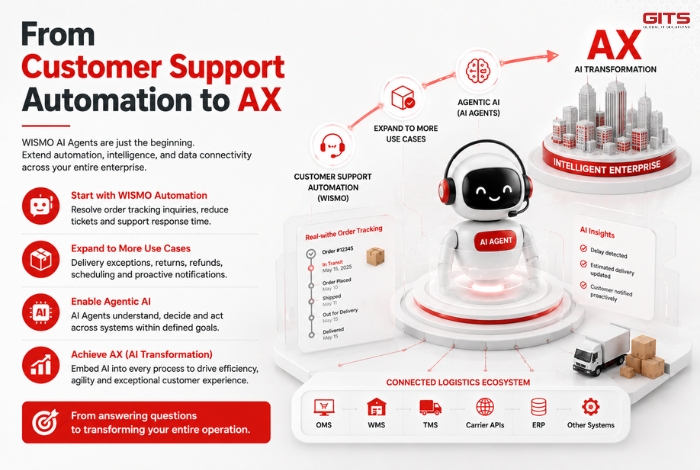
From Customer Support Automation to AX
WISMO is only the starting point.
Once enterprises successfully connect AI Agents with operational systems, the same architecture can support additional use cases such as delivery exception management, returns, refund status, shipment scheduling and proactive customer notifications.
This creates a broader path toward AX, or AI Transformation, where AI becomes an operational layer across the enterprise rather than an isolated chatbot.
The long-term objective is not to replace customer service teams. It is to give them an intelligent system that handles repetitive work, understands operational context and knows when human expertise is needed.

WISMO AI Agents Turn Logistics Support Into an Intelligent Operation
“Where is my order?” is a small question with a large operational impact.
A WISMO AI Agent can connect customer conversations with real-time logistics data, automate routine inquiries, identify delivery exceptions and proactively communicate with customers.
For enterprises across Japan, Korea, Vietnam and global markets, this represents a practical entry point into AI Agents, Agentic AI and AX.
The next generation of logistics customer support will not simply respond faster.
It will understand the shipment, predict the problem and act before the customer needs to ask.