






Modern logistics operations are becoming too complex for disconnected systems and manual decision-making. Orders change in real time, inventory moves across multiple locations, transportation capacity fluctuates, and customers expect accurate delivery information at every stage.
Yet many enterprises still operate Order Management Systems (OMS), Warehouse Management Systems (WMS), and Transportation Management Systems (TMS) as separate platforms. Each system manages its own processes, but the decisions made in one system may not immediately influence the others.
This creates a critical gap between data visibility and operational action.
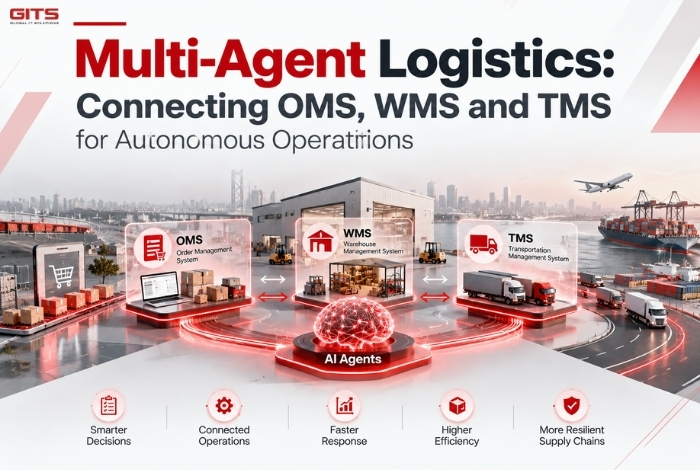
Multi-Agent Logistics offers a new approach. By combining AI Agents, Agentic AI and multi-agent coordination, enterprises can connect OMS, WMS and TMS into a more intelligent operational network where specialized agents monitor events, exchange information, make decisions and trigger actions according to predefined business goals.
Why Traditional Logistics Systems Are No Longer Enough
OMS, WMS and TMS have become essential technologies for modern distribution operations. However, simply implementing these systems does not automatically create an intelligent supply chain.
Consider a common scenario.
An OMS receives an urgent customer order. The WMS shows that the nearest warehouse has insufficient inventory, while another facility has available stock. At the same time, the TMS indicates that transportation capacity from the second facility is limited.
In a conventional architecture, these events may remain distributed across different systems. A planner or logistics manager must identify the problem, compare alternatives and coordinate the response manually.
The result can be delayed fulfillment, unnecessary transportation costs, excess inventory movement and poor customer experience.
The challenge is no longer only system integration. Enterprises need systems that can understand operational context and coordinate decisions across multiple domains.
Research into multi-agent systems has increasingly explored this model as a foundation for more autonomous and resilient supply chains.
What Is Multi-Agent Logistics?
Multi-Agent Logistics is an architecture in which multiple specialized AI Agents collaborate to manage different logistics decisions while sharing operational context.
Instead of relying on one AI model to control the entire supply chain, each agent can focus on a specific business function.
For example:
– Order Agent: monitors incoming orders, priorities and customer commitments.
– Inventory Agent: evaluates stock availability, allocation and replenishment requirements.
– Warehouse Agent: coordinates picking, packing, staging and warehouse capacity.
– Transportation Agent: evaluates carriers, routes, capacity and delivery schedules.
– Exception Agent: detects disruptions and coordinates corrective actions.
– Customer Service Agent: generates proactive shipment and delivery updates.
These agents can communicate through an orchestration layer, allowing decisions in one domain to influence decisions in another.
This distributed architecture is particularly relevant to supply chains because logistics decisions are inherently interconnected and often involve multiple actors with different objectives.
Connecting OMS, WMS and TMS Through AI Agents
The real value of Multi-Agent Logistics emerges when AI Agents connect operational decisions across OMS, WMS and TMS.
From Order to Delivery: One Continuous Decision Loop
Imagine a customer places an order through an e-commerce channel.
The Order Agent first evaluates the order priority, delivery commitment and customer requirements. It then communicates with the Inventory Agent to identify the optimal fulfillment location.
If the preferred warehouse cannot fulfill the order, the agent can evaluate alternative facilities.
The Warehouse Agent then determines whether the selected warehouse has sufficient picking and packing capacity. Once fulfillment is confirmed, the Transportation Agent evaluates available carriers, routes, delivery windows and transportation costs.
If traffic congestion or a carrier disruption occurs, the system can detect the exception and reassess the delivery plan.
Instead of treating order management, warehouse execution and transportation as independent processes, the organization creates a continuous decision loop:
Order → Inventory → Warehouse → Transportation → Delivery → Feedback
This is where logistics automation moves beyond workflow automation toward autonomous operations.
How Agentic AI Changes Logistics Decision-Making
Traditional automation generally follows predefined rules: when condition A occurs, execute action B.
Agentic AI introduces a different operating model. AI Agents can interpret context, evaluate available information, pursue defined objectives and coordinate actions within established guardrails.
For logistics companies, this can transform how exceptions are handled.
For example, when a shipment is predicted to miss its delivery window, an Agentic AI architecture could:
1. Detect the potential delay.
2. Identify the affected orders and customer commitments.
3. Check alternative transportation capacity.
4. Evaluate inventory or fulfillment alternatives.
5. Estimate cost and service impact.
6. Recommend or execute an approved corrective action.
7. Update relevant systems and stakeholders.
Recent industry implementations demonstrate the potential for AI Agents to aggregate data from ERP, WMS, TMS and customer-facing systems to reduce manual information lookup and reconciliation.
The key difference is that AI becomes part of the decision and execution layer, rather than simply generating reports.

The Business Value of Multi-Agent Logistics
For enterprises operating large distribution networks, the benefits extend beyond automation.
1. Faster exception resolution
Disruptions such as stock shortages, carrier delays and capacity constraints can be identified and addressed earlier.
2. Better inventory and transportation coordination
Inventory decisions can consider transportation availability and delivery requirements instead of being optimized in isolation.
3. Lower operational workload
AI Agents can handle repetitive monitoring, data reconciliation and routine decision processes, allowing logistics teams to focus on complex exceptions and strategic planning.
4. Greater supply chain visibility
Instead of viewing OMS, WMS and TMS as separate dashboards, organizations can create a connected operational picture across the order-to-delivery lifecycle.
5. More resilient operations
Multi-agent architectures are designed for environments where information is distributed and conditions change continuously. Research has identified applications ranging from automated rescheduling and warehouse planning to disruption management and transportation route replanning.
Building a Multi-Agent Logistics Architecture
Implementing autonomous logistics does not mean replacing existing OMS, WMS or TMS platforms.
A more practical approach is to build an AI orchestration layer on top of existing enterprise systems.
A typical architecture can include:
Enterprise Systems → Unified Data Layer → AI Agent Layer → Agent Orchestration → Business Applications
The AI layer can connect APIs, operational databases, IoT data, customer platforms and external information sources.
However, autonomy must be introduced with appropriate governance. AI Agents should operate within clearly defined permissions, business rules, approval thresholds and audit mechanisms.
This is especially important when agents can trigger operational actions rather than simply provide recommendations. Recent research also highlights validation and fallback mechanisms as important safeguards when combining LLM-based reasoning with multi-agent logistics execution.
>>> See More: Order Management System: Connect Orders & Fulfillment
From Digital Transformation to Autonomous Operations
For enterprises in Japan, Korea, Vietnam and global markets, the next stage of logistics transformation is not simply adding another software platform.
The opportunity lies in creating an intelligent operational ecosystem where existing systems can sense, reason, coordinate and act.
OMS manages the order.
WMS manages the warehouse.
TMS manages transportation.
Multi-Agent Logistics connects the intelligence between them.
With AI Agents and Agentic AI working across these operational domains, enterprises can move from fragmented automation toward a more adaptive model of autonomous logistics operations.
The Future of Logistics Is Connected Intelligence
The future of distribution management will not be defined by a single AI model or another standalone application. It will be shaped by how effectively enterprises connect data, systems and decisions across the entire logistics network.
Multi-Agent Logistics provides a path toward that connected intelligence.
By orchestrating AI Agents across OMS, WMS and TMS, organizations can transform fragmented operational processes into a continuous decision-making system that responds to demand, inventory, warehouse and transportation changes in real time.
For enterprises looking to advance beyond conventional automation, the next question is no longer simply “How can we automate this process?”
It is:
“How can our logistics systems work together to make and execute better decisions?”
That is the foundation of autonomous operations—and a key direction for the next generation of AI-powered Distribution Management and Supply Chain Transformation.