






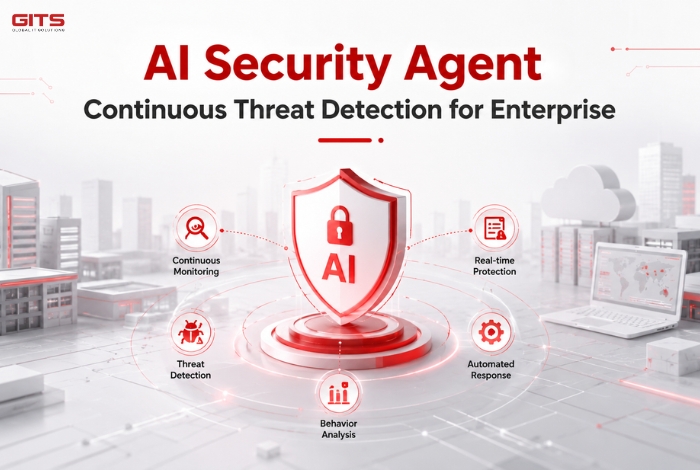
As enterprises accelerate AI adoption, cybersecurity is facing a new challenge: AI agents are no longer passive tools. They can access data, call APIs, make decisions and execute actions autonomously. This creates an attack surface that traditional security monitoring cannot always observe or control in real time.
An AI Security Agent addresses this gap by continuously monitoring enterprise environments, detecting abnormal behavior and helping security teams investigate and respond to threats at machine speed.
For organizations in Japan, Korea and global markets, where operational continuity, data protection and compliance are critical, AI-powered security is becoming an essential component of enterprise AI transformation.
Why Traditional Security Is Not Enough for AI-Driven Enterprises
Conventional cybersecurity typically relies on predefined rules, periodic assessments and human-led investigation. These approaches remain important, but they can struggle when enterprise systems become increasingly dynamic and AI-driven.
AI agents can interact with multiple applications, cloud environments, databases and external services. A compromised credential, malicious prompt or abnormal tool call could therefore propagate across several systems before a security team identifies the incident.
The challenge is no longer simply “Can we detect a cyberattack?” It is increasingly “Can we understand what an autonomous AI system is doing while it is happening?”
Recent industry research highlights this shift. Enterprises are moving toward runtime monitoring, behavioral anomaly detection, activity traceability and automated enforcement for AI agents rather than relying only on traditional alerts.
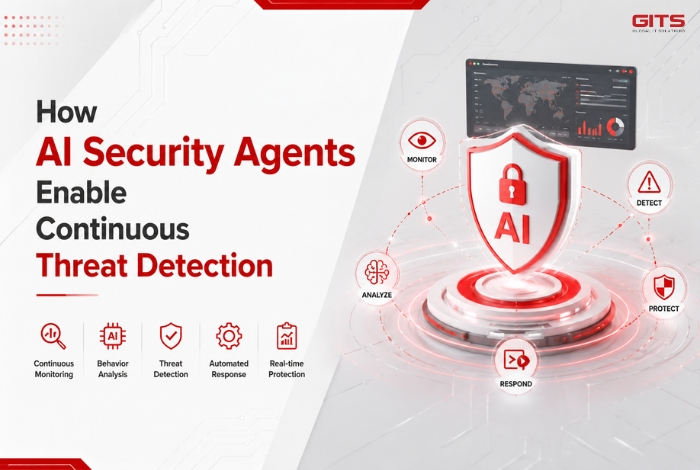
How AI Security Agents Enable Continuous Threat Detection
An AI Security Agent works as an intelligent security layer capable of observing, analyzing and responding to activity across enterprise environments.
Instead of waiting for a security alert, the agent continuously evaluates signals such as user behavior, API calls, access patterns, system events and AI-agent actions.
A typical AI security workflow includes:
– Continuous monitoring: Collect signals from applications, endpoints, cloud infrastructure, identities and AI agents.
– Behavior analysis: Establish normal activity patterns and identify deviations that may indicate threats.
– Contextual investigation: Correlate events across systems to understand the potential impact of an incident.
– Risk assessment: Prioritize threats based on business context, data sensitivity and potential blast radius.
– Automated response: Trigger predefined actions such as blocking access, isolating an agent or escalating an incident to security teams.
This agentic approach allows organizations to move from reactive monitoring toward proactive and continuous security operations. Microsoft similarly describes agentic AI in cybersecurity as autonomous capabilities that can detect, investigate and respond to threats with minimal human intervention.
Key Capabilities of an AI Security Agent
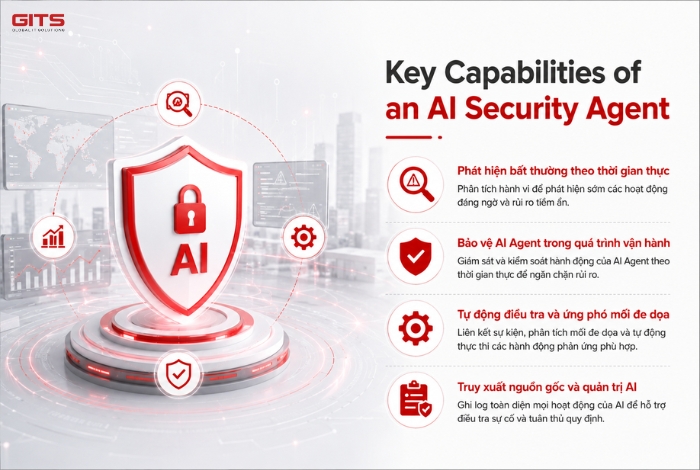
Real-Time Behavioral Anomaly Detection
Traditional signatures may fail when attackers use constantly changing techniques. AI Security Agents can instead analyze behavioral patterns and identify unusual actions, such as unexpected privilege use, abnormal API activity or an AI agent suddenly accessing sensitive resources.
Runtime Protection for AI Agents
Security must extend beyond the initial authentication stage. An AI agent may be legitimately authorized but still behave unexpectedly during execution.
Runtime monitoring enables organizations to evaluate an agent’s actions continuously and enforce policies before high-risk activity affects critical systems.
Automated Threat Investigation and Response
AI Agents can correlate security events, investigate suspicious activity and recommend or execute remediation workflows. This reduces repetitive SOC workloads and allows human analysts to focus on complex incidents and strategic decisions.
Modern agentic SOC approaches are already applying AI to alert triage, threat hunting and detection engineering.
Traceability and AI Security Governance
Enterprise adoption also requires visibility into who or what performed an action, which tools were accessed, what data was processed and why the action occurred.
Comprehensive activity logging and traceability can support security investigations, compliance requirements and governance across AI Services and enterprise systems.
>>> See More: Knowledge AI Agent: From Documents to Business Intelligence
AI Security Agent Use Cases Across Industries
The value of AI-powered security extends beyond IT departments.
– Manufacturing: Monitor industrial networks, connected devices and AI-driven production systems for abnormal behavior.
– Financial services: Detect suspicious transactions, unauthorized access and anomalous agent activity involving sensitive financial data.
– Healthcare: Protect patient information and monitor AI applications interacting with clinical or administrative systems.
– Retail and e-commerce: Identify account abuse, payment anomalies and suspicious activity across customer-facing platforms.
– Enterprise IT: Continuously monitor cloud infrastructure, identities, APIs and AI Agents while accelerating SOC operations.
For Japanese and Korean enterprises in particular, this approach can support AI transformation while maintaining the operational reliability, governance and security controls expected in enterprise environments.

From AI Adoption to Secure AI Transformation
The rise of Agentic AI changes the security equation. Enterprises are no longer securing only applications, employees and devices. They must also secure non-human identities and autonomous systems capable of taking real-world actions.
This creates a new opportunity for organizations to combine AI Services, Technical Solutions and AI Security into a unified security architecture.
The goal is not to eliminate AI autonomy. It is to make that autonomy observable, governed and controllable.
Build Enterprise Security That Never Stops
As AI Agents become embedded in critical business workflows, periodic security checks are no longer enough. Enterprises need continuous visibility into what their AI systems are doing and the ability to detect and respond to threats in real time.
An AI Security Agent provides this next layer of defense by combining continuous monitoring, behavioral intelligence, runtime protection, automated investigation and human oversight.
For enterprises preparing for the next stage of AI Transformation and AX, continuous AI security is not simply a technical upgrade. It is the foundation for deploying autonomous intelligence with confidence, resilience and control.