






Every enterprise has valuable knowledge hidden inside documents, wikis, SOPs, emails, reports, databases, and internal systems. Yet having information is not the same as being able to use it.
Employees may spend hours searching for the latest policy. Managers may rely on outdated reports. Customer service teams repeatedly ask the same internal questions, while critical expertise remains trapped inside individual departments.
This is where a Knowledge AI Agent changes the role of enterprise documentation.
Instead of simply storing information or returning search results, it can understand business context, retrieve relevant knowledge, synthesize information, and turn fragmented documentation into actionable business intelligence.
Why Enterprise Knowledge Is Becoming a Business Challenge
As organizations grow, their knowledge ecosystem becomes increasingly complex.
A manufacturing company may have technical manuals, quality standards, production procedures, and maintenance records stored across different systems. A logistics enterprise may manage shipment policies, warehouse SOPs, customer contracts, and operational reports across multiple platforms.
The problem is not a lack of data. The problem is knowledge fragmentation.
Traditional enterprise search often requires employees to know where information is stored and what keywords to use. Even when the correct document is found, employees still need to read, compare, interpret, and decide.
This creates hidden operational costs:
• Time lost searching for information
• Repeated questions across departments
• Inconsistent decisions based on different documents
• Knowledge silos between teams and locations
• Difficulty identifying outdated or conflicting information
• Slow onboarding of new employees
For enterprises operating across Japan, Korea, Vietnam, and global markets, these challenges become even more significant when knowledge exists in multiple languages and business environments.

What Is a Knowledge AI Agent?
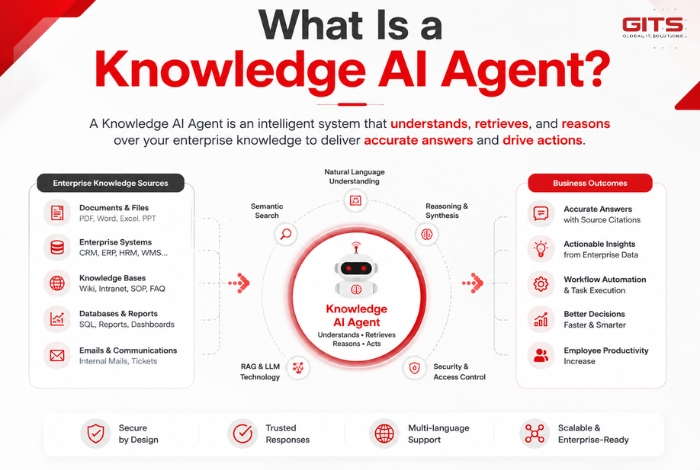
A Knowledge AI Agent is an AI-powered system designed to understand, retrieve, reason over, and act on enterprise knowledge.
Unlike a conventional chatbot, it does not depend only on a predefined FAQ database. It can connect with internal knowledge sources such as:
• SharePoint, Google Drive, Confluence, Notion, and internal portals
• PDFs, Word documents, spreadsheets, manuals, and SOPs
• CRM, ERP, WMS, TMS, HRM, and other enterprise systems
• Databases, knowledge bases, and operational reports
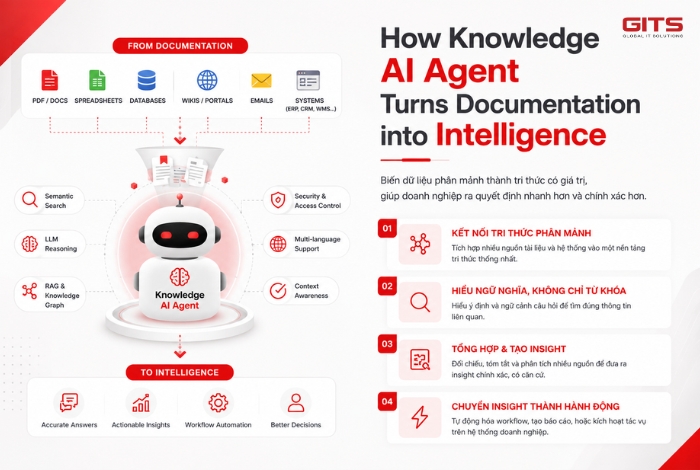
Using technologies such as Retrieval-Augmented Generation (RAG), semantic search, knowledge graphs, LLMs, and Agentic AI, the agent can retrieve relevant information and generate responses grounded in enterprise data.
Modern enterprise knowledge solutions increasingly emphasize source citations, access permissions, outdated-content detection, and the ability to acknowledge when authoritative information does not exist.
How Knowledge AI Agent Turns Documentation into Intelligence
The real value is not simply “asking AI a question.”
The transformation happens across four stages.
1. Connect fragmented enterprise knowledge
The agent brings information from multiple repositories into a unified knowledge layer without requiring employees to manually search every system.
2. Understand context, not just keywords
Semantic retrieval enables the system to understand the meaning behind a question and identify relevant information even when employees use different terminology.
3. Synthesize information into business insights
Instead of returning ten documents, the agent can compare information across sources, summarize key findings, identify conflicts, and provide evidence for its answer.
4. Move from insight to action
With Agentic AI capabilities, the system can go beyond answering questions. It can trigger workflows, prepare reports, recommend next steps, or interact with enterprise applications according to defined permissions.
This shift represents the evolution from AI Search → AI Assistant → AI Agent.
Knowledge AI Agent and the Rise of Agentic AI
Traditional generative AI primarily responds to prompts. Agentic AI introduces reasoning, planning, tool usage, and autonomous execution.
For enterprise knowledge management, this creates a more powerful model.
An employee might ask:
“Why did delivery performance decline in the Korean market last month?”
A basic AI assistant may summarize a report.
A Knowledge AI Agent can potentially combine logistics reports, customer feedback, operational policies, and historical data to identify contributing factors, provide supporting sources, and recommend operational actions.
This is why enterprise knowledge is becoming a foundational layer for Agentic AI. Recent enterprise AI research also emphasizes that organizations need to prepare and structure their knowledge before agents can reliably reason and execute workflows at scale.
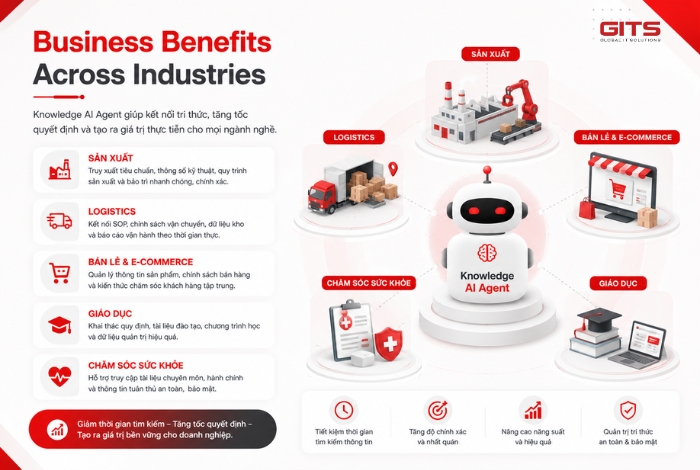
Business Benefits Across Industries
A well-designed Knowledge AI Agent can support multiple enterprise functions.
– Manufacturing: Retrieve machine manuals, quality standards, maintenance procedures, and production knowledge.
– Logistics: Analyze SOPs, shipment policies, warehouse procedures, and operational data.
– Healthcare: Support access to clinical, administrative, and compliance documentation with appropriate governance.
– Retail & E-commerce: Unify product information, operational policies, customer service knowledge, and internal guidelines.
– Education: Connect institutional knowledge, academic documents, policies, and administrative information.
The common objective is simple: reduce the time employees spend searching for knowledge and increase the time they spend applying it.
>>> See More: AI Agents Explained: The Complete Guide to Agentic AI & Enterprise Applications
What Enterprises Need Before Deploying AI Agents
AI cannot create reliable intelligence from unreliable knowledge.
Before implementing a Knowledge AI Agent, enterprises should establish:
1. Knowledge readiness: Identify fragmented, duplicated, outdated, and conflicting content.
2. Data governance: Define ownership, permissions, version control, and access policies.
3. AI-ready architecture: Connect documents, databases, applications, APIs, and enterprise systems.
4. Security: Protect sensitive information through role-based access, audit logs, and controlled AI interactions.
5. Continuous optimization: Monitor knowledge quality and update content as business processes change.
Industry research increasingly highlights that enterprise knowledge management requires a portfolio of connected capabilities rather than relying on a single application.

From Enterprise Documentation to Business Intelligence
The future of enterprise knowledge management is not another document repository.
It is an intelligent knowledge layer that allows employees, AI assistants, and autonomous agents to access trusted organizational knowledge and transform it into decisions and actions.
A Knowledge AI Agent can become the bridge between internal documentation and enterprise intelligence: connecting fragmented information, understanding business context, generating evidence-based insights, and eventually orchestrating workflows.
For organizations preparing their AI Transformation, AX, or Agentic AI strategy, knowledge readiness should therefore be treated as a strategic priority rather than an IT housekeeping task.
The companies that organize their knowledge today will be better positioned to build intelligent, scalable, and trustworthy AI operations tomorrow.