






Artificial Intelligence is rapidly evolving from generating content to executing real business tasks autonomously. While Large Language Models (LLMs) and Generative AI excel at answering questions or creating text, enterprises increasingly require AI systems that can understand objectives, make decisions, and complete complex workflows with minimal human intervention.
This is where AI Agents and Agentic AI come into play.
An AI Agent is more than an intelligent chatbot. It can analyze context, reason through multiple steps, access enterprise systems, use external tools, and continuously improve based on feedback. Instead of simply responding to prompts, AI Agents work toward achieving measurable business goals, making them a key driver of AI Transformation (AX) across industries.
As organizations accelerate digital transformation, AI Agents are emerging as the foundation of next-generation AI Solutions, helping businesses automate operations, improve decision-making, and enhance productivity at scale.
What Is an AI Agent? The Core Differences Between Traditional Chatbots and AI Agents
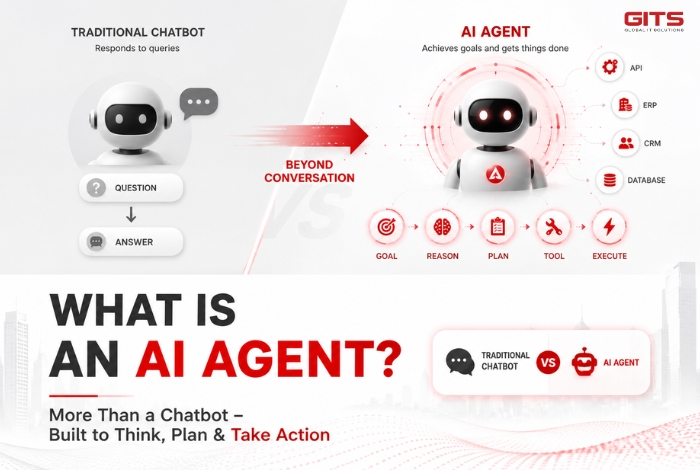
An AI Agent is an autonomous software system that can perceive its environment, reason about goals, plan actions, use external tools, and execute tasks with minimal human supervision. Unlike traditional AI applications that generate responses, AI Agents are designed to complete objectives.
The key difference lies in how they operate. A chatbot follows a simple request-and-response model, whereas an AI Agent follows an end-to-end execution process:
Goal → Reasoning → Planning → Tool Calling → Execution → Reflection → Memory
This workflow enables AI Agents to adapt to changing conditions and continuously improve future decisions.
| Traditional Chatbots | AI Agents |
|---|---|
| Respond to prompts | Execute business goals |
| Short-term conversation | Long-term contextual memory |
| Generate answers | Plan and perform actions |
| Limited integrations | Connect with APIs, databases, ERP and CRM |
| Reactive | Proactive and autonomous |
For example, a customer service chatbot can answer questions about delivery status. An AI Agent can retrieve order information, verify warehouse inventory, update shipment records, notify logistics partners, and proactively inform the customer—all within a single workflow.
This ability to combine reasoning, planning, and execution makes AI Agents a critical technology for modern enterprise automation.
Defining Agentic AI: The Next Evolution of Enterprise Intelligence
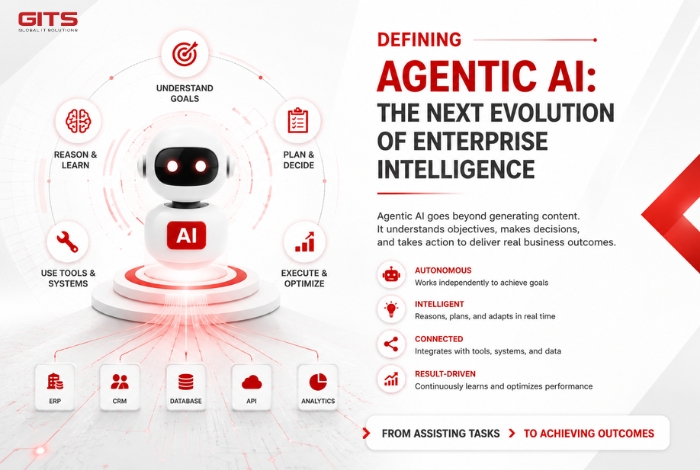
Agentic AI refers to AI systems that can autonomously pursue objectives rather than simply generate outputs. It combines large language models with memory, planning, reasoning, and tool orchestration to complete complex tasks across multiple business systems.
Unlike Generative AI, which focuses on producing text, images, or code, Agentic AI focuses on achieving outcomes.
For example, instead of asking AI to “write a marketing email,” a business can define a broader objective such as “increase customer retention.” An Agentic AI system can then analyze customer data, identify high-risk segments, generate personalized campaigns, launch automated workflows, monitor performance, and refine future actions based on results.
This shift from content generation to autonomous execution is why many technology leaders view Agentic AI as the next major milestone in enterprise AI.
Its core capabilities include:
– Goal-driven reasoning
– Long-term memory
– Multi-step planning
– Tool calling through APIs and enterprise systems
– Continuous learning through feedback
– Collaboration within Multi-Agent Systems
By combining these capabilities, Agentic AI enables organizations to move beyond isolated AI use cases and build intelligent, scalable AI Services that support enterprise-wide digital transformation.
The 4 Core Pillars of AI Agent Architecture
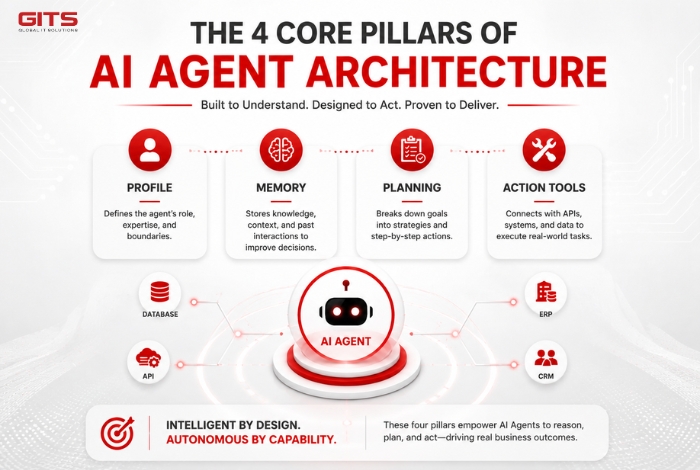
Every AI Agent relies on four essential components that enable autonomous decision-making and task execution. Together, these pillars form the foundation of modern Agentic AI.
Profile
The Profile defines an agent’s identity, expertise, objectives, and operating constraints. For example, a Sales AI Agent focuses on lead qualification and CRM management, while a Warehouse AI Agent specializes in inventory optimization and order fulfillment.
Memory
Memory allows AI Agents to retain context across interactions. Short-term memory supports ongoing tasks, while long-term memory stores business knowledge, historical data, and user preferences. This enables more accurate, personalized, and consistent decision-making.
Planning
Planning is the reasoning engine that transforms a business goal into executable steps. Before acting, an AI Agent evaluates available information, prioritizes tasks, and selects the most efficient strategy to achieve the desired outcome.
Action Tools
AI Agents become truly autonomous when connected to external systems through Tool Calling. They can interact with APIs, ERP, CRM, databases, cloud platforms, and business applications to retrieve information or execute real-world actions. This capability distinguishes AI Agents from traditional AI assistants that only generate responses.
Single-Agent vs. Multi-Agent Systems
AI Agents can operate independently or collaborate as a team, depending on the complexity of the business process.
| Single-Agent | Multi-Agent |
|---|---|
| One agent handles the entire workflow | Multiple specialized agents collaborate |
| Simple implementation | Higher scalability and flexibility |
| Best for focused tasks | Best for enterprise automation |
| Limited parallel processing | Distributed decision-making |
A Multi-Agent System may include a Planner Agent, Research Agent, Execution Agent, and Reviewer Agent working together to complete an objective. This collaborative approach improves accuracy, resilience, and scalability, making it increasingly popular in enterprise AI deployments.
>>> See More: AI Agents vs Traditional Automation: 7 Critical Differences
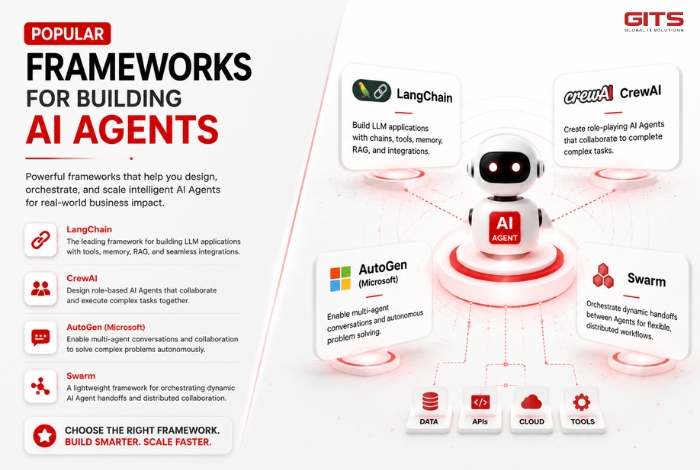
Popular Frameworks for Building AI Agents
Choosing the right framework is essential for building secure and scalable AI Solutions.
CrewAI is designed for role-based collaboration between multiple AI Agents, making it ideal for business workflows that require teamwork.
LangChain provides a comprehensive ecosystem for integrating large language models with enterprise data, Retrieval-Augmented Generation (RAG), memory, and external tools.
AutoGen, developed by Microsoft, enables multiple AI Agents to communicate, delegate tasks, and solve complex problems collaboratively, making it a strong choice for software engineering and enterprise automation.
Swarm explores decentralized coordination, allowing agents to dynamically transfer responsibilities based on context. Although still evolving, it represents the future direction of distributed Agentic AI systems.
Each framework addresses different business requirements, and the right choice depends on scalability, governance, system integration, and development complexity.
Cross-Industry Applications of AI Agents
AI Agents are rapidly becoming a core capability across industries by automating repetitive work and supporting faster, data-driven decisions.
Marketing teams use AI Agents to analyze customer behavior, generate personalized campaigns, optimize SEO, and monitor performance in real time.
Sales organizations leverage AI Agents for lead qualification, CRM automation, sales forecasting, and proposal generation, enabling teams to focus on high-value customer interactions.
In Software Engineering, AI Agents assist with coding, testing, documentation, security reviews, and code optimization, accelerating development while improving software quality.
For Customer Support, AI Agents provide multilingual assistance, access enterprise systems, resolve routine requests, and intelligently escalate complex cases when human expertise is required.
Beyond individual departments, industries such as logistics, manufacturing, healthcare, retail, and finance increasingly rely on AI Agents to optimize operations, improve decision-making, and accelerate enterprise-wide AI Transformation (AX).
Challenges and the Future of AI Agents
As AI Agents become more autonomous, organizations must address several critical challenges.
Key considerations include:
– Protecting sensitive enterprise data through robust governance and security controls.
– Managing infrastructure and computing costs for large-scale AI deployments.
– Ensuring reliable behavior with human oversight, policy enforcement, and continuous monitoring.
– Building transparent AI systems that support explainable and auditable decision-making.
Looking ahead, the future of Enterprise AI will be driven by collaborative ecosystems of AI Agents capable of working alongside employees and business applications. Combined with technologies such as RAG, Model Context Protocol (MCP), and enterprise knowledge bases, Agentic AI will enable organizations to automate increasingly complex workflows while maintaining governance and trust.
AI Agents: The Foundation of the Autonomous Enterprise
AI Agents represent the next evolution of Artificial Intelligence, moving beyond conversation to autonomous execution. By combining reasoning, memory, planning, and Tool Calling, they can complete complex workflows, collaborate across enterprise systems, and continuously improve through feedback.
As organizations pursue digital transformation, adopting Agentic AI is no longer just a technology initiative—it is a strategic investment in productivity, innovation, and long-term competitiveness. Businesses that establish a secure, scalable AI Agent architecture today will be better positioned to lead in the AI-first economy of tomorrow.