





The rapid rise of AI Agents is reshaping how enterprises automate workflows, improve productivity, and accelerate decision-making. Unlike traditional AI chatbots, modern AI Agents can reason through complex tasks, interact with multiple systems, retrieve business data, and execute actions with minimal human intervention.
However, building an AI Agent from scratch often requires extensive expertise in programming, APIs, cloud infrastructure, orchestration, and large language models. This creates a significant barrier for many organizations, especially those seeking rapid AI adoption without expanding engineering resources.
That challenge has fueled the emergence of no-code and low-code AI Agent platforms. These solutions allow business users, IT teams, and digital transformation leaders to design, deploy, and scale intelligent agents through visual workflows instead of writing thousands of lines of code.
For enterprises across Japan, Korea, Vietnam, and global markets, these platforms are becoming a critical foundation for Agentic AI, enabling faster innovation while reducing development costs and time-to-market.
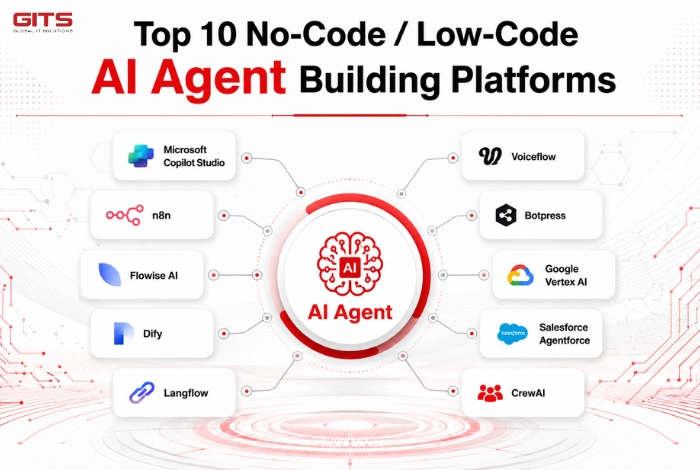
In this article, we’ll explore the Top 10 No-Code / Low-Code AI Agent Building Platforms, compare their strengths, and help you identify the right solution for your AI transformation journey.
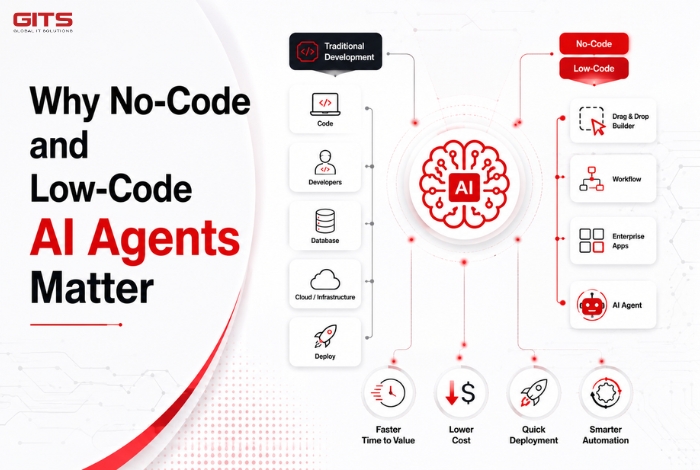
Why No-Code and Low-Code AI Agents Matter
The demand for enterprise AI has grown dramatically over the past two years. Yet many organizations still struggle to move beyond pilot projects due to limited AI talent, high development costs, and lengthy implementation cycles.
No-code and low-code platforms address these challenges by simplifying the development process while maintaining enterprise-grade capabilities.
Instead of building every component manually, organizations can visually connect AI models, enterprise databases, APIs, cloud applications, and business workflows into intelligent AI Agents that deliver measurable business value.
Key advantages include:
– Faster deployment with significantly shorter development cycles
– Lower implementation costs compared to custom AI development
– Reduced dependency on specialized AI engineers
– Easier integration with existing enterprise systems
– Faster experimentation and continuous improvement
– Greater scalability across multiple departments
This approach allows organizations to focus on solving business problems rather than managing technical complexity.
As a result, no-code AI development has become an important driver of AI Transformation (AX) initiatives across manufacturing, logistics, finance, healthcare, retail, and professional services.
Top 10 AI Agents No-Code / Low-Code Platforms
1. Microsoft Copilot Studio
Microsoft Copilot Studio has rapidly become one of the leading enterprise platforms for building AI Agents without extensive coding. Built on Microsoft’s AI ecosystem, it enables organizations to create conversational agents capable of interacting with Microsoft 365, Dynamics 365, Teams, SharePoint, and numerous third-party applications.
Its visual interface allows business users to design workflows, automate repetitive tasks, and deploy AI Agents across multiple communication channels while benefiting from Microsoft’s enterprise security and governance capabilities.
Best for
– Microsoft ecosystem users
– Enterprise workflow automation
– Internal knowledge assistants
– Customer support automation
2. n8n AI Agent Builder
Originally known as an open-source workflow automation platform, n8n has evolved into a powerful solution for building AI Agents through visual automation.
Its node-based architecture makes it easy to connect LLMs, databases, APIs, CRM platforms, ERP systems, and cloud applications without extensive programming. Developers can still extend functionality with custom code when needed, making it highly flexible.
Organizations appreciate n8n for balancing simplicity with technical customization, making it suitable for both business users and engineering teams.
Best for
– AI workflow automation
– API orchestration
– Enterprise integrations
– Hybrid no-code and low-code development
3. Flowise AI
Flowise AI is an open-source visual builder specifically designed for creating LLM-powered AI Agents.
Users can construct sophisticated AI workflows through drag-and-drop components while integrating popular models such as OpenAI, Anthropic Claude, Google Gemini, and open-source LLMs.
Its modular architecture enables rapid experimentation, making it particularly attractive for AI startups, innovation teams, and enterprises building proof-of-concept Agentic AI applications.
Best for
– LLM orchestration
– Retrieval-Augmented Generation (RAG)
– Knowledge assistants
– Internal AI applications
4. Dify
Dify combines AI application development with prompt engineering, knowledge management, and AI Agent orchestration into a unified platform.
It enables organizations to build production-ready AI solutions with integrated datasets, workflow orchestration, API management, and performance monitoring.
Its intuitive interface reduces development complexity while supporting enterprise deployment requirements.
Best for
– Enterprise AI applications
– Knowledge management
– AI Service development
– Customer-facing AI products
5. Langflow
Langflow provides a graphical interface for building applications powered by LangChain.
Rather than writing complex orchestration logic manually, developers can visually design AI Agent pipelines using reusable components that integrate LLMs, vector databases, APIs, tools, and memory systems.
Its flexibility makes Langflow an excellent choice for organizations experimenting with advanced Agentic AI architectures while maintaining transparency over workflow design.
Best for
– AI Agent prototyping
– LangChain development
– Multi-agent workflows
– Advanced enterprise AI solutions
6. Voiceflow
Voiceflow has evolved beyond chatbot design into a collaborative platform for building AI-powered assistants and AI Agents. Its visual workspace enables product teams, designers, and developers to create conversational experiences that integrate with large language models, enterprise knowledge bases, and business applications.
The platform also supports team collaboration, testing, and version control, making it well suited for organizations deploying customer-facing AI at scale.
Best for
– AI customer service
– Conversational AI
– Digital assistants
– Omnichannel customer experiences
7. Botpress
Botpress is an enterprise-grade AI Agent platform designed for organizations that require advanced customization and deployment flexibility. It combines visual workflow design with AI-powered natural language understanding, allowing teams to build intelligent assistants for customer support, HR, IT help desks, and internal operations.
With support for multiple LLM providers and enterprise integrations, Botpress enables organizations to deploy scalable AI solutions while maintaining governance and security.
Best for
– Enterprise AI Agents
– Internal support automation
– Customer service
– Knowledge management
8. Google Vertex AI Agent Builder
Google Vertex AI Agent Builder provides enterprises with a powerful environment for developing AI Agents on Google Cloud. Organizations can build agents that connect to enterprise data, search across documents, reason over business information, and automate complex workflows.
Its integration with Gemini models, Vertex AI Search, and cloud-native services makes it a strong choice for large-scale digital transformation initiatives.
Best for
– Enterprise search
– AI knowledge assistants
– Large-scale AI deployment
– Google Cloud ecosystem

9. Salesforce Agentforce
Salesforce Agentforce is designed to help organizations create AI Agents that automate customer engagement, sales processes, and service operations. Built directly into the Salesforce ecosystem, it enables AI Agents to understand customer context, recommend actions, and complete business workflows without manual intervention.
For organizations already using Salesforce CRM, Agentforce offers a seamless path to adopting Agentic AI while improving customer experience and operational efficiency.
Best for
– Sales automation
– CRM intelligence
– Customer service
– Enterprise AI workflows
10. CrewAI
CrewAI introduces a multi-agent architecture where specialized AI Agents collaborate to solve complex business tasks. Instead of relying on a single assistant, organizations can assign different roles such as planner, analyst, researcher, or reviewer, enabling agents to work together toward a common objective.
This collaborative approach is gaining momentum among enterprises exploring advanced Agentic AI use cases that require reasoning, planning, and autonomous decision-making.
Best for
– Multi-agent systems
– AI research automation
– Complex business processes
– Enterprise AI innovation
How to Choose the Right AI Agent Platform
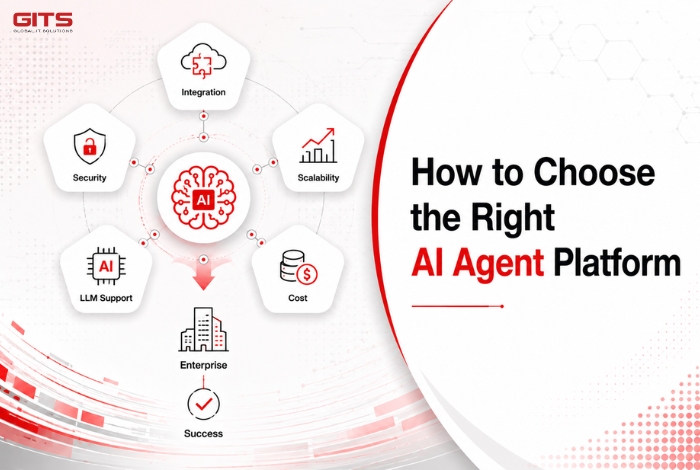
Selecting the right platform depends on your organization’s digital maturity, technical capabilities, and business objectives. While all of the platforms above simplify AI development, each serves different enterprise needs.
Consider the following factors before making a decision:
– Ease of use: Can business users create AI Agents without programming?
– Integration capabilities: Does the platform connect with ERP, CRM, WMS, databases, APIs, and cloud services?
– Scalability: Can it support enterprise-wide deployment as AI adoption grows?
– Security and governance: Does it meet enterprise compliance and data protection requirements?
– Model flexibility: Can you choose between OpenAI, Claude, Gemini, or open-source LLMs?
– Total cost of ownership: Evaluate licensing, infrastructure, maintenance, and long-term operational costs.
Organizations beginning their AI Transformation (AX) journey often benefit from no-code platforms that accelerate proof-of-concept development. As requirements become more sophisticated, low-code solutions provide greater flexibility while still reducing engineering effort.
The Future of AI Agents in Enterprise
The next generation of AI Agents will evolve far beyond simple conversational assistants. Enterprises are increasingly adopting autonomous systems capable of planning, collaborating, executing business processes, and continuously learning from enterprise data.
Several trends are expected to shape the future of Agentic AI:
– Multi-agent collaboration for complex workflows
– Deeper integration with enterprise systems such as ERP, MES, WMS, and CRM
– AI-powered decision support for executives
– Autonomous workflow orchestration across departments
– Stronger governance, security, and explainability for enterprise AI
For manufacturers, logistics providers, retailers, financial institutions, and healthcare organizations, AI Agents are becoming a strategic capability rather than an experimental technology. Businesses that invest early will be better positioned to improve productivity, reduce operational costs, and accelerate innovation.
Frequently Asked Questions (FAQ)
What is a no-code AI Agent platform?
A no-code AI Agent platform enables users to build, deploy, and manage AI Agents through visual interfaces without writing code. It helps organizations accelerate AI adoption while reducing development complexity.
What is the difference between no-code and low-code AI platforms?
No-code platforms are designed primarily for business users with little or no programming experience. Low-code platforms offer visual development while allowing developers to extend functionality through custom code and APIs.
Which industries benefit most from AI Agents?
AI Agents deliver value across manufacturing, logistics, retail, healthcare, finance, education, and customer service by automating workflows, enhancing decision-making, and improving operational efficiency.
Are no-code AI platforms suitable for enterprise use?
Yes. Many leading platforms provide enterprise-grade security, governance, scalability, and integration with existing business systems, making them suitable for large organizations undergoing AI Transformation.
Can AI Agents integrate with existing enterprise systems?
Most modern AI Agent platforms support integration with ERP, CRM, WMS, databases, APIs, cloud services, and productivity tools, enabling organizations to automate end-to-end business processes.

>>> See More: AI Agents Explained: The Complete Guide to Agentic AI & Enterprise Applications
Build AI Agents Faster with the Right Platform
No-code and low-code platforms are making AI Agents accessible to a much broader range of organizations by removing many of the technical barriers associated with traditional AI development.
Whether your goal is automating customer service, streamlining logistics operations, improving knowledge management, or enabling enterprise-wide Agentic AI, selecting the right platform is the first step toward a successful AI strategy.
As AI continues to reshape industries worldwide, organizations across Japan, Korea, Vietnam, and global markets should focus on platforms that combine ease of development, enterprise scalability, security, and seamless integration. With the right AI Solution and implementation strategy, businesses can move beyond experimentation and unlock lasting competitive advantages through intelligent automation.