





For decades, traditional automation has helped businesses streamline operations, reduce manual workloads, and improve efficiency. From workflow automation and Robotic Process Automation (RPA) to rule-based systems, organizations have successfully automated repetitive processes across departments.
However, today’s business environment is fundamentally different.
Companies face rapidly changing customer expectations, growing operational complexity, labor shortages, and increasing pressure to accelerate innovation. While traditional automation excels at executing predefined rules, it struggles when processes require contextual understanding, decision-making, and adaptability.
This challenge is particularly evident across Japan, South Korea, Vietnam, and global enterprises pursuing AI Transformation (AX). Organizations are now seeking intelligent systems that can do more than automate tasks—they need systems capable of understanding objectives, making decisions, and acting autonomously.
This is where AI Agents are transforming enterprise operations.
In this guide, we explore the critical differences between AI Agents and Traditional Automation, examine real-world use cases, and explain why AI Agents are becoming the foundation of next-generation enterprise transformation.
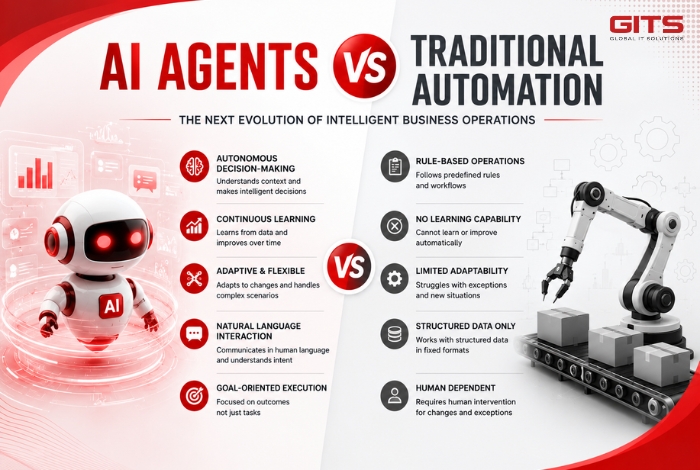
AI Agents vs Traditional Automation: Quick Comparison
| Feature | AI Agents | Traditional Automation |
|---|---|---|
| Decision Making | Autonomous and contextual | Rule-based |
| Learning Capability | Continuously improves | No learning ability |
| Adaptability | High | Low |
| Handling Exceptions | Dynamic responses | Requires manual intervention |
| Understanding Context | Yes | Limited |
| Processing Unstructured Data | Yes | Mostly structured data only |
| Human Intervention | Minimal | Frequent |
| Business Value | Outcome-driven | Task-driven |
| Scalability | High | Moderate |
| Ideal Use Cases | Complex workflows | Repetitive processes |
What Are AI Agents?
AI Agents are intelligent software systems capable of perceiving information, reasoning through problems, making decisions, and taking actions independently to achieve specific goals.
Unlike conventional automation tools, AI Agents are not restricted to predefined workflows. Instead, they leverage technologies such as:
– Large Language Models (LLMs)
– Machine Learning
– Natural Language Processing (NLP)
– Knowledge Retrieval Systems
– Agentic AI Architectures
– Multi-Agent Systems
An AI Agent can understand a business objective, determine the necessary steps, interact with multiple enterprise systems, and continuously refine its actions based on new information.
For example, when a customer submits a support request, an AI Agent can:
– Analyze customer intent
– Search internal knowledge bases
– Generate accurate responses
– Perform follow-up actions
– Escalate complex issues when necessary
– Learn from previous interactions
Rather than automating individual tasks, AI Agents automate outcomes.

What Is Traditional Automation?
Traditional Automation refers to systems designed to execute predefined actions based on fixed rules and workflows.
Common examples include:
– Workflow Automation
– Robotic Process Automation (RPA)
– Automated Approvals
– Data Entry Automation
– Scheduled Reporting Systems
– Rule-Based Customer Support
These solutions are highly effective in structured environments where processes rarely change.
For example:
“If an invoice exceeds $10,000, automatically send it to a manager for approval.”
Every outcome depends on rules created in advance.
While this approach improves efficiency, it lacks the flexibility required to handle dynamic business scenarios.
7 Critical Differences Between AI Agents and Traditional Automation
Decision-Making Intelligence
Traditional automation follows predefined instructions.
When a process falls outside established rules, human intervention becomes necessary.
AI Agents operate differently. They can analyze situations, evaluate multiple options, and make decisions based on context.
This capability enables organizations to automate complex knowledge work that previously required human judgment.
Learning and Continuous Improvement
One of the biggest limitations of traditional automation is its inability to learn.
Any process update requires manual reconfiguration.
AI Agents continuously improve by analyzing:
– Historical performance
– User behavior
– Business outcomes
– Environmental changes
As a result, AI Agents become more effective over time without requiring extensive reprogramming.
Adaptability to Business Changes
Modern businesses operate in constantly evolving environments.
Market conditions, customer preferences, and operational requirements change rapidly.
Traditional automation often breaks when unexpected scenarios occur.
AI Agents adapt to changing circumstances and can modify their actions to achieve desired outcomes.
This adaptability is particularly valuable in manufacturing, logistics, healthcare, financial services, and retail industries.
Handling Unstructured Data
Enterprise data is no longer limited to databases and spreadsheets.
Organizations manage vast amounts of:
– Emails
– Contracts
– Reports
– Images
– Customer conversations
– Knowledge documents
– Traditional automation struggles with these data formats.
AI Agents can understand, interpret, and act upon unstructured information, unlocking significantly broader automation opportunities.
Goal-Oriented Execution
Traditional automation focuses on tasks.
AI Agents focus on objectives.
Consider customer support as an example.
Traditional Automation:
“Send an acknowledgment email when a ticket is received.”
AI Agent:
“Resolve customer issues as quickly and accurately as possible.”
To achieve this goal, the AI Agent can gather information, search knowledge sources, communicate with customers, and escalate issues when appropriate.
This outcome-based approach generates substantially greater business value.
Human-Like Interaction
Traditional automation requires predefined workflows and structured inputs.
AI Agents support natural language interactions.
Employees can simply ask:
“Summarize this contract.”
“Generate a supply chain risk report.”
“Identify delayed shipments and propose solutions.”
The AI Agent understands intent and performs the required actions.
This dramatically improves user adoption and productivity.
Cross-System Orchestration
Modern enterprises rely on multiple systems, including ERP, CRM, SCM, HRM, and knowledge platforms.
Traditional automation often operates within isolated workflows.
AI Agents can coordinate activities across multiple systems simultaneously, creating intelligent end-to-end processes.
This capability is becoming a major driver of Enterprise Agentic AI adoption.
Why Businesses Are Moving Toward AI Agents
Increasing Operational Complexity
Global organizations face increasingly interconnected operations involving suppliers, customers, partners, and internal teams.
Traditional automation struggles to manage these dynamic environments.
AI Agents can analyze information across systems and coordinate actions in real time.
Labor Shortages in Japan and South Korea
Japan and South Korea face significant workforce challenges due to aging populations and declining labor availability.
Organizations are increasingly adopting AI Agents to augment human teams and maintain productivity.
AI Agents function as digital workers capable of handling repetitive, analytical, and knowledge-intensive tasks at scale.
Rising Customer Expectations
Customers expect:
– Instant responses
– Personalized experiences
– 24/7 availability
– Consistent service quality
Traditional automation often lacks the intelligence required to meet these expectations.
AI Agents deliver personalized and context-aware interactions across multiple channels.
Accelerating AI Transformation (AX)
Many organizations have already completed digital transformation initiatives.
The next stage is AI Transformation (AX), where intelligent systems actively participate in decision-making and business operations.
AI Agents are emerging as a core technology powering this transformation.
Why AI Agents Are Becoming the Foundation of AX
Digital Transformation (DX) focuses on digitizing processes.
AI Transformation (AX) focuses on creating intelligent organizations.
The distinction is critical.
DX asks:
“How can we digitize workflows?”
AX asks:
“How can AI improve decision-making, productivity, and business outcomes?”
AI Agents bridge this gap by combining:
– Intelligence
– Automation
– Reasoning
– Learning
– Autonomous execution
As organizations pursue AX strategies, AI Agents are becoming essential components of future enterprise architectures.
Real-World Examples: AI Agents vs Traditional Automation
Customer Support
Traditional Automation:
– Routes tickets
– Sends automated emails
– Assigns support cases
AI Agents:
– Understand customer intent
– Retrieve relevant knowledge
– Generate personalized responses
– Resolve issues autonomously
Manufacturing Operations
Traditional Automation:
– Triggers alerts
– Executes predefined workflows
AI Agents:
– Predict equipment failures
– Recommend corrective actions
– Coordinate maintenance activities
– Optimize production schedules
Supply Chain Management
Traditional Automation:
– Generates reports
– Updates inventory records
AI Agents:
– Forecast demand fluctuations
– Detect supply chain risks
– Recommend inventory adjustments
– Coordinate supplier communications
Enterprise Knowledge Management
Traditional Automation:
– Stores information
AI Agents:
– Retrieve knowledge instantly
– Summarize documents
– Answer employee questions
– Generate actionable insights
AI Agents in Japan, Korea, Vietnam, and Global Markets
Japan
Japanese enterprises traditionally rely on structured workflows and extensive approval processes.
However, labor shortages and workforce aging are accelerating investments in Enterprise AI Agents capable of handling knowledge-intensive operations with minimal supervision.
Industries leading adoption include:
– Manufacturing
– Logistics
– Financial Services
– Healthcare
South Korea
South Korean companies are integrating AI Agents into smart factories, semiconductor production, customer service, and supply chain optimization initiatives.
The country’s strong digital infrastructure positions it as a leading adopter of Agentic AI technologies.
Vietnam
Vietnam is rapidly emerging as a regional AI innovation hub.
Businesses are increasingly leveraging AI Agents to improve operational efficiency, customer engagement, and competitiveness while supporting broader digital transformation initiatives.
Global Markets
Across North America, Europe, and Asia-Pacific, organizations are adopting AI Agents to enhance productivity, reduce operational costs, and create intelligent business ecosystems.
>>> See More: Enterprise AI Infrastructure for AI Transformation
Challenges Organizations Must Address
Despite their advantages, successful AI Agent deployment requires careful planning.
Key considerations include:
– Data governance
– Security and compliance
– AI transparency
– Integration with legacy systems
– Change management
– Human oversight
Organizations that address these challenges early achieve stronger long-term outcomes from their AI initiatives.
Frequently Asked Questions
Are AI Agents replacing traditional automation?
No. Traditional automation remains highly effective for repetitive and predictable processes. AI Agents complement automation by handling complex, dynamic, and decision-intensive tasks.
What is the difference between Agentic AI and RPA?
RPA follows predefined rules and workflows. Agentic AI can reason, learn, adapt, and make autonomous decisions based on context.
Why are Japanese companies investing in AI Agents?
Labor shortages, aging populations, and productivity challenges are driving Japanese enterprises to adopt AI Agents as digital workforce solutions.
Can AI Agents integrate with existing enterprise systems?
Yes. Modern AI Agents can connect with ERP, CRM, SCM, HRM, knowledge management platforms, and other enterprise applications.
What industries benefit most from AI Agents?
Manufacturing, logistics, healthcare, financial services, retail, education, and customer service are among the industries seeing the strongest adoption and ROI.
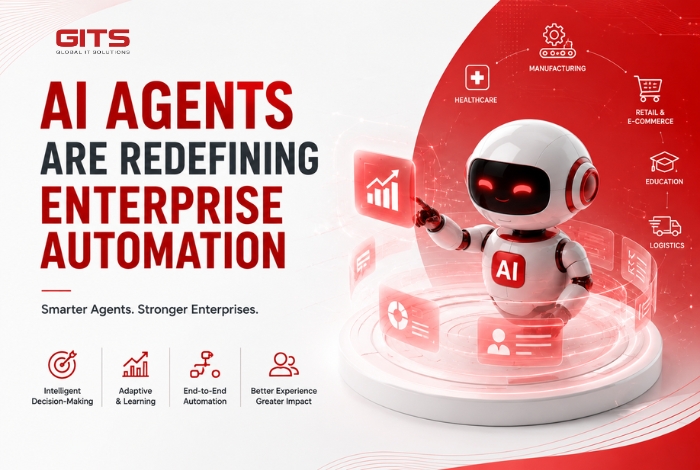
AI Agents Are Redefining Enterprise Automation
Traditional automation transformed business operations by eliminating repetitive tasks and improving efficiency. However, its reliance on fixed rules limits its ability to address today’s increasingly complex business challenges.
AI Agents represent the next evolution of enterprise automation. By combining contextual understanding, reasoning, learning, and autonomous action, they enable organizations to move beyond task automation toward intelligent business execution.
For enterprises across Japan, South Korea, Vietnam, and global markets pursuing AI Transformation (AX), AI Agents are no longer an emerging technology. They are rapidly becoming a strategic foundation for productivity, innovation, operational excellence, and long-term competitive advantage.
Organizations that successfully integrate AI Agents today will be better positioned to lead tomorrow’s intelligent economy.