





Global supply chains are becoming harder to manage through traditional workflows. Demand changes faster, supplier risks emerge unexpectedly, inventory data is fragmented, and logistics teams often need to coordinate across multiple systems before making a single decision.
For enterprises operating across Japan, Korea, Vietnam and global markets, the real challenge is no longer simply gaining more visibility. The challenge is turning real-time information into coordinated action across planning, procurement, manufacturing, warehousing, transportation and fulfillment.
This is where Multi-Agent Supply Chain architecture creates a new opportunity. Instead of relying on one AI model or isolated automation tools, multiple specialized AI Agents can collaborate to analyze events, evaluate trade-offs and execute approved actions across the end-to-end supply chain. Gartner identifies Collaborative Multiagent Systems as a major supply chain technology trend, reflecting the shift from isolated AI use cases toward coordinated, multi-step automation.
Why Traditional Supply Chain Operations Struggle to Keep Up
Most supply chain organizations already use ERP, WMS, TMS, forecasting platforms and BI dashboards. However, these systems often operate in functional silos.
A demand planner may detect a forecast change, while procurement reviews supplier capacity separately. The logistics team may discover a transportation disruption later, and warehouse operations must react based on yet another dataset. By the time teams align on a response, the business may have already lost time, inventory availability or customer service opportunities.
The problem is not always a lack of data. It is a lack of end-to-end orchestration.
According to recent industry analysis, supply chains are increasingly moving from reactive firefighting toward connected orchestration, where planning, logistics, procurement and operations can respond through a shared, real-time decision layer.
What Is a Multi-Agent Supply Chain?
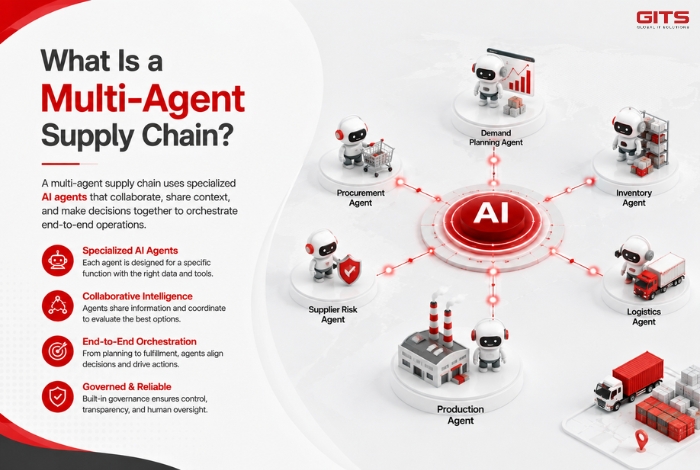
A Multi-Agent Supply Chain is an AI-powered operating model in which multiple AI Agents are assigned specialized responsibilities and collaborate to achieve broader supply chain goals.
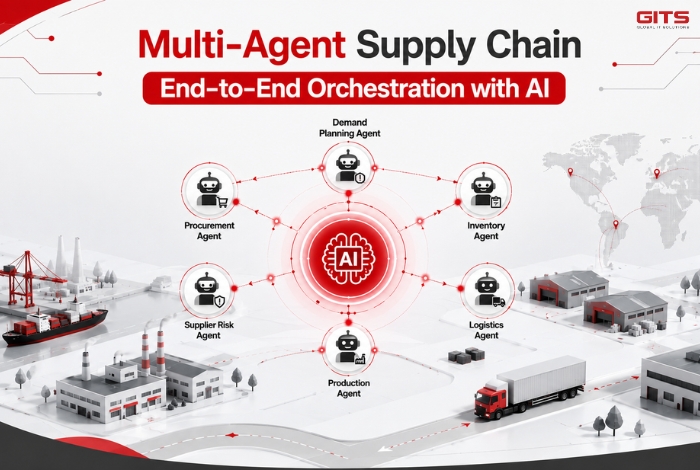
Rather than asking one system to understand every business process, enterprises can deploy domain-specific agents such as:
– Demand Forecasting Agent
– Inventory Optimization Agent
– Procurement Agent
– Supplier Risk Agent
– Production Planning Agent
– Logistics Agent
– Exception Management Agent
Each AI Agent can access relevant data, tools and business rules within its authorized scope. An orchestration layer then coordinates how these agents exchange information, evaluate dependencies and trigger the next best action.
For example, when a Supplier Risk Agent identifies a potential delay, it can initiate collaboration with inventory, production and logistics agents. Together, the system can assess available stock, production priorities, alternative suppliers and transportation options before recommending or executing an approved response.
This allows the supply chain to move from isolated decisions toward connected decision-making.
How AI Agents Enable End-to-End Supply Chain Orchestration
The real value of Agentic AI is not simply generating insights. It is connecting the journey from signal to decision to action.
Detect Events Across the Supply Chain
AI Agents continuously monitor relevant signals from ERP, IoT, WMS, TMS, supplier systems and external data sources. They can identify exceptions such as sudden demand changes, delayed shipments, inventory shortages or supplier disruptions.
Analyze Cross-Functional Impact
A single disruption rarely affects only one department. Multi-agent systems can evaluate downstream and upstream consequences across inventory, production, procurement, transportation and customer fulfillment.
This enables organizations to understand not only what happened, but also what will happen next if no action is taken.
Coordinate Decisions Between Specialized Agents
This is the defining capability of a Multi-Agent Supply Chain. Specialized agents share context and collaborate around a common operational objective.
An inventory agent may recommend reallocating stock, while a logistics agent evaluates delivery capacity and a commercial agent assesses customer impact. The orchestration layer helps reconcile these decisions based on priorities such as cost, service level, resilience and sustainability.
AWS has highlighted similar multi-agent approaches for turning supply chain data into decisions and actions, particularly where specialized agents can coordinate across complex retail workflows.
Execute Actions with Governance
Not every decision should be fully autonomous. A robust AI Solution should define which actions AI Agents can execute automatically and which require human approval.
For high-impact decisions, businesses can apply human-in-the-loop workflows, approval thresholds, audit trails and role-based permissions. This is especially important for enterprises in highly structured operating environments, where reliability, accountability and explainability are essential. Gartner similarly emphasizes governance, workforce readiness and data foundations as critical requirements for scaling AI-driven supply chain operations.
Business Value Beyond Automation
The goal is not to replace every human decision with AI. The greater opportunity is to reduce the time between detecting a problem and coordinating the right response.
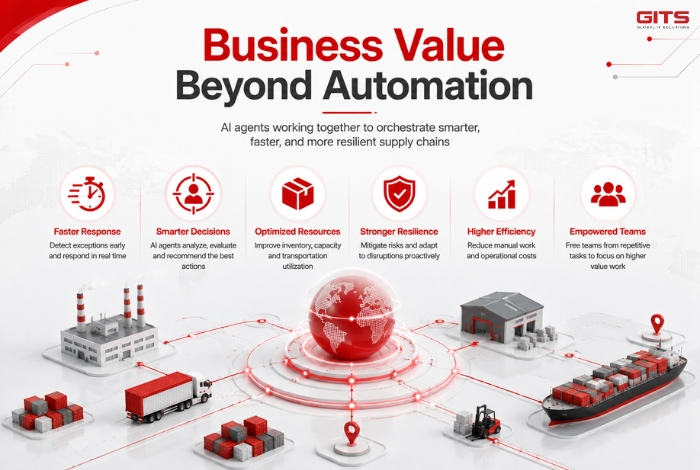
A well-designed Multi-Agent Supply Chain can help enterprises improve:
– Exception response speed and operational agility
– Cross-functional decision consistency
– Inventory and working capital efficiency
– Supply chain resilience and risk management
– Workforce productivity by reducing repetitive coordination
– Scalability across regions, business units and partner networks
This matters particularly for Japanese and Korean enterprises managing complex supplier ecosystems, strict quality requirements and cross-border operations. For fast-growing companies in Vietnam and global markets, AI Services can provide a scalable path to modernizing supply chain processes without requiring every workflow to be rebuilt at once.
>>> See More: AI Route Optimization Agents vs Traditional TMS
Building a Scalable Multi-Agent Supply Chain Architecture
Successful implementation requires more than adding AI Agents to existing systems. The foundation should connect business processes, enterprise data and governance.
A scalable Technical Solution typically includes four layers: enterprise data integration, specialized AI Agents, an orchestration layer and governance controls. The architecture should integrate with existing systems while maintaining clear permissions, traceability and human oversight.
Companies should begin with high-value workflows where fragmented coordination creates measurable business pain, such as supply disruption response, inventory exceptions, order fulfillment or supplier communication. From there, additional agents can be introduced progressively.
This incremental approach is important because the gap between AI potential and operational readiness remains significant. Gartner reports that many supply chain organizations are still scaling AI gradually due to challenges involving data readiness, workforce skills and fragmented technology environments.
From AI Automation to Autonomous Supply Chain Operations
The next phase of supply chain transformation is AX, or AI Transformation, where AI becomes part of how operational decisions are made and coordinated.
Multi-Agent Systems represent an important step toward this model. They enable enterprises to connect specialized intelligence across functions rather than deploying another isolated AI tool for every department.
The strongest opportunity is not creating a fully autonomous supply chain overnight. It is building a reliable orchestration capability that progressively moves more workflows from manual coordination to AI-assisted and, where appropriate, AI-executed operations.
Multi-Agent Supply Chain: The Future of Connected Decision-Making
Multi-Agent Supply Chain is redefining how enterprises orchestrate complex operations from end to end. By enabling specialized AI Agents to collaborate across planning, procurement, production, logistics and fulfillment, businesses can move faster from fragmented data to coordinated action.
The competitive advantage will increasingly belong to organizations that do more than deploy AI. They will build the right AI Solution, Technical Solution and governance framework to make AI Agents work together safely, intelligently and at enterprise scale.
For businesses navigating disruption, labor constraints and rising operational complexity, the question is no longer whether AI can support the supply chain. The strategic question is how quickly the organization can evolve from isolated AI capabilities to truly connected, end-to-end orchestration.