








Healthcare organizations are under pressure to deliver faster, more personalized care while managing rising operational complexity, staffing shortages, fragmented systems, and growing administrative workloads. For many hospitals, the challenge is no longer simply collecting data. It is turning that data into coordinated action.
This is where AI in healthcare operations is becoming increasingly important.
Instead of using AI only as a chatbot or analytics tool, hospitals can deploy AI Agents and Agentic AI that understand operational context, execute multi-step tasks, interact with existing systems, and escalate decisions to human staff when necessary.
The result is a new approach to hospital operations: less manual coordination, fewer repetitive tasks, and more time for healthcare professionals to focus on patient care.
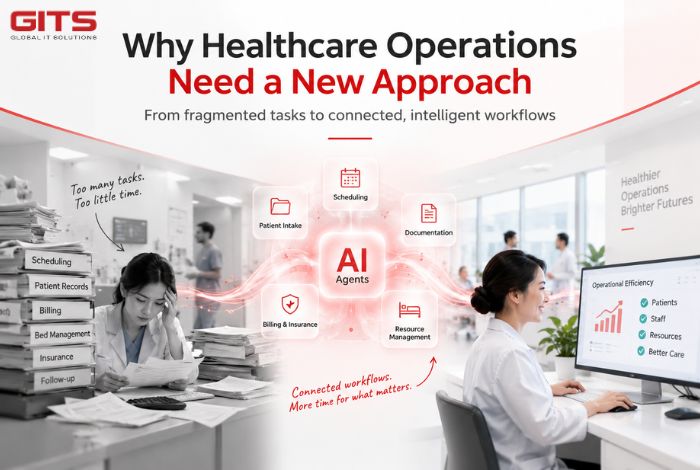
Why Healthcare Operations Need a New Approach
A modern hospital operates as a highly interconnected ecosystem. Patient registration, appointment scheduling, referrals, insurance verification, clinical documentation, billing, staffing, bed management, discharge coordination, and follow-up care all depend on information moving accurately between teams and systems.
Yet many organizations still rely on a combination of EHR/HIS platforms, spreadsheets, emails, phone calls, manual approvals, and disconnected departmental workflows.
This creates a hidden operational cost.
A scheduling team may need to check multiple systems before confirming an appointment. Billing staff may manually review documentation before submitting claims. Nurses and administrative teams may spend significant time coordinating referrals, follow-ups, or discharge processes.
Research on healthcare AI agents highlights administrative automation, scheduling, workflow coordination, and resource optimization as important emerging applications.
The problem is therefore not simply a lack of software. It is the lack of intelligent coordination between systems, people, and processes.
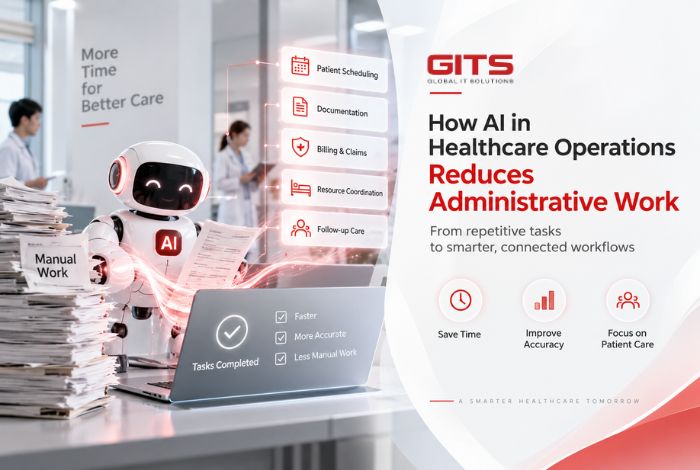
How AI in Healthcare Operations Reduces Administrative Work
Traditional automation usually follows predefined rules: when A happens, execute B.
That approach works for predictable processes, but hospital operations rarely remain predictable.
Agentic AI introduces a more adaptive model. An AI Agent can interpret a goal, gather information from connected systems, determine the next steps, execute permitted actions, monitor outcomes, and escalate exceptions.
For example, instead of simply displaying an appointment request, an AI Agent could:
1. Check provider availability.
2. Review appointment requirements.
3. Identify suitable time slots.
4. Contact or notify the patient.
5. Update the scheduling system.
6. Escalate unusual cases to staff.
This changes AI from a passive information tool into an active workflow participant.
IBM describes this evolution as AI agents becoming active participants in healthcare workflows, supporting scheduling, staffing, resource allocation, patient communication, documentation, and follow-up activities.
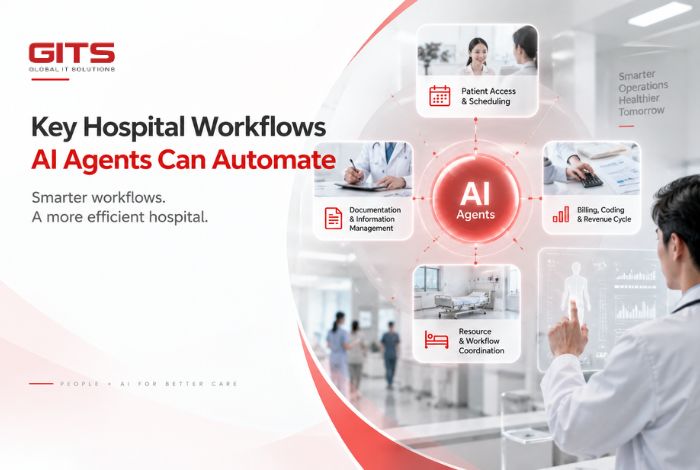
Key Hospital Workflows AI Agents Can Automate
Patient Access and Scheduling
Patient access is one of the most visible areas where administrative friction affects both staff and patients.
AI Agents can support appointment booking, rescheduling, reminders, intake, referral coordination, and routine patient communication. By connecting these activities to existing hospital systems, organizations can reduce repetitive communication and shorten response times.
For hospitals operating across multiple departments, AI can also coordinate provider availability, appointment requirements, and patient preferences rather than treating scheduling as a standalone task.
Documentation and Administrative Coordination
Documentation is essential to healthcare, but repetitive documentation and information handling can consume valuable professional time.
AI-powered systems can summarize information, prepare structured documentation, route information to the appropriate team, and identify missing data.
The goal is not to replace professional judgment. It is to reduce the amount of manual preparation required before a professional can make a decision.
Billing, Coding and Revenue Cycle
Administrative inefficiency also appears after the patient interaction.
AI Agents can help review documentation, identify missing information, support coding workflows, validate claims data, and route exceptions for human review.
This is particularly valuable because errors between documentation, coding, authorization, and billing can create downstream rework.
Real-world implementations are already exploring agentic AI across pre-visit intake, documentation, pre-authorization, coding, billing, and follow-up workflows. IBM reports that its ViClinic case uses governed agentic AI to connect these stages while maintaining human oversight.
Resource and Workflow Coordination
Hospital operations extend beyond administrative desks.
AI Agents can coordinate beds, staffing, operating rooms, diagnostics, laboratory workflows, transportation, and discharge planning.
The advantage becomes more significant when several operational variables change simultaneously.
For example, a sudden increase in emergency department demand may affect bed availability, staffing, diagnostic capacity, and discharge schedules. A multi-agent architecture can coordinate these interconnected workflows instead of optimizing each department independently.
Recent research on autonomous agentic AI for healthcare workflow orchestration specifically explores coordination across triage, bed management, laboratory, imaging, transport, and discharge operations.
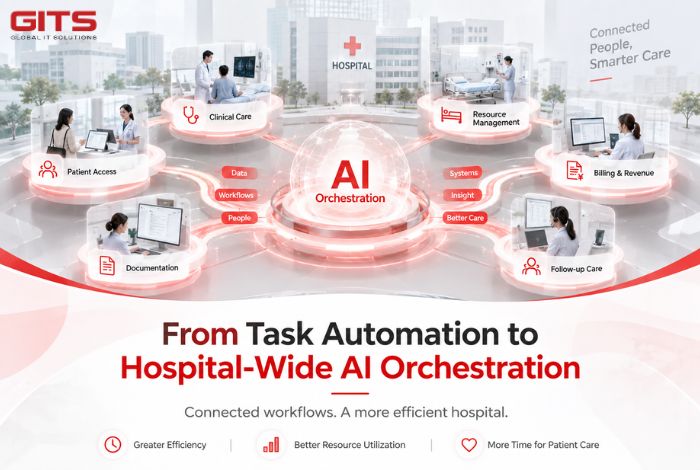
From Task Automation to Hospital-Wide AI Orchestration
The next stage of AI in healthcare operations is not simply automating more individual tasks.
It is connecting those tasks into an intelligent operational layer.
A hospital may have separate AI solutions for scheduling, documentation, billing, patient communication, and workforce management. However, if these systems cannot exchange context, employees still have to manually connect the dots.
An AI orchestration layer can coordinate specialized agents around a shared operational objective.
For example:
Patient admission → eligibility verification → bed availability → staffing check → admission coordination → documentation → follow-up
Instead of requiring different teams to manage every handoff manually, AI Agents can coordinate the workflow while keeping humans responsible for decisions that require professional judgment.
This model is increasingly aligned with the concept of the AI-native hospital, where AI becomes part of the operational infrastructure rather than an isolated software feature.
>>> See More: Healthcare AI: How AI Agents Improve Efficiency Without Compromising Trust
What Hospitals Need Before Deploying AI Agents
Technology alone does not guarantee successful AI transformation.
Healthcare organizations need a structured approach covering:
– Integration with existing HIS, EHR, ERP and other healthcare systems
– Data security and privacy
– Role-based access and permissions
– Human-in-the-loop controls
– Auditability and explainability
– Clear escalation mechanisms
– Workflow-level performance measurement
This is particularly important in Japan and Korea, where hospitals often operate complex legacy environments and place strong emphasis on reliability, governance, security, and operational continuity.
For global healthcare organizations, the same principle applies: AI should fit the existing workflow rather than forcing staff to rebuild their workflow around AI.
AI Agents as the Next Step of Healthcare AX
Healthcare transformation is moving beyond simple digitalization.
Digital transformation digitizes processes. Automation reduces repetitive steps. AI-driven AX can redesign how work is performed.
With Agentic AI, hospitals can move toward an operating model where systems continuously understand operational conditions, recommend or execute appropriate actions, and involve human staff when decisions require expertise or accountability.
The objective is not “more AI.”
The objective is less administrative friction, faster coordination, better resource utilization, and more time for patient care.

Turning Hospital Operations into an Intelligent Workflow
AI in healthcare operations represents a fundamental shift from fragmented automation toward intelligent workflow orchestration.
AI Agents can take over repetitive administrative activities, coordinate information across systems, support scheduling and billing, manage follow-ups, and help optimize operational resources. More importantly, Agentic AI can connect these individual capabilities into coordinated workflows.
For hospitals in Japan, Korea, Vietnam, and global markets, the opportunity is not simply to deploy another AI tool. It is to build a scalable AI solution that works alongside existing healthcare infrastructure and people.
The future hospital will not be defined by how much data it collects.
It will be defined by how intelligently it can turn data into action.