





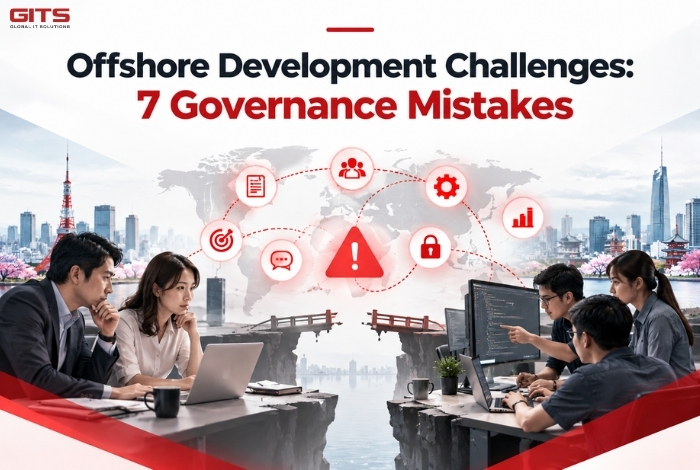
Offshore software development has become an important strategy for enterprises looking to access technical talent, accelerate digital transformation, and control development costs. For companies in Japan, South Korea, Vietnam, and global markets, offshore teams can support everything from enterprise software and cloud platforms to AI Solutions, logistics systems, and business applications.
Yet many offshore projects do not fail because the development team lacks technical skills. They fail because the governance model is not strong enough to manage distance, complexity, communication, and accountability.
Research on offshore software development has identified communication gaps, unclear requirements, cultural differences, weak coordination, undefined responsibilities, and immature project management as recurring factors behind project failures.
Understanding these offshore development challenges is therefore critical before scaling an offshore engagement.
Why Offshore Development Projects Fail
The biggest misconception about offshore development is that outsourcing the execution also means outsourcing responsibility.
In reality, the client still needs to define business objectives, decision rights, quality expectations, security requirements, and escalation mechanisms. When these responsibilities are unclear, small misunderstandings can accumulate into missed milestones, rework, cost overruns, and ultimately a failed project.
For enterprises operating across Japan, Korea, Vietnam, and other international markets, the challenge becomes even greater when teams must work across languages, time zones, organizational cultures, and different expectations around communication and decision-making.
Here are seven governance mistakes that companies should avoid.
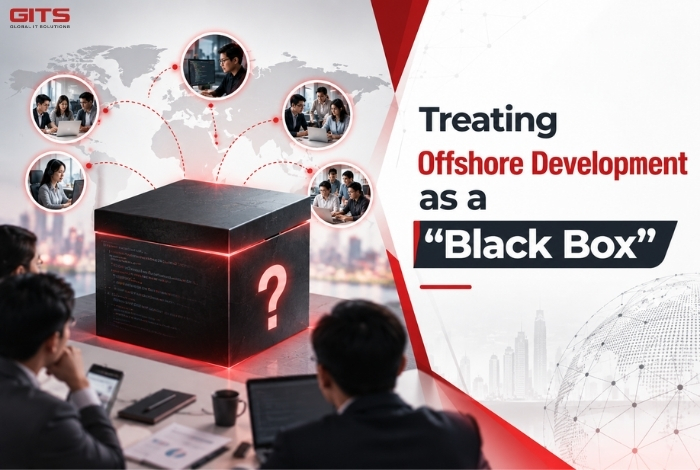
1. Treating Offshore Development as a “Black Box”
One of the most common offshore development challenges is insufficient project visibility.
Some companies provide requirements to an offshore team and wait for the final deliverable. By the time problems become visible, weeks or months of development may already need to be reworked.
Effective governance requires continuous visibility into:
• Project progress and milestone completion
• Development quality and technical debt
• Open risks and blockers
• Scope changes and their impact
• Decisions requiring client approval
Working software, sprint reviews, shared dashboards, and transparent access to development environments can help management identify problems earlier rather than relying solely on periodic status reports.
2. Leaving Requirements Open to Interpretation
A technically capable offshore team cannot compensate for ambiguous business requirements.
Terms such as “improve the system,” “make the process more efficient,” or “integrate AI” are not sufficient specifications for an enterprise project.
Before development begins, companies should establish clear acceptance criteria, business rules, system boundaries, integration requirements, and expected outcomes.
This is especially important for projects involving complex systems such as Distribution Management Systems, WMS, OMS, TMS, ERP integration, or AI-powered business applications.
A strong governance framework converts business expectations into measurable technical requirements.
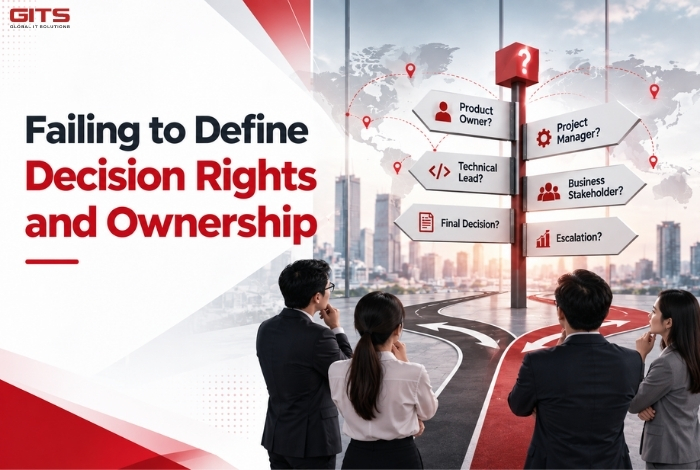
3. Failing to Define Decision Rights and Ownership
When responsibility is shared between an onshore client and an offshore development team, unclear ownership can create decision bottlenecks.
Who approves architecture changes?
Who owns the product roadmap?
Who makes the final decision when business requirements conflict with technical constraints?
Who is responsible when an integration fails?
Without clearly defined decision rights, teams may either wait for approval or make assumptions independently.
A practical governance structure should establish a clear client-side product owner, offshore project manager, technical lead, and escalation path. Governance should make accountability visible rather than allowing responsibility to disappear between organizations.
4. Underestimating Communication and Cultural Differences
Communication is one of the most persistent offshore development challenges.
Geographical distance reduces spontaneous interaction. Time-zone differences can delay decisions, while language and cultural differences may influence how teams interpret requirements, disagreement, urgency, and feedback. Academic research on offshore development has specifically linked geographical, cultural, and language differences with communication and coordination difficulties.
For Japanese and Korean enterprises working with offshore teams, communication governance should go beyond simply scheduling more meetings.
Instead, organizations should define:
• Which decisions require synchronous meetings
• Which information must be documented
• How blockers are escalated
• Expected response times
• Who communicates with business stakeholders
• How technical decisions are recorded
The objective is not more communication. It is more predictable communication.
5. Measuring Activity Instead of Business Outcomes
A project can have completed sprints, closed tickets, and high development activity while still failing to deliver business value.
Counting lines of code or completed tasks does not answer the most important questions:
Is the system reducing operational costs?
Is order processing becoming faster?
Is inventory visibility improving?
Are users actually adopting the solution?
For enterprise software and digital transformation projects, governance should connect technical KPIs with business KPIs.
This becomes even more important when implementing AI Services, AI Agents, Agentic AI, or AX initiatives, where the value of the technology depends on measurable improvements in business processes rather than simply deploying another AI feature.
>>> See More: Vietnam IT Outsourcing Cost: What Are You Paying For?
6. Treating Security and Compliance as a Final-Stage Activity
Security cannot be added immediately before production.
Offshore projects may involve access to source code, customer information, operational data, cloud environments, APIs, and enterprise systems. Weak access governance can therefore create risks that extend beyond the software project itself.
The same principle applies to AI-enabled development.
AI Agents can access enterprise data, make decisions, and perform actions across multiple systems. Microsoft recommends establishing centralized governance covering identity, ownership, access control, data governance, security, development standards, and observability.
For companies adopting Agentic AI, governance should therefore define who owns each agent, what data it can access, what actions it can perform, and when human approval is required.
Security, compliance, and AI governance should be designed into the Technical Solution from the beginning.
7. Choosing a Vendor Without Evaluating Governance Capability
Technical capability is important, but it is not the only factor determining offshore success.
A development partner may have strong engineers but still struggle with enterprise-scale governance, documentation, communication, quality assurance, or cross-border coordination.
When evaluating an offshore partner, companies should assess not only technical skills but also:
• Project management maturity
• Communication and escalation processes
• Quality assurance practices
• Security and data protection controls
• Documentation standards
• Business-domain understanding
• Ability to scale teams and technology
This is particularly relevant when offshore development becomes part of a long-term AI Solution, AX, or digital transformation strategy rather than a one-time development project.
How Companies Can Build a Stronger Offshore Governance Model
A successful offshore model should create a clear operating framework before development scales.
At minimum, companies should establish five layers of governance:
– Business governance: objectives, KPIs, scope, and decision rights.
– Project governance: milestones, responsibilities, risks, changes, and escalation.
– Technical governance: architecture, coding standards, APIs, infrastructure, and quality controls.
– Security governance: identity, access permissions, data protection, compliance, and auditability.
– AI governance: model usage, AI Agents, data access, human oversight, monitoring, and accountability.
This structure becomes increasingly important as enterprises move from traditional outsourcing toward AI-enabled development and Agentic AI. Current enterprise guidance emphasizes centralized governance, standardized controls, clear ownership, and continuous monitoring as AI systems scale across organizations.
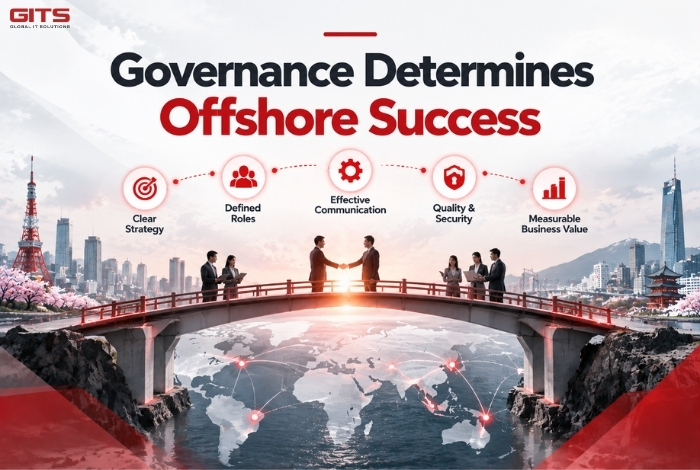
Governance Determines Offshore Success
The real challenge of offshore development is not simply managing a team in another country. It is creating an operating model that makes responsibility, communication, quality, security, and business outcomes visible across organizational boundaries.
The seven governance mistakes discussed above share one common problem: companies often treat offshore development as a delivery arrangement instead of a strategic technology partnership.
For enterprises in Japan, Korea, Vietnam, and global markets, a mature offshore model should combine strong project governance with modern Technical Solutions, AI Services, AI Agents, Agentic AI, and AX capabilities.
The goal is not merely to develop software at a distance. It is to build a reliable technology partnership that can scale with the business while maintaining visibility, security, quality, and measurable business value.