






In logistics, uncertainty is expensive. A sudden spike in customer demand, delayed supplier shipments, or inaccurate inventory planning can quickly create operational chaos. For logistics leaders, these disruptions often lead to stockouts, excess inventory, missed delivery deadlines, and rising transportation costs. This is why demand forecasting has become one of the most strategic functions in modern supply chain management, yet traditional forecasting models are no longer enough.
In today’s fast-moving global market, businesses across Japan, South Korea, Vietnam, and international markets are rapidly investing in AI-driven forecasting systems to improve agility and resilience. As the AI in logistics market continues to grow, enterprises are shifting toward intelligent forecasting models powered by AI agents, machine learning, and real-time data integration. The goal is no longer just prediction, but prediction with action.
What Is AI Demand Forecasting in Logistics?
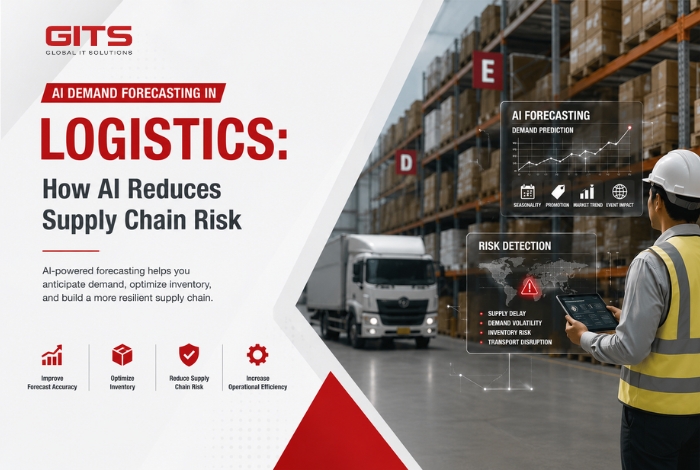
AI demand forecasting in logistics uses artificial intelligence to analyze historical, real-time, and external supply chain data to predict future customer demand more accurately.
Unlike traditional forecasting, AI can continuously adapt to changing conditions.
This includes variables such as:
• Seasonal demand fluctuations
• Promotions and campaigns
• Supplier lead times
• Transportation bottlenecks
• Weather conditions
• Regional demand patterns
• Inventory turnover speed
Using technologies like Machine Learning, predictive analytics, and AI agents, logistics teams can make faster and more accurate decisions.
This is becoming one of the fastest-growing segments inside the AI in logistics market.
Why Traditional Forecasting Fails in Modern Logistics
Most conventional forecasting systems rely heavily on historical sales data, but this approach cannot effectively respond to real-time market volatility, creating significant blind spots. As a result, forecasting errors extend beyond inventory issues and generate ripple effects across the entire logistics chain.
A single demand mismatch can impact:
• Warehouse labor allocation
• Truck capacity planning
• Tupplier procurement timing
• Dock scheduling
• Warehouse slotting optimization
• Cross-border shipping lead times
For example, in lean manufacturing environments in Japan, even a small forecast error can disrupt production efficiency, while in fast-moving retail environments like South Korea, inaccurate forecasting can lead to inventory shortages during high-demand periods. This is why enterprises need more than forecasting; they need predictive execution.
Demand Sensing vs Demand Forecasting vs Inventory Optimization
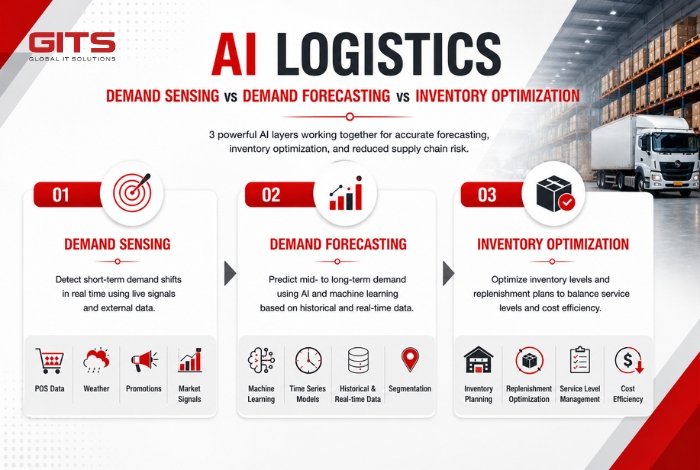
One of the biggest misconceptions in AI logistics is treating demand sensing, demand forecasting, and inventory optimization as the same function. In reality, each plays a distinct role within the supply chain and contributes differently to operational efficiency.
Demand Sensing
Demand sensing focuses on short-term demand shifts using real-time signals such as POS sales, weather changes, and promotional campaigns. Its primary purpose is to react immediately to fluctuations in demand, allowing businesses to adjust operations quickly and avoid disruptions.
Demand Forecasting
Demand forecasting focuses on mid- and long-term planning by predicting future demand based on historical patterns and market behavior. Its purpose is to support strategic decision-making, helping organizations plan production, procurement, and distribution more effectively.
Inventory Optimization
Inventory optimization uses insights from demand forecasting to balance stock levels, storage space, and replenishment timing. Its purpose is to improve cost efficiency by minimizing excess inventory while ensuring product availability.
Together, these three layers create a comprehensive predictive logistics ecosystem that enhances both responsiveness and long-term planning.
How AI Improves Demand Forecasting Accuracy
AI transforms forecasting by identifying patterns that humans and legacy systems often miss.
Modern AI logistics platforms use multiple forecasting methods.
Time-Series Forecasting Models
Models like LSTM, Prophet, and XGBoost analyze historical trends and seasonality.
They improve long-range forecasting accuracy.
Real-Time Demand Sensing
By integrating live data from WMS, OMS, TMS, ERP, and IoT systems, AI can detect immediate demand changes.
This improves short-term response.
Demand Clustering
AI can segment demand behavior by product, region, customer type, or season.
This creates more precise forecasting models.
Reinforcement Learning for Adaptive Planning
Reinforcement learning allows AI systems to improve forecasting decisions based on outcomes over time.
This supports continuous optimization.
These technologies are becoming core drivers of the AI in logistics market.
How AI Agents Turn Forecasts Into Autonomous Actions
Forecasting alone is no longer enough, as the next evolution lies in execution. This is where AI Agents become critical, acting as autonomous systems that not only analyze demand but also trigger actions.
Examples include:
• detecting sudden regional demand spikes
• reallocating inventory between warehouses
• adjusting procurement schedules
• recommending transportation capacity changes
• triggering replenishment orders automatically
This creates a closed-loop logistics model where forecasting leads to decision-making and then to action. For enterprise logistics teams, this approach reduces human workload while increasing operational speed, making it one of the strongest AI solution strategies in AX transformation.
Business Benefits of AI-Powered Forecasting
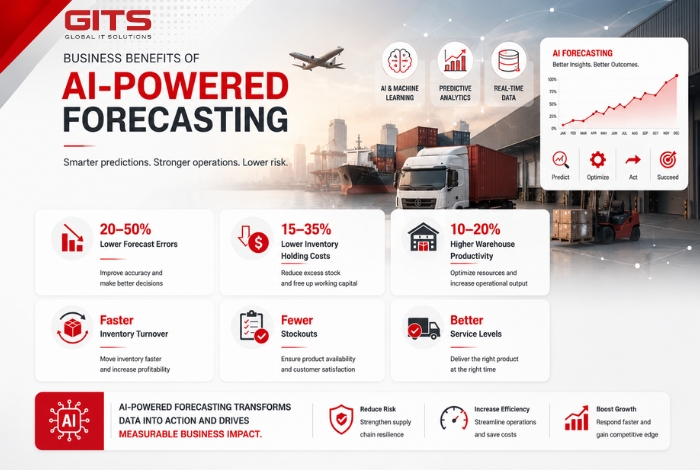
According to McKinsey & Company, AI-driven supply chains can significantly reduce forecasting errors and improve inventory efficiency.
Companies adopting AI demand forecasting in logistics often see:
• 20–50% lower forecasting errors
• 15–35% lower inventory holding costs
• 10–20% higher warehouse productivity
• Faster inventory turnover
• Reduced stockout frequency
• Improved service levels
Beyond cost savings, the biggest benefit is resilience.
When supply chain disruptions happen, AI allows businesses to react faster and recover faster.
>>> See More: AI in logistics optimize supply chain operations
Traditional Forecasting vs AI Forecasting in Logistics
| Factor | Traditional Forecasting | AI Forecasting |
|---|---|---|
| Data Source | Historical only | Historical + Real-time + External |
| Adaptability | Low | High |
| Speed | Manual / Slow | Automated / Fast |
| Accuracy | Moderate | High |
| Risk Detection | Reactive | Predictive |
| Automation | Limited | Autonomous with AI Agents |
This comparison clearly shows why enterprises are accelerating investment in AI logistics.
Real-World Use Cases Across Industries
AI demand forecasting is expanding across multiple sectors.
Retail and E-commerce
Predicting high-volume order peaks during campaigns and seasonal events.
Manufacturing
Supporting lean production and procurement scheduling.
Healthcare Logistics
Managing critical stock levels for medical supplies and temperature-sensitive products.
Automotive Supply Chains
Reducing supplier disruptions and production bottlenecks.
This cross-industry adoption is fueling growth in the AI in logistics market globally.
How to Start AI Adoption in Logistics
For many enterprises, successful adoption starts with a phased strategy.
Step 1: Assess data maturity across WMS, OMS, ERP, and TMS.
Step 2: Identify the biggest forecasting bottlenecks.
Step 3: Deploy AI models in a limited workflow.
Step 4: Introduce AI agents for execution automation.
Step 5: Scale into a full predictive logistics ecosystem.
This approach is particularly effective for enterprise AX transformation in Japan and Korea, where operational precision is critical.
FAQ About AI Demand Forecasting in Logistics
How accurate is AI demand forecasting in logistics?
AI forecasting can reduce forecasting errors by 20–50% compared to traditional models, depending on data quality and system integration.
Can AI agents automate inventory replenishment?
Yes. AI agents can monitor stock levels, predict shortages, and trigger replenishment orders automatically.
Which industries benefit the most from AI logistics forecasting?
Retail, manufacturing, healthcare, and automotive sectors benefit the most due to complex supply-demand dynamics.
Is AI forecasting suitable for small logistics businesses?
Yes. Scalable cloud-based AI solutions make forecasting technology accessible even for small and mid-sized businesses.
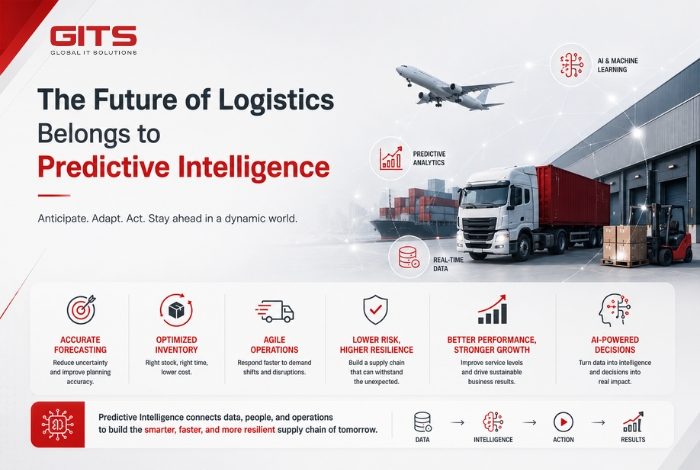
The Future of Logistics Belongs to Predictive Intelligence
Demand forecasting is no longer just about estimating future sales. It is about building a resilient, intelligent supply chain that can adapt in real time. As the AI in logistics market continues to expand, businesses that adopt AI demand forecasting in logistics will gain a clear competitive advantage.
From demand sensing and forecasting to inventory optimization and autonomous execution, AI is reshaping how logistics works. The companies that move first will not only reduce risk, but also define the future of supply chain intelligence.