






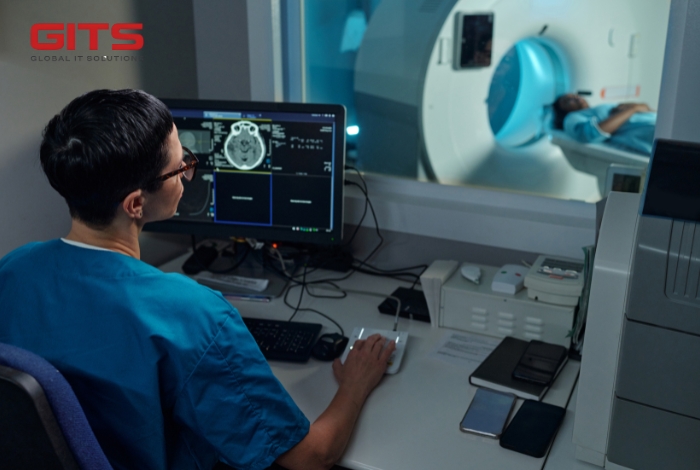
Medical Image Processing refers to the acquisition, enhancement, analysis, and visualization of medical imaging data generated by diagnostic modalities such as CT, MRI, CBCT, PET, and X-ray systems.
As healthcare organizations accelerate their digital transformation initiatives, medical imaging has evolved beyond a diagnostic support tool into a critical source of clinical intelligence. Modern healthcare providers increasingly rely on advanced Medical Imaging Software to improve diagnostic precision, optimize treatment planning, and support data-driven decision-making.
Across global healthcare markets, including Japan, South Korea, North America, and Europe, medical image processing is becoming a foundational technology for AI-powered healthcare ecosystems.
Project Overview
The client is a healthcare technology company specializing in diagnostic imaging solutions for hospitals, clinics, and specialized medical centers.
As imaging volumes continue to grow and clinical expectations for diagnostic accuracy increase, the organization sought to develop a next-generation Medical Imaging Software platform capable of delivering advanced image visualization, measurement, and analysis capabilities.
The primary objective was to create a scalable solution that not only supports current imaging workflows but also provides a future-ready foundation for AI Medical Imaging applications.
Business and Technical Challenges
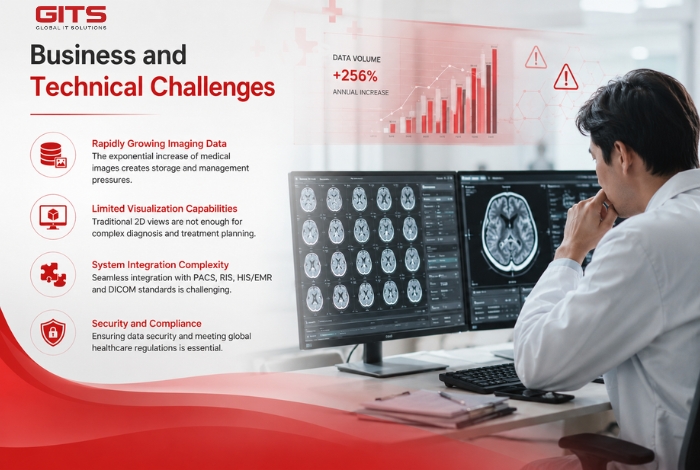
Managing Increasing Volumes of Medical Imaging Data
Modern CT and MRI examinations can generate hundreds or even thousands of image slices per patient. Reviewing these datasets manually requires significant time and effort, creating operational challenges for radiologists and clinicians.
Healthcare providers worldwide face increasing pressure to improve efficiency while maintaining high diagnostic accuracy. As patient volumes continue to rise, reducing interpretation time without compromising quality has become a strategic priority.
Limited Visualization Capabilities in Traditional Systems
Many conventional imaging platforms focus primarily on 2D image viewing, making it difficult for clinicians to fully understand complex anatomical structures.
This limitation can impact critical healthcare workflows such as:
– Surgical planning
– Digital dentistry
– Orthopedic treatment planning
– Tumor assessment
– Implant design and placement
Advanced visualization capabilities have therefore become essential for modern clinical practice.
Demand for Interoperability Across Healthcare Systems
Healthcare organizations increasingly require seamless integration between imaging platforms and existing clinical systems.
This includes interoperability with:
– DICOM Servers
– PACS (Picture Archiving and Communication Systems)
– RIS (Radiology Information Systems)
– HIS, EMR, and EHR platforms
Without proper integration, healthcare providers face workflow inefficiencies, fragmented data access, and increased operational costs.
Medical Image Processing Solution
Developing a Specialized Medical Imaging Software Platform
To address these challenges, the development team built a cloud-enabled Medical Imaging Software solution leveraging:
– C# .NET
– WinForms
– OpenCV
– Advanced Medical Visualization Technologies
The architecture was designed with scalability in mind, allowing healthcare organizations to expand capabilities as clinical and business requirements evolve.
Advanced DICOM Viewer and Measurement Tools
The platform includes a comprehensive DICOM Viewer equipped with advanced measurement and analysis capabilities.
Key functionalities include:
– Distance measurement
– Linear and angular measurement
– Radius and diameter calculation
– Region of Interest (ROI) analysis
– Histogram analysis
– Signal-to-Noise Ratio (SNR) calculation
– Image density evaluation
These capabilities help clinicians perform more precise assessments and support evidence-based treatment decisions.
3D Reconstruction and Multi-Planar Visualization
One of the platform’s core strengths is its ability to transform imaging datasets into highly detailed three-dimensional visualizations.
Supported technologies include:
– Surface Rendering
– Volume Rendering
– Multi-Planar Reconstruction (MPR)
– Simultaneous Axial, Coronal, and Sagittal Views
By providing a more comprehensive view of anatomical structures, the platform enables clinicians to better understand patient conditions and improve treatment planning accuracy.
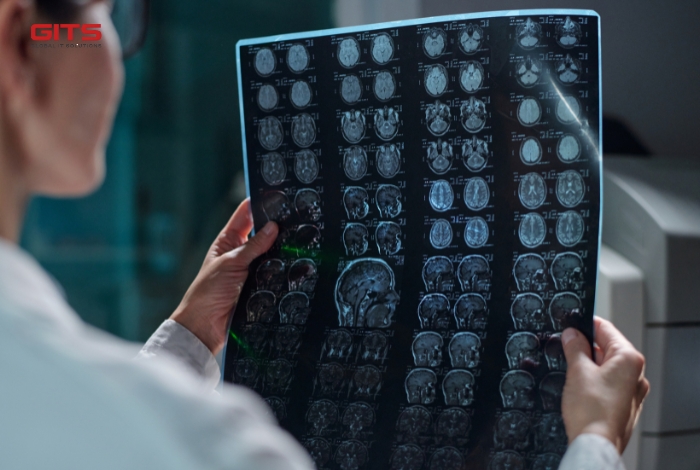
Image Enhancement Powered by Computer Vision
The solution incorporates advanced image processing algorithms using OpenCV to improve image quality and support more effective clinical analysis.
Capabilities include:
– Noise Reduction
– Gaussian Filtering
– Sobel Edge Detection
– Image Sharpening
– Smoothing and Enhancement
These technologies help improve image clarity while preserving clinically significant details.
Built for AI Medical Imaging and Intelligent Healthcare
The platform has been designed as a foundation for Healthcare AI Transformation initiatives.
Future AI-driven capabilities may include:
– Automated lesion detection
– AI-powered segmentation
– Tumor identification and classification
– Automated measurement assistance
– Clinical decision support systems
– AI Agents for healthcare professionals
This future-ready architecture enables healthcare organizations to gradually adopt AI while maintaining operational continuity.
Technology Stack and Compliance Considerations
Beyond performance and scalability, healthcare software solutions must meet strict security and regulatory requirements.
The platform can be aligned with industry standards such as:
– HIPAA Compliance
– GDPR Compliance
– ISO 13485
– IEC 62304
These frameworks are particularly important for organizations operating in highly regulated healthcare markets such as Japan, South Korea, the United States, and the European Union.
Results and Business Impact
Following implementation, the client gained a scalable Medical Imaging Software platform capable of supporting both current and future clinical requirements.
Key outcomes include:
– Faster image review and analysis workflows
– Improved diagnostic confidence
– Enhanced 3D visualization capabilities
– More effective treatment planning
– A scalable foundation for AI-driven healthcare innovation
For specialties such as digital dentistry, maxillofacial surgery, and orthopedics, advanced 3D visualization significantly improved clinical workflow efficiency and treatment preparation.
Expert Perspective
Based on industry experience across healthcare technology projects in Asia-Pacific and global markets, advanced visualization and intelligent image analysis are becoming critical differentiators for healthcare providers.
Organizations that invest in medical image processing technologies today are better positioned to improve patient outcomes, increase operational efficiency, and accelerate their AI adoption journey in the future.
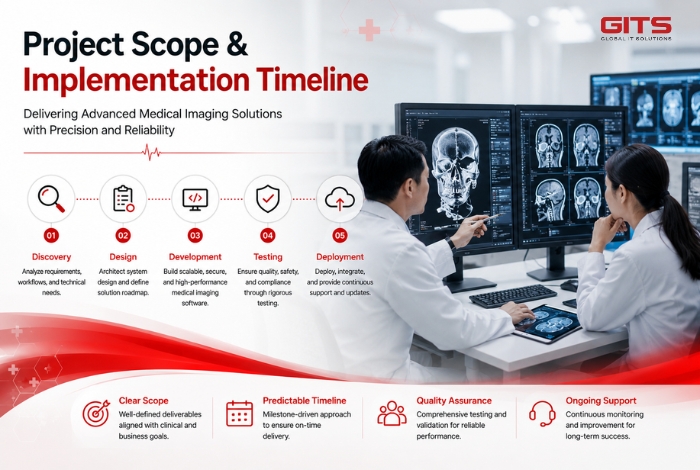
Project Scope and Implementation Timeline
Project Scope
The solution was designed for healthcare organizations requiring advanced medical imaging capabilities across multiple hospitals, clinics, and specialty care centers.
The architecture supports future scalability in terms of users, imaging data volumes, and AI-powered functionalities.
Implementation Timeline
Phase 1: Discovery and Requirements Analysis
Gather business requirements, assess clinical workflows, and define the overall system architecture.
Phase 2: Core Viewer Development
Develop DICOM viewing capabilities, measurement tools, and image visualization modules.
Phase 3: 3D Visualization Development
Implement Multi-Planar Reconstruction, Surface Rendering, and Volume Rendering capabilities.
Phase 4: Image Processing Optimization
Integrate OpenCV and advanced image enhancement algorithms.
Phase 5: Testing and Deployment
Conduct performance validation, user training, and production deployment.
>>> See More: AI-Powered Patient Workflow Optimization
Frequently Asked Questions
How is Medical Image Processing different from a standard image viewer?
Medical image processing platforms provide advanced analytical capabilities such as image enhancement, measurement, segmentation, and 3D visualization, whereas standard viewers primarily focus on image display.
Why is DICOM important in Medical Imaging Software?
DICOM is the global standard for storing, transmitting, and managing medical imaging data, enabling interoperability between healthcare systems and imaging devices.
How can AI improve medical image processing?
AI can assist healthcare professionals through automated lesion detection, image segmentation, anomaly identification, measurement automation, and clinical decision support.
Why is PACS integration important?
PACS enables centralized image storage, retrieval, and sharing across healthcare organizations, improving collaboration and operational efficiency.
What are the benefits of 3D visualization in healthcare?
3D visualization helps clinicians better understand complex anatomical structures, improve treatment planning, reduce procedural risks, and enhance patient communication.

Medical Image Processing as the Foundation of Healthcare AI Transformation
Medical Image Processing is rapidly becoming one of the most important technologies driving the future of healthcare. By combining DICOM viewing, PACS integration, advanced 3D visualization, Computer Vision, and AI Medical Imaging, healthcare organizations can significantly improve diagnostic accuracy, optimize clinical workflows, and enhance patient care outcomes.
For hospitals, clinics, and healthcare technology providers seeking to accelerate digital transformation, investing in next-generation Medical Imaging Software is no longer simply a technology upgrade. It is a strategic initiative that enables long-term innovation, operational excellence, and sustainable competitive advantage in the evolving healthcare landscape.