







E-commerce website development is no longer just about creating an online storefront. In today’s rapidly evolving digital economy, businesses require scalable, flexible, and future-ready platforms capable of supporting omnichannel commerce, integrating multiple business systems, and leveraging emerging technologies such as AI Solutions, AI Agents, and AI Transformation (AX).
However, many enterprises across Vietnam, Japan, South Korea, and global markets continue to rely on legacy e-commerce platforms built years ago. These systems often operate on traditional monolithic architectures, making it difficult to scale operations, accelerate innovation, and integrate modern technologies.
This case study highlights how an enterprise successfully modernized its e-commerce ecosystem by migrating from a legacy monolithic platform to a cloud-native Microservices architecture, creating a foundation for long-term growth and digital transformation.
Customer Background
The client is a sales and distribution company operating a large-scale e-commerce platform that supports multiple business partners and customer segments.
While the existing system had served the business for many years, increasing customer demand and business expansion exposed several technical limitations that were slowing growth and reducing operational agility.
The company sought to build a modern e-commerce platform capable of supporting diverse business models, accelerating innovation, and enabling future AI-driven initiatives.
Challenges of the Legacy Platform
Monolithic Architecture Slowed Business Agility
The existing platform was built using a monolithic architecture where all application components were tightly coupled.
As a result, even minor feature updates required extensive testing and redeployment of the entire system. This increased operational risk, extended development cycles, and limited the organization’s ability to respond quickly to market changes.
Outdated Frameworks Restricted Scalability
The legacy technology stack was no longer aligned with modern business requirements.
Integrating advanced capabilities such as AI Solutions, Machine Learning, Data Analytics, and Cloud Native Services became increasingly complex and costly, leading to higher maintenance efforts and reduced innovation capacity.
Limited Integration Across the Business Ecosystem
The company needed seamless connectivity with various enterprise systems, including:
• Online payment gateways
• Logistics platforms
• Accounting systems
• Inventory management systems
• Data warehouses
• Analytics platforms
However, the existing architecture lacked the flexibility required to support enterprise-scale integrations efficiently.

E-commerce Website Development with a Microservices Architecture
Following a comprehensive assessment, GITS designed a modernization strategy focused on three key objectives: platform modernization, scalability enhancement, and AI readiness.
Building a Microservices-Based E-commerce Platform
The new platform was redesigned as a collection of independent services, enabling greater flexibility, faster development cycles, and easier maintenance.
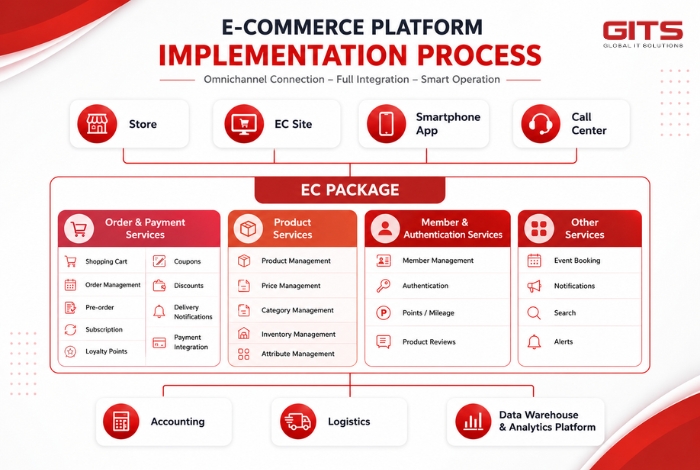
Core service domains included:
Order and Payment Services
Managing shopping carts, payments, discount programs, subscriptions, recurring purchases, and customer loyalty programs.
Product Management Services
Supporting product catalogs, pricing management, inventory tracking, and category management in real time.
Membership and Authentication Services
Providing customer account management, authentication, loyalty points, and product review capabilities.
Content and Search Services
Delivering content management, intelligent search, notifications, and enhanced user experiences through independent service modules.
Implementing DevOps and CI/CD
One of the primary goals of the project was to accelerate software delivery while reducing operational risk.
The organization adopted DevOps practices and CI/CD pipelines to automate testing, deployment, and monitoring processes.
This enabled faster feature releases, improved deployment reliability, and reduced time-to-market for new business initiatives.
Deploying on AWS Cloud Infrastructure
The entire platform was deployed on AWS Cloud to ensure scalability, resilience, and cost efficiency.
The cloud-native architecture allows the business to handle traffic spikes during major shopping events such as Black Friday, Cyber Monday, and seasonal promotional campaigns without compromising performance.

Project Scope and Implementation Timeline
The project followed an Agile Scrum methodology with two-week development sprints to ensure transparency, flexibility, and continuous stakeholder collaboration.
Implementation was divided into three strategic phases.
Phase 1: Assessment and Migration Planning
The technical team conducted a comprehensive analysis of the existing platform, identified operational risks, and developed a phased migration roadmap.
Phase 2: Platform Development
Core services were developed using ReactJS, Node.js, and ExpressJS on AWS Cloud infrastructure.
The platform was designed following cloud-native principles and prepared for future AI Commerce integrations.
Phase 3: Data Migration and Go-Live
Data migration was executed incrementally to minimize business disruption and ensure operational continuity.
Performance testing, security validation, and integration testing were completed before the platform was officially launched.
>> See More: Enhancing retail efficiency with AI-driven demand forecasting
Business Outcomes and Measurable Results
Following the successful implementation of the new e-commerce platform, the company achieved several significant improvements.
System scalability increased substantially due to the adoption of Microservices architecture.
The time required to release new features was significantly reduced compared to the previous development model.
Customization capabilities improved, allowing the business to respond more effectively to unique customer and partner requirements.
Integration with payment providers, logistics services, and analytics platforms became more streamlined and efficient.
Most importantly, the new architecture established a strong foundation for future AI initiatives, including AI Recommendation Engines, AI-Powered Customer Service Agents, Intelligent Product Search, and Predictive Analytics.
Key Lessons Learned
Many modernization initiatives fail because organizations attempt to replace their entire platform in a single deployment.
This project demonstrated that a phased migration strategy combined with Microservices architecture provides a lower-risk and more sustainable approach for large-scale e-commerce environments.
The project also reinforced the importance of building an open and extensible architecture from the outset, enabling future integration of AI Solutions, AI Agents, and emerging technologies without requiring major system redesigns.
The Next Evolution: AI Agents and AI Commerce
As digital commerce continues to evolve, enterprises are increasingly integrating AI across the entire customer journey.
Technologies such as AI Shopping Assistants, AI Recommendation Engines, Conversational Commerce, and Autonomous AI Agents are becoming key competitive differentiators.
Because the new platform was built on Microservices and cloud-native principles, the organization is well-positioned to accelerate AI Transformation and enterprise-wide AX initiatives in the years ahead.

Modern Platforms Drive Sustainable E-commerce Growth
E-commerce website development today extends far beyond building an online sales channel. It represents the modernization of the entire digital commerce ecosystem.
By transitioning from a monolithic architecture to Microservices, adopting DevOps practices, leveraging cloud computing, and preparing for AI-driven innovation, the company established a scalable, resilient, and future-ready platform.
For enterprises across Vietnam, Japan, South Korea, and global markets, modernizing e-commerce infrastructure is becoming a strategic necessity for maintaining competitiveness and unlocking long-term growth in the AI-powered digital economy.