






This case study presents how GITS delivered an AI Services project to build a Smart Parking System that provides real time parking guidance using fisheye cameras and analytics. The goal was to transform existing AI camera devices into an operational system that can detect parking availability, support daily monitoring, and integrate cleanly with a video management ecosystem.
The project focuses on practical delivery rather than experimental AI. It combines computer vision configuration, multi stream video processing, system integration, and operational readiness so the solution can run reliably in a live parking environment.
The customer and the business goal behind the project
A Korean security manufacturer extending its AI camera portfolio
The customer is a Korean security manufacturer with an established portfolio of AI camera devices. They aimed to expand into smart parking guidance by leveraging the existing camera hardware and building a solution that helps drivers identify available parking spaces faster.
What the parking operator needed to improve
From an operator perspective, the Smart Parking System is expected to improve parking space utilization and reduce time spent searching for available spots. That translates into smoother traffic flow and better efficiency for parking management.
What made this smart parking system technically challenging
Handling multi stream video while keeping performance stable
A key requirement was supporting multi stream video with the ability to run up to five channels simultaneously. In real deployments, multi channel streaming introduces constraints across bandwidth, decoding, stability, and monitoring. A smart parking platform must maintain consistent performance under concurrent streams while keeping latency low enough for real time guidance.
Making detection zones match the physical parking layout
Computer vision in parking lots is sensitive to camera placement, lighting, and perspective. The system required vehicle detection zones to be defined precisely so that detection aligns with each space or lane segment. The project implemented a method to configure zones using direct points, enabling operators to map detection areas to the real parking geometry with minimal ambiguity.
Giving operators practical control with DPTZ
The solution needed DPTZ control so operators can fine tune the camera field of view during operations. For fisheye cameras, effective DPTZ improves usability by enabling focus on high traffic areas, low visibility corners, or zones where occlusion is more frequent.
Connecting analytics to alert workflows through alarm I O
The platform needed to support analytics outputs and connect to alarm input output flows. In smart parking operations, alert workflows are essential for incident response and daily monitoring. This includes the ability to trigger notifications based on events or detection conditions and integrate those signals into existing systems.
Ensuring the solution fits into a Wisenet WAVE VMS environment
The customer required compatibility with the Wisenet WAVE video management software platform. For enterprise deployments, VMS compatibility is critical because monitoring screens, user roles, and retention policies often sit inside the VMS ecosystem.
How GITS delivered the implementation from integration to operations
Scope of delivery across build test and support
GITS delivered the project end to end, covering development and unit testing, camera integration testing, and maintenance and operational support. The implementation prioritized stability, configuration clarity, and integration readiness so the Smart Parking System could be adopted as a production product.
Building a 5 channel streaming foundation with RJ 45 camera connectivity
The system supports five channel streaming to process multiple camera inputs simultaneously. Cameras connect through cable conduits via an RJ 45 port, enabling standardized deployment and simplified expansion when adding new camera feeds.
Configuring occupancy logic with point defined detection zones
GITS implemented zone configuration so operators can define vehicle detection zones using direct points. This matters in practice because parking layouts vary widely, and a flexible zoning tool reduces calibration time during installation and future site changes.
Operational video features needed in real environments
To support daily operations, the solution includes features commonly required in security and monitoring contexts, including audio detection, blurring, and video manipulation, along with configurable analytics and alarm I O flows.
Keeping monitoring consistent with Wisenet WAVE
GITS ensured the system works within Wisenet WAVE so the customer can keep familiar monitoring workflows and reduce change friction for teams already invested in the VMS environment.
A simple architecture view of the smart parking workflow
From camera feeds to guidance and alerts
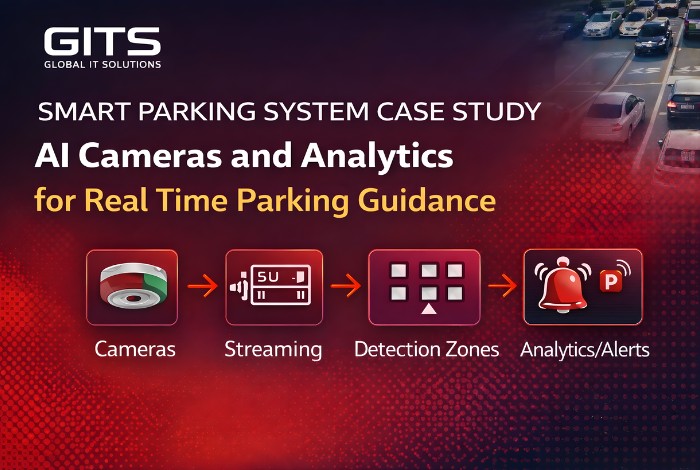
At a high level, the system follows a clear operational pipeline
Cameras
Wide-angle and AI cameras capture video covering multiple parking zones per camera.
Streaming
The streaming layer handles concurrent channels, delivering stable frames for analytics and viewing.
Detection zones
Zones are defined by direct points and mapped to physical parking spaces or monitored areas.
Analytics and alerts
The analytics layer processes events and outputs signals to alert workflows and operational dashboards.
This architecture emphasizes reliability and configurability, which are essential for enterprise smart parking deployments.
Technology stack used in the project
UI layer with ReactJS and ExpressJS
The user interface is implemented using ReactJS and ExpressJS to support configuration, monitoring, and daily workflow operations.
Backend services with C# .NET MVC
The backend uses C# .NET MVC to manage integration logic, event handling, configuration patterns, and service APIs.
Testing approach and operational readiness
Unit testing to validate core functions
GITS conducted unit testing for key functions including multi stream handling, zone configuration logic, and alert workflows.
Integration testing with real camera feeds
Integration testing verified camera connectivity, streaming stability, DPTZ behavior, and correctness of zone mapping under real conditions. This phase is essential because parking environments vary and computer vision outcomes depend on calibration.
Maintenance and support for production environments
GITS provides operational support to handle real world changes such as camera repositioning, lighting shifts, new zones, seasonal usage patterns, and monitoring environment updates.
Measurable results and the KPI set recommended for going live
This brief does not include final numeric outcomes. To measure success after pilot or go live, GITS recommends tracking:
Detection accuracy by zone
Evaluate how accurately the system identifies occupancy status in each zone, including precision and recall.
Real time latency
Measure end to end latency from capture to updated occupancy state.
Stream uptime and stability
Track uptime, reconnection behavior, and stability when running up to five channels concurrently.
False alarm rate
Measure incorrect alert triggers to reduce operational noise and improve trust.
Time to park improvement when data is available
If the operator has data, compare average time to find a space before and after deployment to quantify business impact.
Project scale and timeline in a realistic delivery model
Exact duration depends on site size, number of cameras, and deployment constraints. A practical structure typically follows:
Phase 1 Align on requirements and integration boundaries
Define coverage areas, camera assumptions, zoning strategy, and VMS integration needs.
Phase 2 Build the streaming zoning and analytics components
Implement the streaming foundation, configuration UI, zoning logic, and alert workflows.
Phase 3 Validate on site through integration testing
Test real feeds, tune zones, confirm DPTZ controls, and verify Wisenet WAVE compatibility.
Phase 4 Stabilize go live and support ongoing operations
Monitor performance, reduce false alarms, and optimize the system for long term stability.
>>> See more: Vehicles license plates recognition
Smart parking system outcomes designed for accuracy latency and uptime
This Smart Parking System case study demonstrates a practical AI delivery approach where the key success factor is not only computer vision, but the ability to integrate into real operations. By combining multi stream video, point defined detection zones, DPTZ controls, analytics and alarm I O, and Wisenet WAVE compatibility, GITS delivered a system designed to run reliably in production environments and support measurable outcomes after going live.