






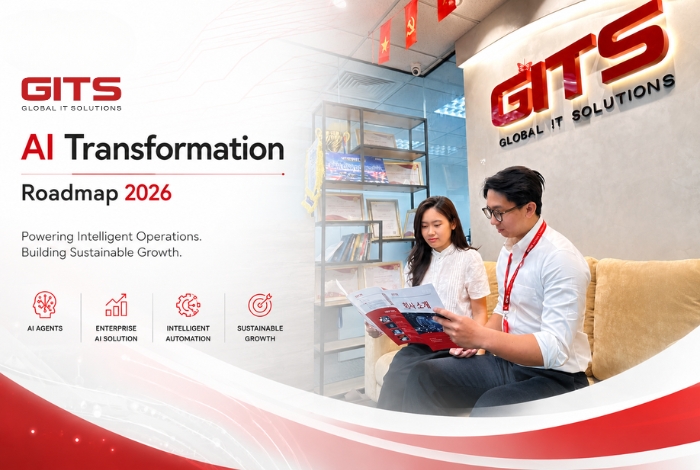
AI transformation is becoming a strategic priority for enterprises in 2026 as businesses across Japan, South Korea, Vietnam, and global markets face increasing pressure to improve operational efficiency, accelerate decision-making, and deliver more intelligent customer experiences. Traditional digital transformation is no longer enough to maintain competitiveness in an increasingly AI-driven economy.
Modern enterprises are now shifting toward AI-powered operations through AI Agents, predictive analytics, enterprise AI solutions, and autonomous workflows. The challenge for enterprise leaders is no longer whether to adopt AI, but how to build a scalable AI transformation roadmap that delivers measurable business value while ensuring long-term operational stability and growth.
Why AI Transformation Becomes Essential for Enterprises in 2026
The global business landscape is evolving faster than ever. Enterprises across manufacturing, finance, retail, healthcare, education, logistics, and technology sectors are facing increasing pressure to operate more efficiently while adapting to rapid market changes.
Organizations that fail to integrate AI into their operations risk losing competitiveness in an increasingly intelligent and data-driven economy.
Rising Operational Complexity
As enterprises expand across multiple markets and digital ecosystems, operational complexity continues increasing significantly.
Companies now manage enormous amounts of enterprise data, multi-channel customer interactions, distributed workforces, hybrid operational environments, and increasingly complex business processes. Traditional systems alone can no longer manage this level of operational demand efficiently.
AI transformation enables enterprises to automate repetitive workflows, improve visibility across operations, and support faster strategic decision-making at scale.
Data Is Growing Faster Than Human Decision-Making
Modern enterprises generate massive amounts of operational and customer data every day. However, many organizations still struggle to convert fragmented data into actionable intelligence.
Without AI-powered analysis, businesses remain reactive instead of predictive.
Enterprise AI solutions help organizations identify patterns, forecast risks, optimize resources, and generate real-time business insights. This allows enterprises to make smarter decisions faster while improving overall operational efficiency.
Customer Expectations Continue to Increase
Customers in 2026 expect more personalized, responsive, and intelligent experiences across every touchpoint.
Enterprises are now under pressure to provide faster response times, predictive support, seamless digital experiences, and highly personalized customer engagement.
AI transformation helps businesses deliver these capabilities while simultaneously optimizing operational performance.

The Shift from Digital Transformation to AX
For years, digital transformation focused primarily on digitizing workflows and modernizing enterprise infrastructure.
In 2026, the focus is shifting toward AX, also known as AI Transformation.
Unlike traditional digital transformation, AX integrates AI intelligence directly into enterprise operations. AI becomes part of how organizations analyze information, automate decisions, optimize workflows, and improve customer experiences in real time.
This transition is fundamentally reshaping how enterprises operate.
Instead of relying solely on manual coordination and static workflows, enterprises are moving toward intelligent operational ecosystems where AI Agents continuously support, automate, and optimize business activities.
This evolution enables organizations to achieve:
– Faster decision-making
– Higher operational efficiency
– Improved forecasting accuracy
– Better customer experiences
– Greater business agility
– Stronger organizational resilience
For many enterprises, AX is becoming a key driver of long-term competitiveness and sustainable growth.

The Biggest Challenges Enterprises Face During AI Transformation
Although AI adoption continues accelerating globally, many enterprises still struggle to achieve measurable business outcomes from their AI initiatives. The challenge is rarely the technology itself. The real challenge lies in execution strategy, operational alignment, and organizational readiness.
Legacy Systems and Fragmented Infrastructure
Many enterprises continue operating on disconnected systems built over multiple years or even decades. ERP, CRM, HRM, financial systems, and operational platforms often function independently, making enterprise-wide data integration difficult. Without unified infrastructure, AI models cannot access reliable and consistent enterprise data. This significantly limits the effectiveness of enterprise AI solutions.
AI Projects Lack Enterprise-Wide Integration
In many organizations, AI initiatives are implemented as isolated pilot projects within specific departments. While these projects may demonstrate short-term success, they often fail to create scalable business impact across the organization. Successful AI transformation requires enterprise-wide integration rather than isolated experimentation.
Fear of Operational Disruption
Many enterprises hesitate to accelerate AI adoption because they fear security vulnerabilities, compliance risks, workflow interruptions, and operational instability.
This concern is especially common among Japanese and Korean enterprises where operational continuity, precision, and long-term reliability are highly prioritized.
Limited Internal AI Expertise
Many organizations still lack experienced AI strategists capable of aligning AI initiatives with real business objectives.
As a result, enterprises often invest in AI technologies without clear KPIs, governance structures, or scalable implementation roadmaps.
AI Transformation Roadmap 2026 for Enterprise
Successful AI transformation requires a structured and scalable roadmap aligned with business priorities, operational maturity, and long-term growth objectives.
Build a Unified Data Foundation
AI performance depends heavily on data quality and accessibility. Before deploying enterprise AI solutions, organizations must establish a centralized and connected data environment capable of integrating information across departments and operational systems.
This includes enterprise platforms such as ERP, CRM, HRM, cloud infrastructure, operational databases, and customer interaction systems. Unified data architecture enables AI systems to generate more accurate insights and support enterprise-wide intelligence.
Prioritize High-Impact Business Use Cases
Not every business process should be automated immediately.
Enterprises should first focus on areas where AI can generate measurable operational value within a relatively short timeframe.
High-impact use cases often include:
– Customer service automation
– Intelligent document processing
– Predictive analytics
– Workforce optimization
– Financial forecasting
– AI-powered decision support
– Enterprise workflow automation
This phased implementation approach reduces operational risk while increasing internal confidence in AI transformation initiatives.
Deploy AI Agents Across Enterprise Operations
AI Agents are becoming one of the most transformative technologies within modern enterprise environments.
Unlike conventional automation systems, AI Agents can analyze data, coordinate workflows, trigger actions autonomously, and continuously optimize operational processes.
Within enterprise operations, AI Agents can:
– Support strategic decision-making
– Automate repetitive workflows
– Coordinate cross-functional operations
– Generate intelligent recommendations
– Improve customer engagement
– Enhance productivity across departments
This enables enterprises to move toward intelligent operational ecosystems rather than traditional static workflows.
Scale Enterprise AI Solutions Strategically
Once early AI initiatives demonstrate measurable business outcomes, enterprises can begin scaling AI transformation across broader organizational ecosystems. This phase focuses on enterprise AI governance, workforce AI readiness, security management, cross-department integration, performance monitoring, and continuous optimization.
Organizations that successfully scale AI transformation often achieve long-term advantages in efficiency, innovation capacity, and business agility.

Enterprise AI Trends Defining 2026
Several major trends are expected to shape enterprise AI transformation strategies throughout 2026.
Multi-Agent AI Ecosystems
Enterprises are increasingly deploying multiple AI Agents capable of collaborating across departments and operational systems. This creates more adaptive, scalable, and intelligent enterprise environments.
Human-Centered AI Adoption
Rather than replacing employees entirely, enterprises are prioritizing AI strategies that enhance human productivity and support decision-making. This balanced approach improves workforce acceptance while supporting sustainable organizational growth.
AI Governance and Responsible AI
As AI adoption accelerates globally, enterprises are investing heavily in enterprise AI governance, regulatory compliance, data privacy protection, and responsible AI deployment. These capabilities are becoming essential for large-scale AI transformation initiatives.
Predictive and Autonomous Operations
AI transformation is shifting enterprises from reactive operational models toward predictive and autonomous business environments. Organizations can now identify risks, optimize resources, and automate decisions before operational issues escalate.
Why Japan, Korea, and Vietnam Are Accelerating AI Transformation
Japan
Japanese enterprises are increasingly adopting AI to address labor shortages, improve productivity, and maintain operational precision while preserving long-term business stability.
South Korea
South Korean enterprises continue investing aggressively in AI-driven innovation to strengthen global competitiveness across manufacturing, technology, finance, and enterprise services.
Vietnam
Vietnam is rapidly emerging as a strategic digital transformation hub in Southeast Asia. Enterprises are accelerating AI adoption to improve scalability, optimize operations, and compete more effectively in global markets.
>>> See More: Top AI Solution Trends for Enterprise Growth in 2026
How GITS Supports Enterprise AI Transformation
As enterprises accelerate AI transformation initiatives, the challenge is no longer simply adopting AI technologies. The real challenge lies in integrating AI into complex enterprise environments while maintaining scalability, operational continuity, and long-term business stability.
This is where GITS delivers long-term enterprise value. With strong expertise in enterprise software development, AI solutions, and intelligent operational systems, GITS helps organizations build practical AI transformation strategies tailored to real business environments.
Rather than deploying isolated AI tools, GITS focuses on building connected enterprise AI ecosystems capable of integrating seamlessly with existing ERP, CRM, HRM, and enterprise infrastructures. From AI Agents and intelligent workflow automation to predictive analytics and enterprise AI platforms, GITS supports businesses throughout every stage of AI transformation.
For enterprises in Japan, Korea, Vietnam, and global markets, GITS provides a balanced approach between technological innovation, operational reliability, and long-term scalability. By combining deep enterprise expertise with advanced AI capabilities, GITS helps organizations move beyond traditional digital transformation toward sustainable AI-powered growth.
AI Transformation Will Define Enterprise Leadership in 2026
The enterprises leading the market in 2026 will not simply be the organizations investing in more technology. They will be the companies capable of integrating AI transformation strategically across operations, decision-making, customer experience, and long-term business strategy.
AI Agents, enterprise AI solutions, predictive intelligence, and autonomous operational ecosystems are rapidly becoming the new foundation of modern enterprises. For businesses across Japan, South Korea, Vietnam, and global markets, the competitive window for AI transformation is narrowing quickly.
Organizations that establish a scalable AI transformation roadmap today will position themselves for stronger operational resilience, higher productivity, greater innovation capacity, and sustainable competitive leadership in the AI-driven economy.