





The global race toward AI adoption is entering a new phase.
As enterprises move beyond generative AI and traditional automation, the focus is shifting toward AI agents that can reason, plan, make decisions, and execute tasks autonomously. Unlike conventional AI systems that respond to individual prompts, AI agents can pursue goals, interact with enterprise systems, and coordinate complex workflows.
While the potential is significant, scaling AI agents across an organization requires more than advanced models alone. Enterprises need a structured approach to ensure governance, security, interoperability, and measurable business outcomes.
This is where Agentic AI frameworks play a critical role. They provide the architecture, orchestration, and operational controls needed to deploy and manage AI agents effectively at enterprise scale.
What Are Agentic AI Frameworks?
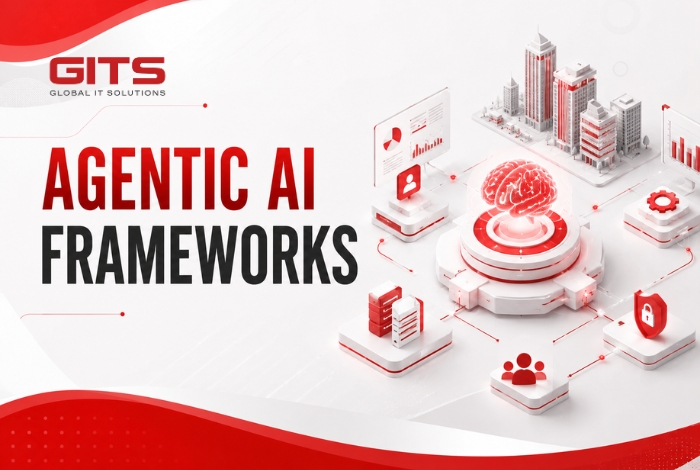
Agentic AI frameworks are enterprise architectures that provide the foundational layers required for autonomous AI agents to operate effectively within business environments.
These frameworks enable AI agents to move beyond content generation and perform goal-oriented actions by combining reasoning, planning, memory, orchestration, tool integration, and governance capabilities.
At a high level, Agentic AI frameworks help organizations answer a critical question:
How can AI agents make decisions and take actions while remaining aligned with business objectives, compliance requirements, and operational standards?
Unlike traditional AI implementations that focus on individual tasks, Agentic AI frameworks create a structured environment where AI agents can collaborate, learn from context, access enterprise systems, and execute multi-step workflows.
Core Layers of an Agentic AI Framework
A modern Agentic AI framework typically consists of six foundational layers:
Reasoning Layer
The reasoning layer enables AI agents to analyze situations, interpret objectives, evaluate options, and determine the most appropriate course of action.
This layer is often powered by large language models and advanced decision-making mechanisms.
Memory Layer
Memory allows AI agents to retain context over time.
Modern frameworks generally include:
– Short-term memory for active tasks
– Long-term memory for historical knowledge
– Vector databases for semantic retrieval
– Enterprise knowledge repositories
Tool Integration Layer
AI agents must interact with business systems to create real business value.
This layer connects agents to:
– ERP platforms
– CRM systems
– Supply chain applications
– Business databases
– APIs
– RPA solutions
Planning Layer
The planning layer enables agents to break complex objectives into smaller tasks and determine the optimal execution sequence.
This capability is essential for enterprise workflow automation.
Agent Orchestration Layer
This layer coordinates interactions between multiple agents, systems, and human stakeholders.
It ensures tasks are delegated efficiently while maintaining visibility and control.
Governance Layer
The governance layer provides oversight, security, compliance, monitoring, and auditability.
For enterprises operating in regulated markets such as Japan, South Korea, Europe, and healthcare environments, governance is a non-negotiable requirement.
Agentic AI vs Traditional AI: Understanding the Difference
Many organizations mistakenly view AI agents as simply more advanced chatbots.
In reality, Agentic AI represents a fundamental shift in how artificial intelligence operates within the enterprise.
| Traditional AI | Agentic AI |
|---|---|
| Responds to prompts | Pursues goals |
| Performs isolated tasks | Executes multi-step workflows |
| Limited memory | Persistent memory and context |
| Human-driven process | Autonomous decision support |
| Static workflows | Dynamic adaptation |
| Minimal system interaction | Deep enterprise integration |
Traditional AI focuses on generating outputs.
Agentic AI focuses on achieving outcomes.
This distinction is one of the primary reasons why Agentic AI frameworks are becoming increasingly important for organizations pursuing large-scale AI Transformation initiatives.

Why Enterprises Are Investing in Agentic AI Frameworks
Enterprise leaders are under increasing pressure to improve efficiency, reduce operational costs, and accelerate innovation.
While traditional automation has delivered meaningful gains, many business processes still require extensive human coordination across multiple systems.
Agentic AI frameworks address this challenge by enabling autonomous AI systems capable of managing complex workflows.
Key business drivers include:
– Workforce productivity enhancement
– Operational efficiency improvement
– Faster decision-making
– Reduced manual processes
– Improved customer experiences
– Enhanced business agility
Organizations that successfully implement Agentic AI frameworks gain a significant competitive advantage by creating scalable AI operating models rather than isolated automation projects.

Why Most Enterprise AI Scaling Initiatives Fail
Despite growing investment in AI, many organizations struggle to move beyond pilot programs.
Understanding the common causes of failure can help enterprises avoid costly mistakes.
Mistake #1: Starting with Technology Instead of Business Outcomes
Many organizations begin their AI journey by selecting tools or models before defining the business problems they aim to solve.
Successful AI initiatives always start with measurable business objectives.
Mistake #2: Ignoring Data Readiness
AI agents are only as effective as the data available to them.
Fragmented, outdated, or inconsistent data significantly reduces agent performance.
Mistake #3: Treating AI Agents as Chatbots
AI agents are designed to execute tasks and achieve goals.
Organizations that deploy them solely as conversational interfaces often fail to unlock their full value.
Mistake #4: Overlooking Governance
Without governance structures, enterprises expose themselves to security, compliance, and reputational risks.
Mistake #5: Scaling Before Demonstrating ROI
Expanding AI initiatives before proving business value often leads to budget constraints and stakeholder resistance.
Architecture of Modern Agentic AI Frameworks
Building enterprise-grade AI requires a robust architecture capable of supporting autonomous operations.
Enterprise Data Foundation
Data serves as the fuel for AI agents.
Organizations must establish:
– Unified data architecture
– Real-time data pipelines
– Knowledge management systems
– Data governance policies
– Secure data access controls
Without these capabilities, AI agents cannot operate effectively.
Multi-Agent Collaboration Architecture
Most enterprise environments require multiple specialized agents working together.
Examples include:
– Customer support agents
– Procurement agents
– Operations agents
– Compliance agents
– Analytics agents
Agent orchestration ensures these agents collaborate efficiently while maintaining governance and accountability.
Human-in-the-Loop Architecture
Although autonomous AI continues to evolve, human oversight remains critical for high-risk decisions.
Organizations should establish approval workflows for:
– Financial transactions
– Compliance actions
– Strategic decisions
– Sensitive customer interactions
Security-by-Design Architecture
Security must be embedded into every layer of the framework.
Essential controls include:
– Identity management
– Role-based access control
– Data encryption
– Threat monitoring
– API security
– Audit logging
Choosing the Right Agentic AI Framework
Selecting the right framework depends on organizational goals, technical maturity, and existing infrastructure.
LangGraph
Best suited for complex enterprise workflows requiring advanced orchestration and state management.
CrewAI
Ideal for organizations focused on collaborative multi-agent systems.
AutoGen
Well-suited for agent-to-agent communication and enterprise task automation.
Semantic Kernel
A strong choice for enterprises operating within the Microsoft ecosystem.
OpenAI Agents SDK
Designed for rapid AI agent development and deployment.
Amazon Bedrock Agents
Suitable for organizations leveraging AWS-native infrastructure.
Agentic AI Frameworks Across Industries
Manufacturing
Manufacturers use AI agents to optimize production schedules, improve quality control, and enable predictive maintenance.
This is particularly relevant in Japan and South Korea, where operational excellence remains a strategic priority.
Logistics and Supply Chain
AI agents can coordinate inventory planning, route optimization, warehouse operations, and supplier management.
The result is greater efficiency and resilience across global supply chains.
Healthcare
Healthcare organizations are leveraging AI agents to streamline documentation, patient coordination, scheduling, and clinical decision support.
Retail and E-commerce
AI agents help improve personalization, inventory management, demand forecasting, and customer engagement.
Financial Services
Banks and financial institutions use AI agents for fraud detection, risk assessment, compliance monitoring, and customer service automation.

Agentic AI Trends Shaping Enterprise AI in 2026
Several trends are accelerating enterprise adoption of Agentic AI frameworks.
Multi-Agent Enterprises
Organizations are moving from single-agent deployments toward interconnected AI ecosystems.
AI Workforce Augmentation
AI agents increasingly function as digital coworkers rather than automation tools.
Autonomous Operations
Businesses are exploring autonomous execution across supply chain, finance, and customer service functions.
AI Governance Platforms
Demand for governance, observability, and compliance solutions continues to increase.
Industry-Specific AI Agents
Verticalized AI agents are emerging across manufacturing, healthcare, logistics, and financial services.
>>> See More: AI Transformation Roadmap 2026 for Enterprise
Enterprise Agentic AI Readiness Model
Level 1: AI Exploration
Organizations experiment with AI use cases and proof-of-concept initiatives.
Level 2: AI Pilot
Departments begin testing AI solutions in controlled environments.
Level 3: AI Operationalization
AI becomes embedded within business processes.
Level 4: AI Integration
Multiple AI systems collaborate across departments.
Level 5: Autonomous Enterprise
AI agents coordinate workflows, support decision-making, and drive operational execution at scale.
Frequently Asked Questions About Agentic AI Frameworks
What is an Agentic AI framework?
An Agentic AI framework is a structured architecture that enables AI agents to reason, plan, execute actions, access enterprise systems, and operate safely within governance requirements.
Why do enterprises need Agentic AI frameworks?
They provide the governance, security, orchestration, and scalability necessary for deploying AI agents across complex business environments.
What is the difference between AI agents and chatbots?
Chatbots primarily respond to user prompts, while AI agents pursue goals, execute workflows, and interact with systems autonomously.
Which Agentic AI framework is best for enterprises?
The best framework depends on business requirements, infrastructure, governance needs, and technical maturity.
How do Agentic AI frameworks support AI Transformation?
They provide the operational foundation required to scale AI across the enterprise while maintaining security, compliance, and business alignment.
Building the Foundation for Scalable Enterprise AI
The future of enterprise AI will not be defined by individual models or isolated automation projects. It will be shaped by how effectively organizations deploy autonomous AI systems across their operations.
Agentic AI frameworks provide the foundation required to transform AI from a promising technology into a scalable business capability. By investing in architecture, governance, security, orchestration, and workforce readiness, enterprises can unlock the full potential of AI agents while minimizing risk.
As organizations continue their AI Transformation journey, the question is no longer whether AI agents will become part of the enterprise. The real question is whether businesses are prepared to scale them successfully.