






Artificial Intelligence is no longer an emerging technology. Across industries such as manufacturing, logistics, healthcare, retail, finance, and education, organizations are accelerating investments in AI to improve productivity, reduce operational costs, enhance customer experiences, and create new revenue opportunities.
Despite growing investment, many AI initiatives never move beyond the pilot stage. While some organizations successfully experiment with AI tools, they often struggle to scale solutions across departments or generate measurable business value. The reason is rarely the technology itself. In most cases, the underlying challenge is organizational readiness.
Many companies rush into AI adoption without evaluating whether their strategy, data infrastructure, workforce capabilities, governance frameworks, and operational processes are prepared for AI-driven transformation. As a result, AI projects become costly experiments rather than long-term business assets.
This is why an AI Readiness Assessment has become a critical first step for organizations pursuing AI Transformation, AI Agents, and enterprise-wide automation. Before asking what AI can do for the business, leaders should first ask a more important question: Is the organization truly ready for AI?
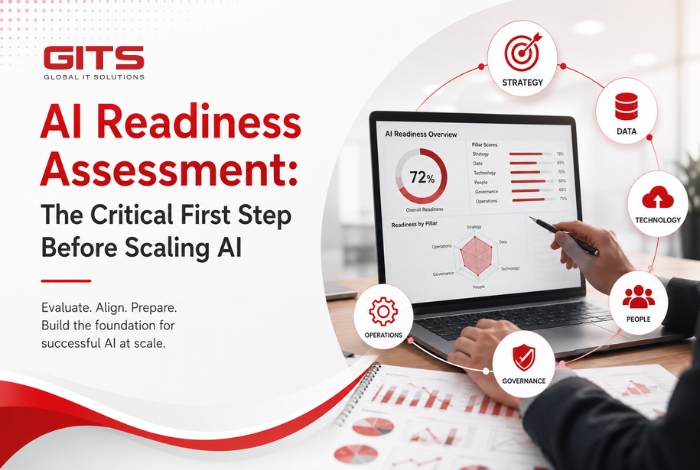
AI Readiness Assessment: The Critical First Step Before Scaling AI
An AI Readiness Assessment is a structured evaluation that measures an organization’s ability to successfully adopt, deploy, scale, and govern AI technologies. Rather than focusing solely on software or infrastructure, the assessment examines business, technical, operational, and organizational capabilities that directly impact AI success.
The purpose of an AI Readiness Assessment is to identify capability gaps, reduce implementation risks, and create a practical roadmap for AI adoption. For organizations exploring AI Agents, Generative AI, Intelligent Automation, or Agentic AI, the assessment provides a clear understanding of current maturity levels and the actions required to achieve sustainable results.
By evaluating readiness before implementation, organizations can avoid common pitfalls, improve return on investment, and accelerate time-to-value from AI initiatives.
Why AI Projects Fail Before They Even Start
Many organizations assume that AI implementation begins with selecting a technology vendor or deploying a machine learning model. In reality, successful AI adoption starts much earlier with organizational preparation and strategic alignment.
Several factors contribute to AI project failure:
– No clear AI strategy linked to business objectives
– Poor data quality and fragmented information systems
– Legacy infrastructure that cannot support modern AI workloads
– Limited AI skills and internal expertise
– Weak governance and compliance frameworks
– Lack of executive sponsorship and ownership
When these foundational issues are not addressed, organizations often experience delayed implementation timelines, budget overruns, low user adoption rates, and disappointing business outcomes. An AI Readiness Assessment helps identify these risks before significant investments are made.
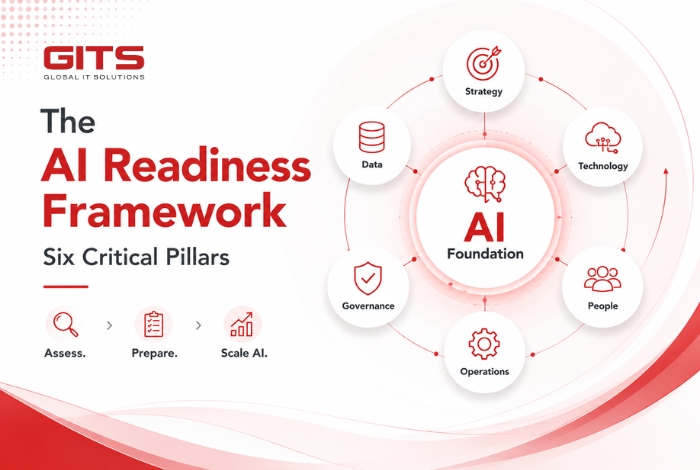
The AI Readiness Framework: Six Critical Pillars
A comprehensive AI Readiness Assessment should evaluate six interconnected dimensions. Together, these pillars provide a holistic view of an organization’s ability to successfully implement and scale AI across the enterprise.
Strategy Readiness
AI initiatives should be driven by business objectives rather than technology trends. Organizations must ensure that AI investments support strategic priorities such as operational efficiency, revenue growth, customer experience improvement, or innovation.
Key assessment areas include executive sponsorship, AI vision, investment priorities, success metrics, and organizational alignment. Companies with a well-defined AI strategy are significantly more likely to achieve measurable business outcomes and sustainable competitive advantages.
Data Readiness
Data serves as the foundation of every successful AI initiative. Even the most advanced AI models will underperform if they rely on incomplete, inconsistent, or inaccessible information.
Organizations should evaluate data quality, governance, accessibility, integration capabilities, and real-time availability. A strong data foundation enables AI systems to deliver accurate insights, reliable predictions, and consistent performance at scale.
Technology Readiness
Modern AI solutions require a scalable, secure, and flexible technology environment. Organizations must determine whether their existing infrastructure can support AI workloads and future growth requirements.
Technology readiness assessments typically examine cloud infrastructure, API architecture, cybersecurity frameworks, data platforms, system interoperability, and AI development environments. These capabilities determine how effectively AI can be integrated into existing business operations.
People Readiness
AI transformation is ultimately a people transformation. While technology plays an important role, long-term success depends on employee adoption, leadership support, and organizational culture.
Organizations should assess AI literacy, workforce capabilities, change management maturity, and cross-functional collaboration. Investing in employee enablement helps organizations maximize the value of AI while reducing resistance to change.
Governance Readiness
As AI becomes increasingly integrated into business operations, governance can no longer be treated as an afterthought. Organizations must establish clear policies and controls to ensure responsible and compliant AI adoption.
Key areas of evaluation include regulatory compliance, risk management, ethical AI practices, data privacy, model monitoring, and accountability structures. Strong governance frameworks help organizations build trust while minimizing operational and legal risks.
Operational Readiness
Many AI projects fail because operational processes are not designed to support automation and intelligent decision-making. Even highly capable AI solutions struggle when integrated into inefficient or inconsistent workflows.
Organizations should evaluate process standardization, workflow maturity, performance measurement systems, and continuous improvement mechanisms. Operational readiness ensures that AI can create sustainable business value rather than isolated efficiency gains.
AI Readiness Assessment for AI Agents and Agentic AI
The rise of AI Agents is fundamentally changing how organizations evaluate AI readiness. Traditional AI systems primarily analyze information and generate recommendations to support decision-making. AI Agents, however, can autonomously perform tasks, coordinate workflows, interact with enterprise applications, and execute business processes with minimal human intervention.
As organizations move toward Agentic AI and Autonomous Enterprise models, readiness requirements become significantly more complex. Businesses must evaluate not only technology capabilities but also operational controls, governance mechanisms, and human-AI collaboration frameworks.
Additional Factors for AI Agent Deployment
Organizations planning to implement AI Agents should assess:
– API ecosystem maturity
– Knowledge management systems
– Process automation readiness
– Human-in-the-loop governance
– Security and access management
– Multi-system integration capabilities
Without these foundations, AI Agents may introduce operational complexity and governance risks rather than delivering meaningful business value.
AI Agents Readiness Questions
Before deploying AI Agents, business leaders should ask several critical questions. Can existing systems communicate effectively through APIs? Is organizational knowledge properly documented and accessible? Are workflows standardized and measurable? Do governance frameworks exist for autonomous decision-making?
Answering these questions early helps organizations reduce implementation risks, improve adoption rates, and accelerate value realization from AI Agents.
AI Readiness Challenges in Japan, South Korea, and Vietnam
While AI adoption is accelerating globally, organizations in different regions face unique readiness challenges. Understanding these market-specific barriers helps leaders create more effective AI transformation strategies.
Japan
Many Japanese enterprises continue to operate complex legacy systems that have been developed over decades. While these systems provide stability and reliability, they often create challenges related to data integration, interoperability, and modernization.
Japanese organizations also face workforce challenges associated with an aging population and limited AI talent availability. As a result, companies often prioritize governance, reliability, and risk management before scaling AI initiatives across the enterprise.
South Korea
South Korea is among the world’s most advanced digital economies and has demonstrated strong adoption of AI technologies. However, organizations frequently encounter challenges related to governance requirements, integration complexity, and rapidly evolving technology landscapes.
To maintain competitiveness, many Korean enterprises are investing heavily in AI Agents, intelligent automation, and enterprise-wide AI transformation programs. This increases the importance of readiness assessments that can identify scalability and governance risks early.
Vietnam
Vietnam is experiencing rapid digital transformation across industries, creating significant opportunities for AI adoption. However, many organizations still face challenges related to AI talent shortages, fragmented data environments, and limited governance frameworks.
Companies that establish clear AI strategies and readiness frameworks early are better positioned to capture competitive advantages and scale AI initiatives successfully over the long term.
AI Readiness vs AI Maturity: What Is the Difference?
Although the terms AI Readiness and AI Maturity are often used interchangeably, they represent different stages of an organization’s AI journey. Understanding the distinction is important for setting realistic expectations and measuring progress accurately.
| AI Readiness | AI Maturity |
|---|---|
| Measures preparedness for AI adoption | Measures advancement of existing AI capabilities |
| Focuses on future implementation | Focuses on current performance |
| Identifies capability gaps | Evaluates optimization and scaling |
| Used before deployment | Used after deployment |
Organizations should first evaluate readiness before attempting to measure maturity. Without a strong foundation, efforts to scale AI capabilities are unlikely to produce sustainable results.
Benefits of Conducting an AI Readiness Assessment
A structured AI Readiness Assessment provides organizations with a clear understanding of their current capabilities and future requirements. More importantly, it helps leaders make informed investment decisions and reduce uncertainty throughout the transformation journey.
Reduced AI Project Risk
Organizations can identify technical, operational, and governance challenges before committing significant resources. This proactive approach reduces implementation risks and increases the likelihood of project success.
Faster Time-to-Value
By understanding readiness gaps early, organizations can focus resources on the most impactful initiatives. This enables faster deployment and accelerates the realization of business value from AI investments.
Improved AI ROI
Organizations can prioritize use cases with the highest strategic impact and avoid investments that are unlikely to generate measurable results. This leads to stronger returns and more efficient resource allocation.
Stronger Governance
A readiness assessment helps establish policies, controls, and accountability structures before AI solutions are deployed at scale. This improves compliance and reduces operational risks.
Better Executive Alignment
Leaders gain a shared understanding of AI opportunities, challenges, priorities, and expected outcomes. This alignment supports more effective decision-making and long-term transformation planning.

>>> See More: Enterprise AI Infrastructure for AI Transformation
Frequently Asked Questions
What is an AI Readiness Assessment?
An AI Readiness Assessment is a structured process used to evaluate whether an organization has the necessary strategy, data, technology, governance, workforce capabilities, and operational maturity to successfully implement AI. The assessment identifies readiness gaps and provides a roadmap for AI adoption and long-term transformation.
Why is AI readiness important before deploying AI Agents?
AI Agents require strong foundations in data quality, governance, infrastructure, security, and workflow management. Without adequate readiness, organizations may encounter implementation failures, governance issues, and operational risks that reduce the effectiveness of AI Agent deployments.
How long does an AI Readiness Assessment take?
The duration varies depending on organizational size and complexity. Most enterprise assessments take between two and six weeks, covering stakeholder interviews, technology reviews, process evaluations, and readiness scoring across multiple business functions.
What industries benefit most from AI readiness assessments?
Manufacturing, logistics, healthcare, retail, finance, education, and e-commerce organizations all benefit from AI readiness assessments. Any industry pursuing AI Transformation or AI Agents can improve outcomes by evaluating readiness before implementation.
What is the first step in becoming AI-ready?
The first step is understanding your current state. Organizations should assess their strategy, data, technology infrastructure, workforce capabilities, governance frameworks, and operational processes to identify readiness gaps and prioritize improvement initiatives.
Build the Foundation Before Accelerating AI Transformation
Organizations worldwide are investing billions of dollars into Artificial Intelligence, AI Agents, and intelligent automation. However, technology alone does not guarantee success. The organizations generating the greatest business value from AI are those that establish the right foundations before implementation begins.
An AI Readiness Assessment enables leaders to identify capability gaps, align stakeholders, reduce implementation risks, and develop a practical roadmap for AI Transformation. Whether the objective is deploying AI Agents, improving operational efficiency, modernizing legacy systems, or building an Autonomous Enterprise, readiness remains the single most important factor influencing long-term success.
The question is no longer whether organizations should adopt AI. As AI becomes a strategic business necessity, the more important question is whether the organization is prepared to implement, govern, and scale AI successfully.

Build the Foundation for Sustainable AI Success
AI success begins long before technology deployment. A comprehensive AI Readiness Assessment helps organizations evaluate their strategy, data, infrastructure, workforce capabilities, governance frameworks, and operational maturity before making major investments.
As AI Agents, Agentic AI, and Autonomous Enterprises become the next phase of digital transformation, organizations that strengthen their readiness today will be better positioned to lead tomorrow’s AI-driven economy. By assessing readiness early, businesses can reduce risk, accelerate value creation, and ensure that AI becomes a sustainable source of competitive advantage rather than a short-term technology experiment.
At GITS, we help enterprises evaluate AI readiness, identify transformation opportunities, and develop practical roadmaps for AI adoption at scale. From AI consulting and AI Agents development to enterprise AI transformation strategies, our experts help organizations move from experimentation to measurable business outcomes.