






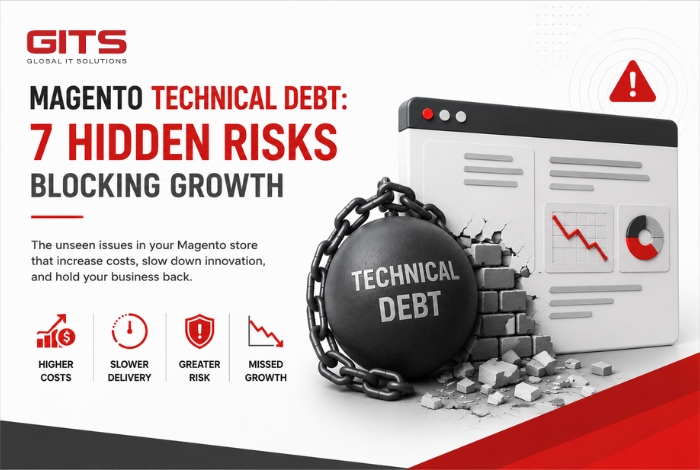
Magento remains one of the most powerful enterprise ecommerce platforms in the world. Its flexibility, customization capabilities, and scalability make it a preferred choice for complex B2B and B2C operations. However, there is a hidden cost that many enterprises underestimate: Magento technical debt.
At first, technical debt looks harmless. It often begins with small decisions such as adding a custom module to speed up deployment, applying a temporary patch for a checkout issue, or creating a quick API workaround for ERP integration. Over time, these decisions accumulate. What starts as convenience gradually becomes complexity, and what appears to be flexibility turns into operational friction.
For enterprises across Japan, South Korea, Vietnam, and global markets, this hidden debt often becomes the silent reason why growth slows, innovation stalls, and AI transformation fails.
What Is Magento Technical Debt?
Magento technical debt refers to the accumulated cost of outdated code, inefficient architecture, legacy customizations, and short-term development decisions that make future changes harder, slower, and more expensive. In simple terms, technical debt occurs when businesses choose speed today but pay with complexity tomorrow.
In Magento, technical debt often appears across five layers:
| Technical Layer | Common Debt Area | Business Impact |
|---|---|---|
| Application Layer | Custom modules, plugin conflicts | Slower releases |
| Data Layer | Fragmented schema, duplicate entities | Sync failures |
| Integration Layer | Legacy APIs, unstable connectors | Operational disruption |
| Infrastructure Layer | Poor scaling architecture | Rising cloud costs |
| Experience Layer | Legacy Luma frontend | Lower conversion |
This layered debt is especially dangerous for enterprise ecosystems connected to ERP, WMS, OMS, CRM, and AI platforms, where stability and data consistency are critical.
Why Magento Technical Debt Has Become a Strategic Business Risk
Five years ago, technical debt was mainly considered a developer problem. Today, it directly impacts business growth. Enterprise ecommerce now depends on real-time data orchestration, AI-driven personalization, smart logistics, and omnichannel fulfillment. This means even small technical inefficiencies inside Magento can create enterprise-wide disruption.
For companies in Japan, operational stability and long-term maintainability are critical. For businesses in South Korea, speed, agility, and omnichannel responsiveness define market competitiveness. For global enterprises, AI readiness has become a board-level priority. Magento technical debt directly affects all three dimensions.

Dependency Injection Overload Is Slowing Development
Magento 2 relies heavily on Dependency Injection (DI), which is a powerful architectural approach but often misused. Common technical debt patterns include excessive preference overrides, circular dependencies, deeply nested service layers, and plugin interception conflicts.
These issues lead to slower compile times, more difficult debugging processes, unpredictable regression risks, and longer release cycles. For enterprise teams, this translates into slower feature delivery and rising maintenance costs. As a result, a Magento code audit should always begin with evaluating the DI structure.
Indexing Debt Creates Inventory and Pricing Errors
One of the most overlooked forms of Magento technical debt is indexing debt. Critical Magento indexes include catalog_product_price, inventory_stock, and catalogsearch_fulltext. As SKU counts grow beyond 100,000, indexing inefficiencies become increasingly dangerous.
Typical symptoms include delayed stock updates, incorrect product pricing, slow search responses, and checkout mismatches. For enterprise retail, especially in markets like Japan and South Korea where customer trust is highly sensitive, these errors can directly impact brand credibility. AI agents can help proactively detect index lag before it affects customer experience.

Cron Job Debt Breaks Operational Continuity
Magento cron architecture powers essential processes such as email workflows, order processing, reindexing, queue consumers, and promotions. However, over time, cron-related technical debt accumulates.
This includes overlapping cron executions, failed consumers, deadlocks, and memory leaks. As a result, critical business operations may silently fail without immediate detection. This is one of the most dangerous hidden risks because teams often discover it too late. For enterprise businesses, especially in high-volume markets, operational continuity is non-negotiable.
Database Fragmentation Is Increasing System Complexity
Years of customization often leave Magento databases fragmented. This typically results in orphan tables, duplicated entities, unoptimized joins, and inconsistent attribute models.
The business impact is significant, including slower reporting, poor BI accuracy, broken OMS synchronization, and delayed WMS data updates. For enterprises operating complex supply chain systems, database debt creates organization-wide inefficiency. This is where a Magento architecture review becomes essential.
Legacy Frontend Debt Is Killing Conversion Performance
Many enterprise Magento stores still rely on the legacy Luma architecture. The issue is no longer limited to user experience but extends to performance.
Common problems include excessive JavaScript rendering, poor Core Web Vitals, slow mobile experiences, and bloated frontend assets. These issues directly affect SEO rankings, conversion rates, and customer retention. Modern alternatives such as Hyvä and PWA architectures offer significant performance improvements. For global markets, frontend debt is now one of the highest ROI areas for modernization.

Magento Technical Debt Is Blocking AI Agents and Automation
This is where the problem becomes more critical. Modern enterprises are increasingly investing in AI, including AI agents for customer support automation, predictive inventory planning, dynamic pricing, intelligent product recommendations, and order routing optimization.
However, AI systems depend on clean APIs, stable architecture, structured data, and predictable workflows. Magento technical debt disrupts these foundations. Without proper architectural cleanup, AI implementation becomes expensive, unstable, and difficult to scale. This is why many AX transformation initiatives fail—not because AI is ineffective, but because legacy architecture is not ready.
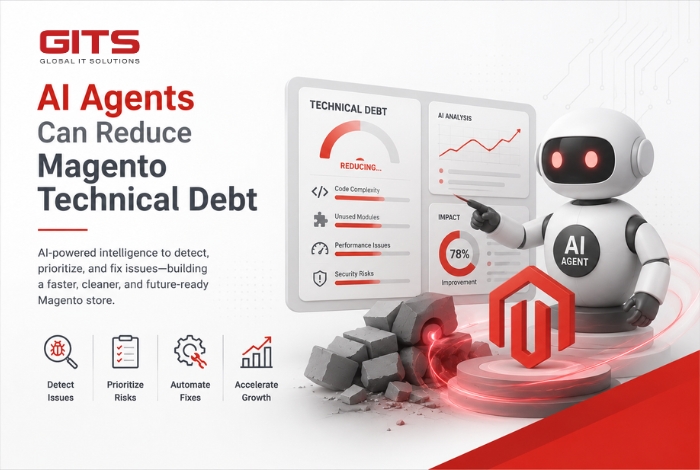
How AI Agents Can Reduce Magento Technical Debt
AI is no longer limited to customer-facing automation; it is becoming a powerful technical solution for engineering teams. AI agents can support Magento technical debt remediation in several key areas.
AI Code Audit Agents
These agents scan codebases for deprecated methods, duplicate logic, risky plugin conflicts, and architecture violations. This significantly accelerates Magento code audits and improves code quality.
AI Observability Agents
AI observability tools monitor cron failures, queue bottlenecks, API latency, and indexing lag. This enables proactive risk detection and reduces downtime.
AI Refactoring Copilots
AI can recommend module cleanup, dependency optimization, service layer simplification, and schema normalization. This helps reduce engineering effort and improves maintainability.
AI Performance Intelligence
AI systems can predict traffic bottlenecks, checkout failures, and scaling pressure before they occur. This enhances enterprise resilience and ensures smoother operations.
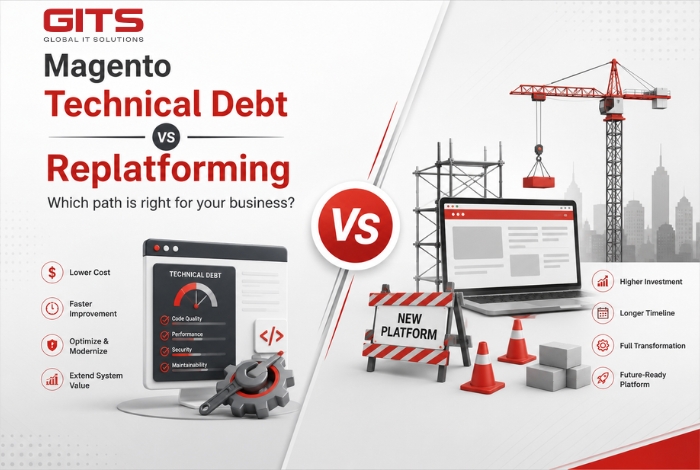
Magento Technical Debt vs Replatforming: Which Is Better?
This is one of the most common questions among enterprise leaders. The decision depends on the current state of the system and business goals.
| Option | Best For | Risk Level |
| Technical Debt Remediation | Existing Magento with strong business fit | Medium |
| Full Replatforming | Outdated architecture beyond recovery | High |
| Hybrid Modernization | AI-first enterprises scaling globally | Low to Medium |
For most enterprises, remediation is the smarter first step. Replatforming should only be considered when technical debt has reached a point where the architecture is no longer sustainable.
>>> See More: Magento for Enterprise Ecommerce: Why It Still Wins in 2026
Signs Your Enterprise Needs a Magento Technical Audit Now
If your business is experiencing issues such as slower release cycles, rising infrastructure costs, frequent integration failures, inconsistent performance, delayed AI projects, or declining customer experience, technical debt is likely already affecting growth.
These are not isolated technical problems but clear signals that your system requires immediate attention.
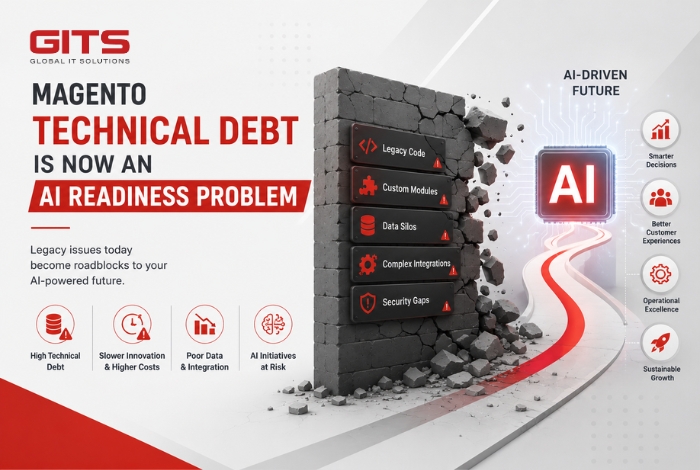
Magento Technical Debt Is Now an AI Readiness Problem
Magento technical debt is no longer just about poor code quality. It directly impacts business scalability, operational resilience, and AI readiness. Increasingly, it is also a factor in competitive survival.
For enterprise leaders across Japan, South Korea, Vietnam, and global markets, the companies that scale fastest in the coming years will not necessarily have the largest ecommerce systems. Instead, they will have the cleanest architecture, the most stable integrations, and the strongest AI foundations.
Before investing in AI agents, enterprise automation, or digital transformation, organizations should ask one critical question: Is your Magento architecture ready for the future? Because today, technical debt is no longer what slows engineering—it is what slows the entire business.