






Enterprises worldwide are moving beyond AI experimentation into large-scale deployment. AI Agents are automating business processes, generative AI is transforming knowledge work, and AI Solutions are becoming core to digital operations. Yet many organizations encounter the same challenge: AI adoption grows faster than their ability to manage it.
Without a structured AI Governance Framework, AI can introduce inconsistent decisions, security risks, compliance issues, and a lack of accountability. Governance is no longer a barrier to innovation—it is the foundation that enables enterprises to scale AI with confidence.
Why AI Governance Matters More Than Ever
Many AI initiatives succeed as pilot projects but struggle in production. As more AI models and AI Agents are introduced across departments, organizations often lose visibility into how AI is used, who owns it, and whether it complies with internal policies or regulations.
Common challenges include:
– Inconsistent AI decisions across business units
– Limited transparency into AI-generated outputs
– Security and privacy risks involving enterprise data
– Difficulty meeting compliance requirements
– Lack of governance over autonomous AI Agents
These issues become even more significant for enterprises operating across multiple regions, where regulatory expectations continue to evolve.
What Is an AI Governance Framework?
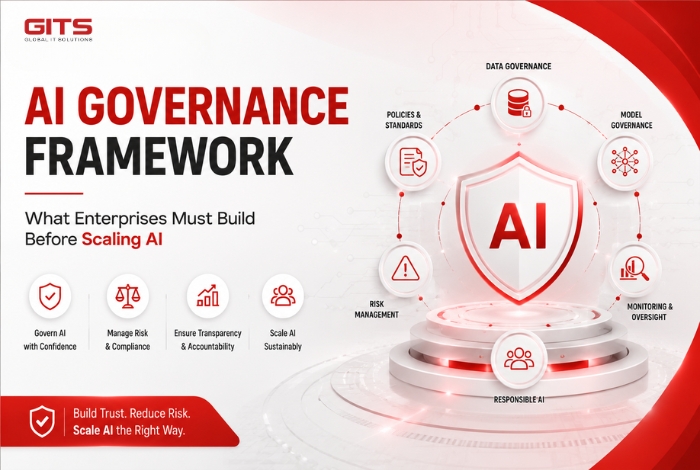
An AI Governance Framework is a structured set of policies, processes, technologies, and organizational responsibilities that ensure AI is developed, deployed, monitored, and improved in a secure, ethical, and compliant manner.
Rather than restricting innovation, governance provides a clear operating model for enterprise AI. It helps organizations balance innovation with risk while maintaining trust among customers, employees, and regulators.
A mature framework enables businesses to:
– Standardize AI development
– Improve transparency and accountability
– Protect sensitive enterprise data
– Monitor AI performance continuously
– Reduce operational and compliance risks
– Scale AI Agents across business functions with confidence
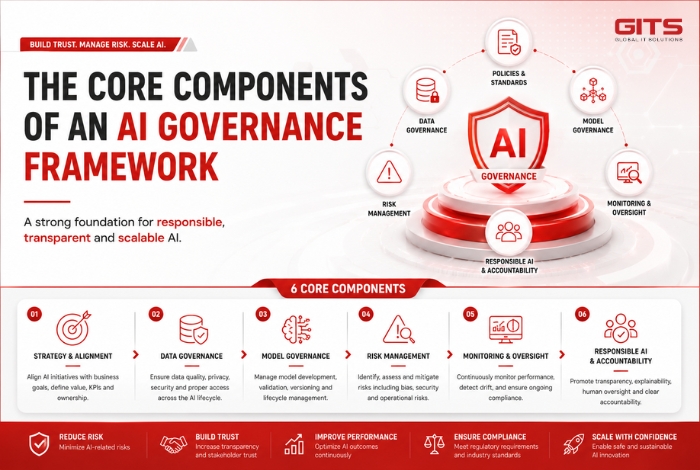
The Core Components of an AI Governance Framework
Align AI With Business Strategy
Successful AI initiatives begin with business objectives rather than technology. Every AI Solution should solve a measurable business challenge, supported by executive ownership, governance policies, and clear performance indicators. This alignment ensures AI investments generate sustainable value instead of isolated experiments.
Establish Data and AI Risk Governance
High-quality data is the foundation of trustworthy AI. Enterprises should implement governance over data ownership, access control, quality, and lifecycle management while continuously assessing AI-related risks such as bias, hallucinations, privacy breaches, and cybersecurity threats.
Risk management should be integrated throughout the AI lifecycle rather than applied only before deployment.
Govern AI Agents Responsibly
AI Agents introduce a new level of autonomy by making decisions, executing workflows, and interacting with enterprise systems. As their capabilities expand, organizations need stronger governance to define decision boundaries, approval processes, identity management, activity logging, and human oversight.
Responsible governance ensures AI Agents remain aligned with business objectives without compromising security or compliance.
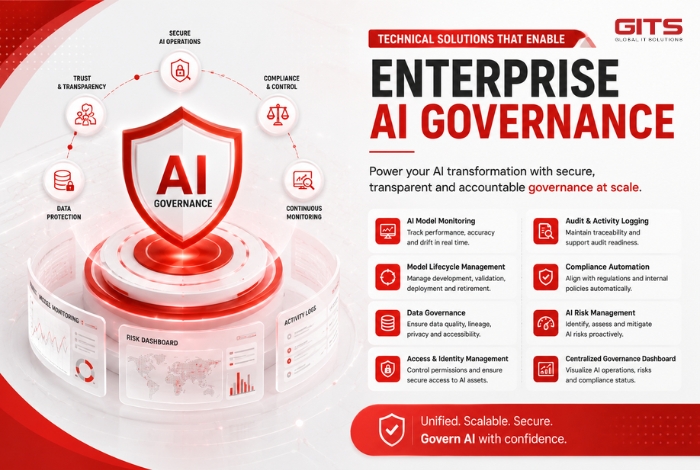
Technical Solutions That Enable Enterprise AI Governance
Governance depends on more than policies. Modern enterprises require integrated Technical Solutions that provide visibility across the entire AI ecosystem.
Key capabilities include AI monitoring, model lifecycle management, access control, audit logging, compliance automation, and governance dashboards. Together, these technologies help organizations identify risks early, maintain consistent AI performance, and support continuous improvement.
For companies pursuing AI Transformation (AX), governance technologies create the operational foundation needed to scale AI across departments while maintaining enterprise control.
Best Practices for Scaling AI Successfully
Organizations that scale AI effectively typically follow a structured approach.
First, assess current AI maturity and identify governance gaps. Next, establish enterprise-wide policies covering data, AI models, AI Agents, security, and Responsible AI. Finally, implement continuous monitoring to ensure AI systems remain accurate, secure, and aligned with changing business and regulatory requirements.
Governance should evolve alongside AI rather than being treated as a one-time compliance initiative.
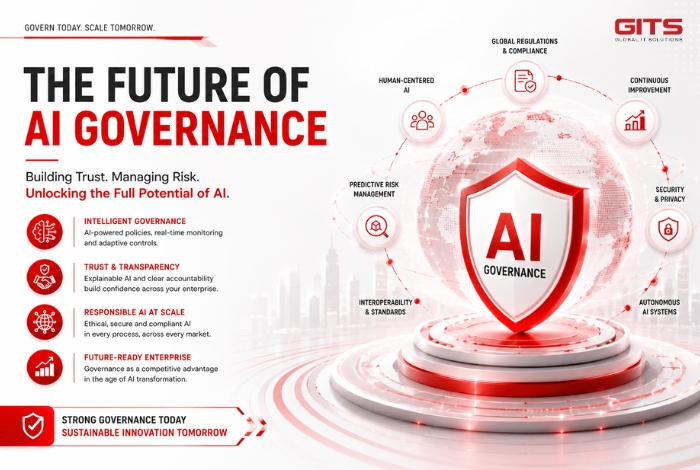
The Future of AI Governance
As enterprises adopt increasingly autonomous AI Agents and generative AI, governance will become a strategic business capability rather than a regulatory obligation.
Organizations that invest in a robust AI Governance Framework today will be better positioned to accelerate innovation, strengthen customer trust, and reduce operational risk. Those without governance may struggle to manage increasingly complex AI ecosystems as adoption expands.
AI success is no longer defined by how quickly an enterprise deploys new AI technologies. It is defined by how responsibly, securely, and effectively those technologies are governed at scale.
>>> See More: Agentic AI Frameworks: What Enterprises Need Before Scaling AI
Build AI Governance Before You Scale AI
Scaling AI requires more than advanced models or intelligent AI Agents. It requires a comprehensive AI Governance Framework that aligns business strategy, AI Solutions, Technical Solutions, security, compliance, and Responsible AI into a unified operating model.
For enterprises across Japan, South Korea, Vietnam, and global markets, governance is becoming the critical enabler of successful AI Transformation. By establishing the right framework before expanding AI initiatives, organizations can unlock innovation while maintaining transparency, resilience, and long-term business value.