





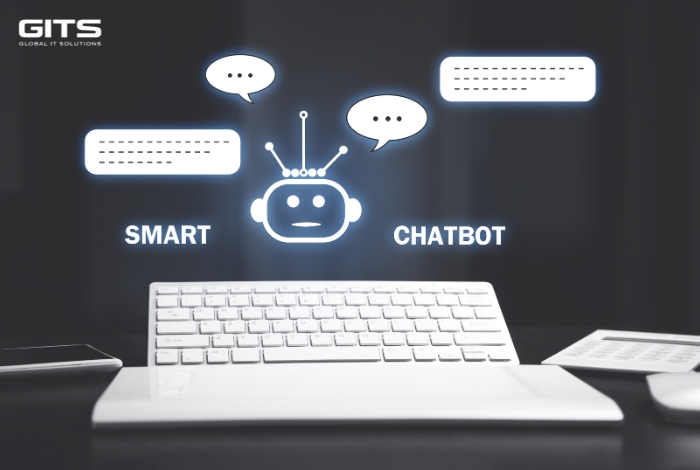
As enterprises expand their product portfolios, customers and employees increasingly expect instant, accurate answers. However, traditional customer support relies on manual document searches, while standalone Large Language Models (LLMs) often struggle with proprietary knowledge and may generate inaccurate responses.
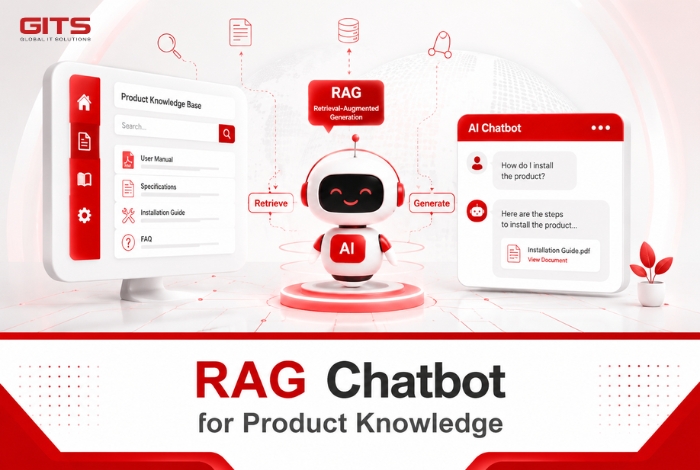
A RAG Chatbot combines Retrieval-Augmented Generation (RAG) with enterprise search and vector databases, enabling organizations to provide trusted, context-aware answers without retraining AI models. This case study demonstrates how GITS implemented an enterprise-grade RAG solution to improve customer support and knowledge management.
Customer Background
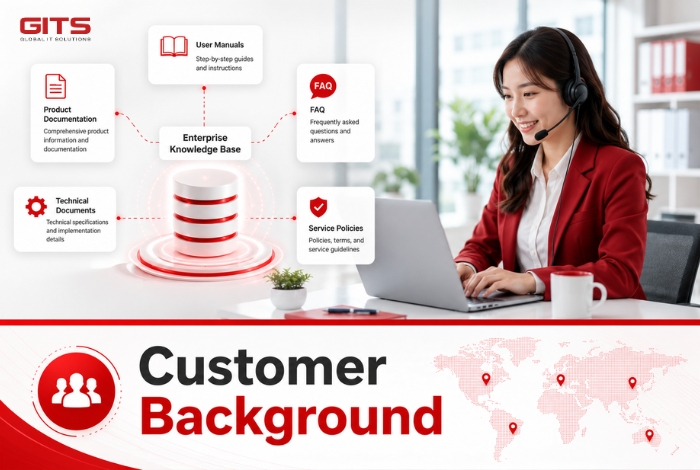
The client manages thousands of product manuals, technical documents, FAQs, and internal knowledge assets. Customers frequently requested information about product specifications, installation guides, troubleshooting, and service policies.
Because information was scattered across multiple systems, support teams spent significant time answering repetitive questions, leading to slower response times and inconsistent customer experiences.
The company required an AI assistant capable of delivering accurate answers based on internal knowledge.
Technical Challenges
Deploying enterprise AI introduced several challenges.
Limited access to proprietary knowledge
Public LLMs cannot understand confidential documents or continuously updated product information.
Hallucination risks
Without verified references, AI models may generate inaccurate or misleading answers.
Difficult knowledge updates
Every product change traditionally requires costly retraining or fine-tuning.
Fragmented documentation
Product information is distributed across PDFs, Word files, technical manuals, and knowledge portals, making manual searches inefficient.
RAG Chatbot Solution
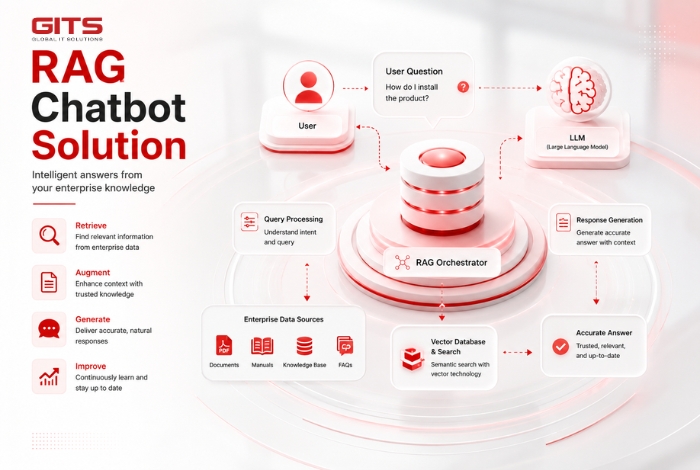
The implemented solution combines semantic search with Large Language Models to deliver reliable responses.
The architecture includes:
User Interface
A responsive React web application allows customers and employees to ask questions in natural language.
Document Processing
Enterprise documents are automatically processed, segmented into searchable chunks, converted into vector embeddings, and indexed for semantic search.
RAG Orchestration
The RAG engine retrieves relevant documents, ranks the most useful information, and provides verified context to the LLM before generating responses.
Vector Database & Enterprise Search
Using OpenSearch and vector search, the chatbot understands semantic meaning instead of relying solely on keyword matching, significantly improving retrieval accuracy.
AI & Cloud Infrastructure
The platform is deployed on AWS with REST APIs, scalable storage, monitoring services, and enterprise-grade security, ensuring high availability and future scalability.
Measurable Results
Following implementation, the organization achieved significant operational improvements:
– Faster customer response times through AI-powered automation
– Higher answer accuracy by grounding responses in verified enterprise – documents
– Reduced support workload by automating repetitive inquiries
– Improved customer satisfaction with consistent, reliable information
– Simplified knowledge management without retraining the LLM whenever documents change
– Scalable architecture capable of supporting future product expansion
>>> See More: AI Chat Bot For Call Center Efficiency
Project Scope and Timeline
Project Scope
The implementation included:
– Enterprise Product Knowledge Chatbot
– Document Processing Pipeline
– RAG Orchestration
– Vector Database
– OpenSearch Integration
– AWS Cloud Infrastructure
– REST API Development
– Responsive Web Application
Estimated Timeline
| Phase | Duration |
|---|---|
| Requirements & Architecture | 4 Weeks |
| Data Preparation & Document Processing | 6 Weeks |
| RAG & LLM Integration | 5 Weeks |
| Frontend, Testing & Deployment | 6 Weeks |
Total Project Duration: 20–24 Weeks
RAG Chatbot Powers Enterprise Knowledge Automation
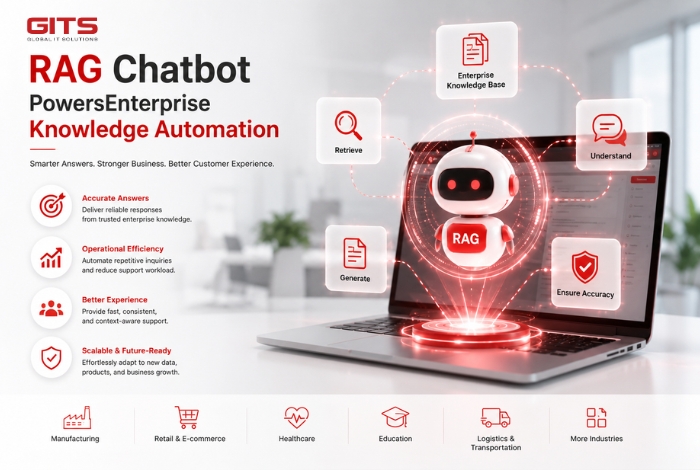
A RAG Chatbot enables enterprises to combine Large Language Models with trusted internal knowledge, delivering accurate, explainable, and scalable AI-powered customer support.
By integrating semantic search, vector databases, and Retrieval-Augmented Generation, organizations can reduce hallucinations, improve operational efficiency, and provide consistent product guidance without continuously retraining AI models. As enterprise AI adoption accelerates across Japan, South Korea, Vietnam, and global markets, RAG has become the preferred architecture for building reliable, future-ready intelligent assistants.