






The logistics industry is entering a new era of intelligent automation. While many organizations have adopted AI-powered forecasting, warehouse management, or transportation optimization, these systems often operate independently, creating information silos and slowing decision-making.
As supply chains become increasingly complex, enterprises need AI that can collaborate—not just automate. This is where Multi-Agent Systems in Logistics are redefining modern operations.
Instead of relying on a single AI model, multiple intelligent agents work together, continuously sharing information, making decentralized decisions, and adapting to real-time changes across the supply chain. For manufacturers, retailers, logistics providers, and e-commerce businesses in Japan, Korea, Vietnam, and global markets, Multi-Agent Systems are becoming a critical foundation for AI Logistics and Autonomous Transformation (AX).
Why Traditional Logistics Automation Is Reaching Its Limits
Many organizations have invested in digital transformation, yet common operational challenges remain:
– Warehouse and transportation systems operate independently.
– Manual coordination delays operational decisions.
– Demand fluctuations lead to inventory shortages or excess stock.
– Disruptions require human intervention before corrective actions can be taken.
Traditional workflow automation follows predefined rules, making it effective for repetitive tasks but less capable of responding to dynamic business environments.
According to McKinsey, AI-powered supply chain solutions can reduce logistics costs by up to 15% while improving inventory management and service levels, highlighting the growing value of intelligent decision-making across logistics operations.
What Are Multi-Agent Systems in Logistics?
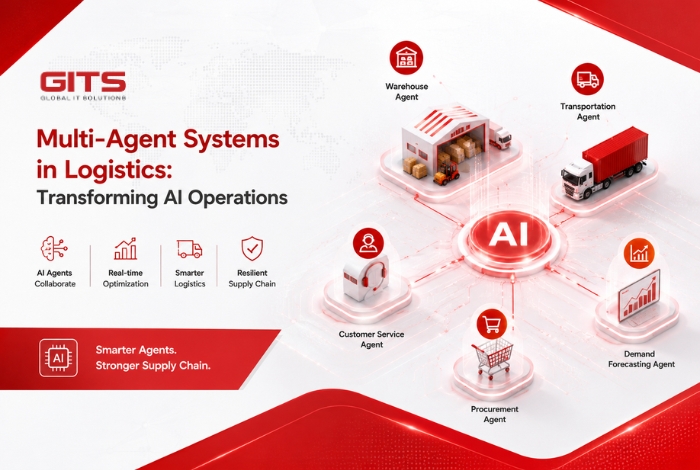
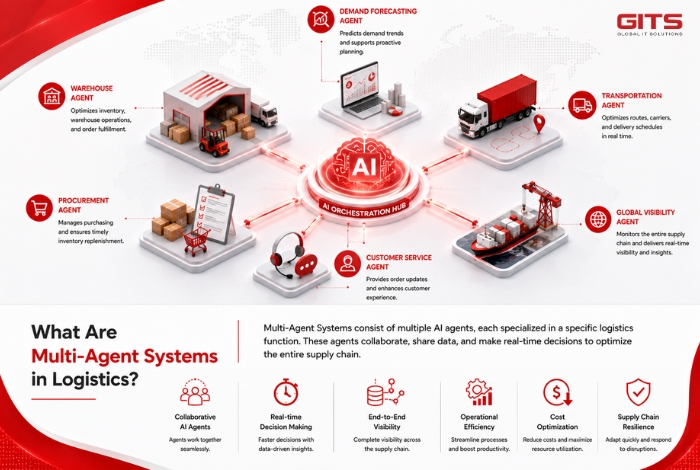
A Multi-Agent System is a network of autonomous AI agents, each responsible for a specific business function while continuously communicating with other agents to achieve a common operational goal.
Rather than using one centralized AI engine, organizations deploy specialized agents such as:
– Warehouse Agent managing inventory allocation
– Transportation Agent optimizing delivery routes
– Demand Forecasting Agent predicting market demand
– Procurement Agent coordinating supplier replenishment
– Customer Service Agent providing shipment visibility
Together, these AI agents create an intelligent ecosystem capable of making coordinated decisions in real time.
How Multi-Agent Systems Improve AI Logistics
Imagine customer demand suddenly increases for a specific product.
Instead of waiting for human intervention, the Demand Forecasting Agent immediately detects the trend and shares insights with the Warehouse Agent, which reallocates inventory. At the same time, the Transportation Agent recalculates delivery routes while the Procurement Agent initiates replenishment orders.
This collaborative decision-making enables enterprises to respond within seconds rather than hours.
Unlike traditional automation, Multi-Agent Systems combine Large Language Models (LLMs), contextual reasoning, enterprise data, and AI orchestration to continuously optimize logistics workflows.
Traditional Automation vs Multi-Agent Systems
| Traditional Automation | Multi-Agent Systems |
|---|---|
| Rule-based workflows | AI-driven reasoning |
| Centralized decisions | Distributed intelligence |
| Limited adaptability | Real-time collaboration |
| Reactive operations | Predictive decision-making |
| Human coordination required | Autonomous agent coordination |
This evolution allows organizations to move beyond automation toward intelligent and self-optimizing logistics operations.
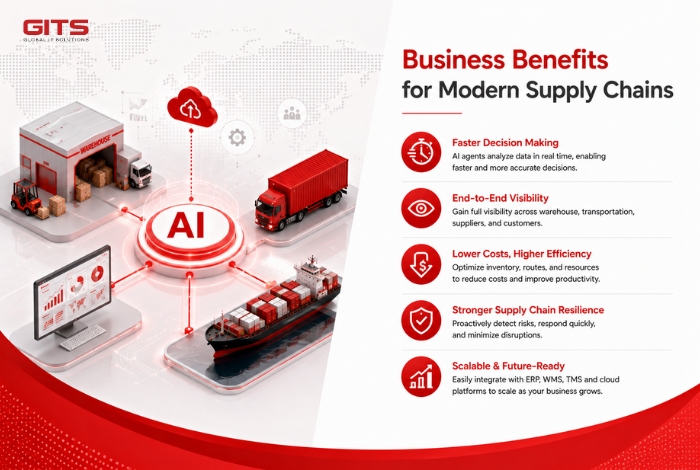
Business Benefits for Modern Supply Chains
Organizations adopting Multi-Agent Systems gain advantages that extend far beyond process automation.
Faster Decision-Making
AI agents analyze operational data simultaneously, enabling real-time responses to inventory changes, transportation delays, and customer demand.
End-to-End Supply Chain Visibility
Connected AI agents provide a unified view across warehouses, suppliers, transportation, and customer fulfillment, reducing information silos.
Lower Operating Costs
By improving inventory planning, warehouse utilization, and transportation efficiency, enterprises can significantly reduce logistics expenses while maintaining service quality.
Greater Supply Chain Resilience
When disruptions occur, AI agents automatically adjust inventory allocation, optimize delivery routes, and coordinate alternative supply strategies without waiting for manual intervention.
Scalable Enterprise AI
Multi-Agent Systems integrate seamlessly with ERP, WMS, OMS, TMS, IoT platforms, and cloud infrastructure, allowing organizations to scale AI capabilities without replacing existing systems.
Real-World Applications
Leading global organizations are already leveraging AI-driven logistics.
Amazon uses AI and robotics to optimize warehouse operations and accelerate order fulfillment.
DHL applies AI for demand forecasting and predictive logistics, improving delivery accuracy and operational efficiency.
Samsung SDS and Hyundai Glovis continue investing in intelligent supply chain platforms to support manufacturing and international logistics across Asia.
These initiatives demonstrate that collaborative AI is no longer an emerging concept but an operational reality.
Challenges Enterprises Should Consider
Although Multi-Agent Systems offer significant advantages, successful implementation requires careful planning.
Organizations should address several key considerations:
– Integration with legacy ERP and logistics platforms
– AI governance and data security
– Human oversight for critical business decisions
– Data quality across enterprise systems
– Scalable AI architecture for long-term growth
Enterprises that combine strong governance with modern AI infrastructure are more likely to achieve sustainable digital transformation.
How GITS Helps Enterprises Build AI Logistics
At GITS, we help organizations accelerate AI transformation through intelligent logistics solutions tailored to enterprise operations.
Our expertise includes:
– AI-powered Warehouse Management Systems (WMS)
– Transportation Management Systems (TMS)
– Order Management Systems (OMS)
– Enterprise AI Agents
– Predictive Analytics
– AI Services and Technical Solutions
– AI Transformation (AX) Consulting
Rather than deploying isolated AI tools, GITS builds connected AI ecosystems where intelligent agents collaborate across the entire supply chain, enabling faster decisions, lower costs, and long-term operational resilience.
>>> See More: Enterprise AI Infrastructure: What Makes It Future-Proof?
Frequently Asked Questions (FAQ)
What is a Multi-Agent System in Logistics?
A Multi-Agent System is a network of autonomous AI agents that collaborate to optimize logistics functions such as inventory management, transportation, warehouse operations, and demand forecasting.
How is it different from traditional logistics automation?
Traditional automation follows predefined rules, while Multi-Agent Systems enable AI agents to communicate, reason, and make decentralized decisions based on real-time operational data.
Which industries benefit the most?
Manufacturing, retail, e-commerce, third-party logistics (3PL), healthcare, automotive, and global supply chain organizations can all benefit from Multi-Agent Systems.
Can Multi-Agent Systems integrate with existing enterprise platforms?
Yes. Modern Multi-Agent architectures can integrate with ERP, WMS, OMS, TMS, IoT platforms, and cloud-based enterprise systems, enabling organizations to enhance existing infrastructure rather than replace it.
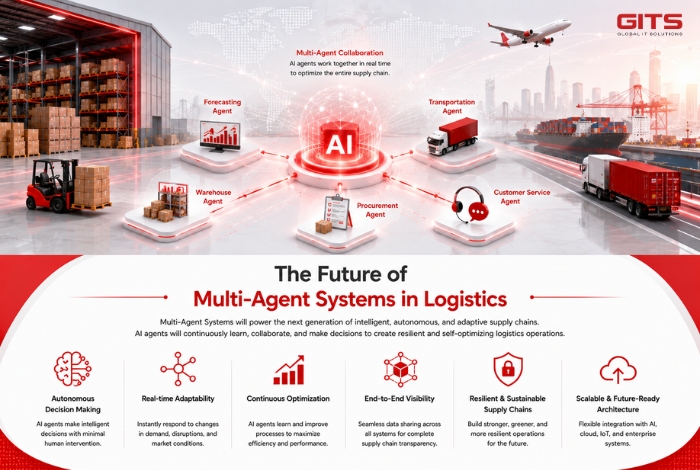
The Future of Multi-Agent Systems in Logistics
As supply chains become more dynamic, enterprises need AI that can reason, collaborate, and adapt in real time.
Multi-Agent Systems in Logistics represent the next evolution of AI Logistics, enabling autonomous coordination across warehouses, transportation, procurement, and customer operations. By combining Agentic AI, Large Language Models, predictive analytics, and enterprise data, organizations can create intelligent supply chains that are more efficient, resilient, and scalable.
For companies preparing for the future of logistics, adopting Multi-Agent Systems is no longer simply a technology upgrade—it is a strategic investment that strengthens competitiveness, accelerates AI transformation, and lays the foundation for truly autonomous operations.