






Manufacturing, energy, logistics, and industrial enterprises continue to face growing pressure to improve procurement efficiency while maintaining full visibility across increasingly complex supply chains. As supplier networks expand and inventory operations become more sophisticated, traditional development approaches often struggle to deliver enterprise systems quickly enough to support evolving business needs.
A Low-Code Material Management System offers a practical alternative. By combining rapid application development with standardized business components, organizations can modernize procurement and material management processes without the lengthy implementation cycles associated with conventional software projects.
This case study demonstrates how GITS successfully delivered a large-scale material management platform for one of Japan’s leading gas companies using OutSystems Low-Code technology.
Customer Background
The customer is one of Japan’s major gas providers responsible for managing extensive procurement activities across multiple business units. As business operations expanded, the organization required a centralized platform capable of supporting both procurement management and enterprise-wide material control.
The company’s objective extended beyond replacing manual processes. It sought to establish a scalable digital foundation capable of supporting future operational growth while reducing project delivery risks and overall development costs.
The new platform needed to manage procurement requests, supplier information, inventory records, equipment assets, and business workflows through a unified enterprise system.

Technical Challenges Facing the Enterprise
Although procurement operations were already well established, several technical limitations prevented further optimization.
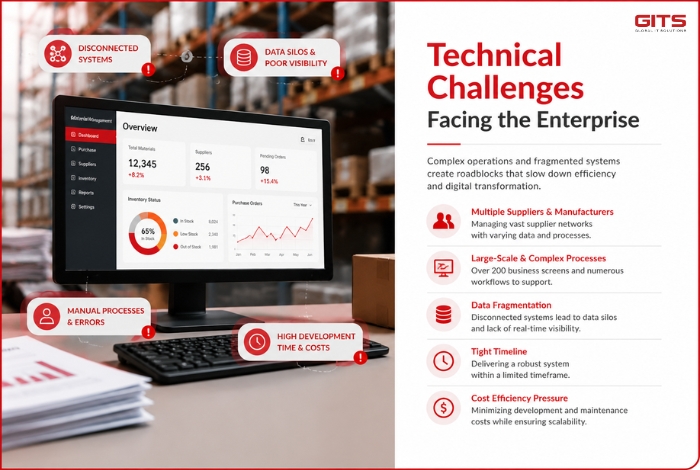
The existing environment lacked a centralized material management platform capable of integrating suppliers, procurement workflows, and inventory information into a single system. Data remained fragmented across departments, making collaboration increasingly difficult as operations expanded.
Several additional challenges also emerged:
– Managing materials from multiple manufacturers and suppliers
– Supporting hundreds of complex business processes
– Standardizing user interfaces across large enterprise applications
– Delivering the project within a compressed implementation schedule
– Controlling development costs without compromising scalability
The project scope included more than 200 business screens, reflecting the complexity typically found in enterprise procurement systems serving large industrial organizations.
Without a standardized development methodology, maintaining consistency, reducing future maintenance costs, and ensuring long-term scalability would become increasingly difficult.
Why a Low-Code Material Management System Was the Right Choice
A traditional software development approach would have required significant coding effort across hundreds of interfaces and business modules, increasing project timelines and long-term maintenance complexity.
Instead, the organization selected a Low-Code Material Management System built on the OutSystems platform to accelerate development while maintaining enterprise-grade quality.
Low-Code technology offered several strategic advantages:
– Rapid application development
– Reusable UI and functional components
– Standardized enterprise architecture
– Faster requirement changes
– Lower total development costs
– Easier future expansion
For organizations pursuing digital transformation, these capabilities significantly reduce implementation risk while enabling continuous innovation.
Implementation Strategy
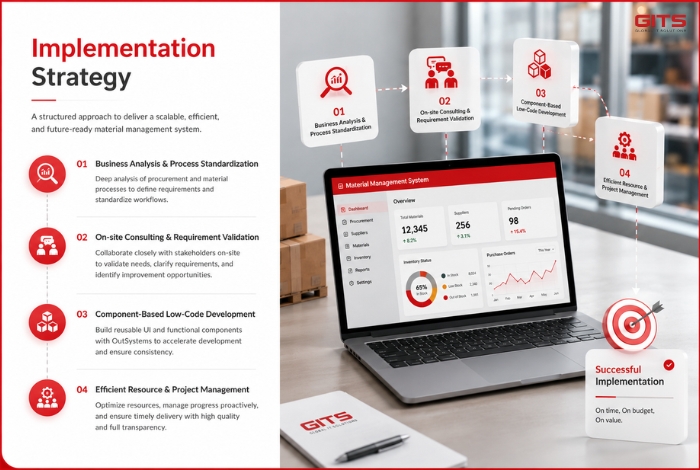
Business Analysis and Process Standardization
The project began with comprehensive business analysis to fully understand procurement workflows, supplier management processes, inventory operations, and equipment lifecycle requirements.
Rather than developing individual modules independently, GITS standardized common business functions across the entire platform.
This approach established reusable design patterns that could be applied consistently throughout more than 200 application screens.
On-Site Consulting and Requirement Validation
To ensure the system accurately reflected real operational needs, the project team conducted on-site workshops with business stakeholders.
Direct collaboration enabled engineers to:
– Validate functional requirements
– Identify workflow optimization opportunities
– Recommend process improvements
– Reduce requirement ambiguity before development
This consulting-first methodology minimized costly redesign during later project stages.
Component-Based Low-Code Development
One of the project’s biggest strengths was its component-driven architecture.
Using OutSystems, developers created reusable UI elements and shared business logic that could be deployed across multiple modules.
Instead of repeatedly building identical features, standardized components accelerated development while maintaining a consistent user experience throughout the enterprise application.
This significantly improved development productivity and simplified future maintenance.
Efficient Resource and Project Management
Given the project’s scale, effective resource allocation was critical.
Development teams carefully coordinated implementation schedules, technical resources, and business priorities to ensure the platform was delivered according to plan without sacrificing software quality.
The structured project governance model also reduced implementation risks commonly associated with large enterprise software projects.
Measurable Business Outcomes
The completed Low-Code Material Management System delivered measurable improvements across both technical performance and business operations.
Faster Development Delivery
Reusable components dramatically reduced development time compared to traditional custom coding.
Optimized Procurement Operations
The centralized platform improved visibility across procurement activities while simplifying supplier and material management.
Improved Operational Efficiency
Standardized business workflows reduced manual effort, increased process consistency, and enhanced overall operational productivity.
Lower Development and Maintenance Costs
The Low-Code architecture minimized repetitive coding while making future enhancements significantly easier.
Stronger Foundation for Digital Transformation
The new system established a scalable enterprise platform capable of supporting future business expansion without requiring major architectural redesign.
>>> See More: Purchase Approval Workflow Optimization with Low-Code
Project Scale and Timeline
| Project Scope | Details |
|---|---|
| Industry | Energy (Gas Utility) |
| Customer | Major Japanese Gas Company |
| Solution | Low-Code Material Management System |
| Development Platform | OutSystems |
| Business Scope | Procurement, Supplier Management, Material Management |
| System Size | 200+ Business Screens |
| Delivery Approach | Business Analysis, On-Site Consulting, Component-Based Development |
| Timeline | Accelerated enterprise implementation through Low-Code methodology |
Why Enterprises Are Adopting Low-Code for Material Management
Across Japan, South Korea, Vietnam, and global manufacturing markets, enterprises are increasingly replacing fragmented procurement systems with integrated Low-Code platforms.
The primary drivers include:
– Faster digital transformation initiatives
– Growing supplier ecosystems
– Increasing operational complexity
– Pressure to reduce IT development costs
– Demand for scalable enterprise applications
– Continuous business process optimization
Low-Code enables organizations to respond to these challenges much faster than conventional software development models while maintaining enterprise-grade reliability and governance.

Building a Smarter Procurement Future with Low-Code
A modern Low-Code Material Management System is more than a procurement application. It becomes the digital backbone that connects suppliers, materials, inventory, and enterprise operations through a unified platform.
This case study illustrates how combining OutSystems Low-Code development, standardized components, and business-focused consulting enabled a large Japanese enterprise to accelerate project delivery, reduce implementation costs, and establish a scalable foundation for long-term digital transformation.
For organizations seeking to modernize procurement and material management without lengthy development cycles, Low-Code has become one of the most effective strategies for achieving measurable business value while preparing for the next stage of enterprise growth.