





Transportation management has traditionally depended on TMS platforms to manage shipments, vehicles, carriers, schedules, and transportation costs. These systems remain essential, but modern logistics is becoming too dynamic for planning models that depend heavily on predefined rules and periodic human intervention.
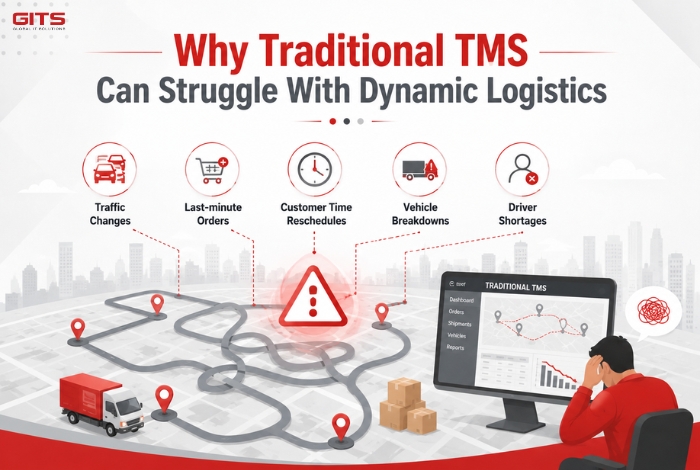
Traffic changes. Orders arrive late. Customers reschedule. Vehicles become unavailable. Delivery priorities shift throughout the day. For logistics companies in Japan, Korea, Vietnam, and global markets, the challenge is no longer simply finding the shortest route. It is making the right transportation decision at the right moment.
This is where AI Route Optimization Agents and Agentic AI are emerging as a new layer of intelligence.
Traditional TMS vs AI Route Optimization Agents: What’s the Difference?
The fundamental difference is how each technology approaches decision-making.
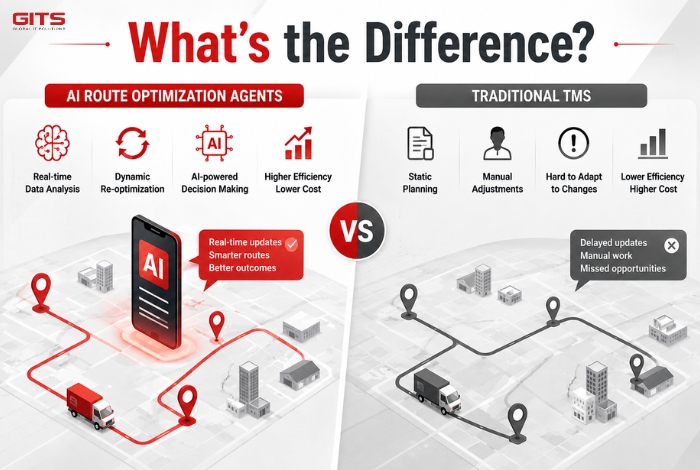
A traditional TMS is primarily a system of record and operational management platform. It centralizes transportation data, applies predefined business rules, supports dispatching, tracks shipments, and provides reporting. Route optimization may be included, but the system generally operates according to configured parameters and requires planners to intervene when conditions change.
An AI Route Optimization Agent works differently. Instead of simply executing predefined instructions, it can interpret operational data, identify changing conditions, evaluate alternatives, recommend actions, and continuously re-optimize transportation decisions.
| Traditional TMS | AI Route Optimization Agent |
|---|---|
| Rule-based planning | Context-aware decision-making |
| Periodic optimization | Continuous re-optimization |
| Human-led exception handling | AI-assisted exception handling |
| Historical and predefined data | Real-time + historical signals |
| Executes configured workflows | Reasons across multiple variables |
| Primarily manages operations | Helps make operational decisions |
The distinction is important: AI Agents do not necessarily replace a TMS. They can become an intelligence layer that makes the existing transportation ecosystem more adaptive.
Why Traditional TMS Can Struggle With Dynamic Logistics
Traditional TMS platforms are highly effective when transportation conditions are relatively predictable. However, modern delivery operations increasingly involve thousands of variables that can change during execution.
Consider a fleet operating across Tokyo, Seoul, or Ho Chi Minh City. A delivery route optimized at 8:00 AM may become inefficient an hour later because of congestion, a delayed shipment, a vehicle issue, or a newly added priority order.
A conventional workflow may require a dispatcher to identify the problem, review the available options, modify the route, communicate the change, and monitor its execution.
At scale, this creates a familiar operational problem: planners spend valuable time reacting to exceptions instead of improving the transportation network.
Modern route optimization platforms increasingly address this challenge through real-time traffic, operational constraints, scenario simulation, and dynamic re-planning.
How AI Route Optimization Agents Work
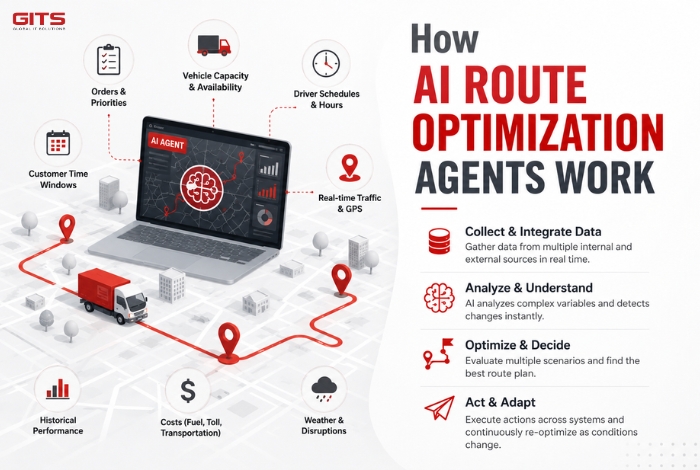
An AI Route Optimization Agent can sit above existing transportation systems and coordinate decisions across multiple data sources.
For example, the agent can process:
– Order volume and delivery priorities
– Vehicle capacity and availability
– Driver schedules and working hours
– Customer time windows
– GPS and traffic conditions
– Historical delivery performance
– Fuel and transportation costs
– Weather or operational disruptions
Instead of asking only, “What is the shortest route?”, the system can evaluate a broader question:
“What transportation plan provides the best balance between cost, delivery performance, capacity, and operational constraints right now?”
This is where Agentic AI becomes particularly valuable. The agent can observe conditions, reason about alternatives, select an action, and trigger downstream workflows through connected systems.
Research into agentic AI is also expanding into complex logistics scheduling, demonstrating the potential for AI agents to translate operational requirements into optimization problems and coordinate sophisticated routing decisions.
>>> See More: AI Agents in Logistics: How Intelligent Automation Will Transform Supply Chains by 2030
AI Route Optimization Agents vs Traditional TMS: Which One Should Businesses Choose?
The answer is not necessarily “TMS or AI.”
For most enterprises, the stronger architecture is TMS + AI Agent + existing operational systems.
A TMS remains valuable for transportation execution, shipment management, compliance, carrier coordination, and centralized visibility. An AI Agent can complement this infrastructure by providing an intelligent decision-making layer.
This approach is particularly relevant for businesses dealing with:
– High delivery volumes: More orders and vehicles create exponentially more routing combinations.
– Frequent operational changes: Dynamic environments require continuous optimization rather than once-a-day planning.
– Complex constraints: Manufacturing, retail, healthcare, and cold-chain logistics may require vehicle, capacity, temperature, SLA, and time-window considerations simultaneously.
– Multiple systems: AI Agents can help connect ERP, WMS, TMS, CRM, GPS, e-commerce, and external data sources into a more intelligent workflow.
Enterprise route optimization platforms are already moving toward AI-driven planning, real-time visibility, constraint management, and automated re-optimization.
From Digital Transformation to AX: The Next Step in Logistics
For many companies, digital transformation has focused on replacing spreadsheets, connecting systems, and creating centralized dashboards.
The next step is AI Transformation (AX): enabling systems to actively support decisions and automate increasingly complex workflows.
In logistics, this means moving from:
Manual planning → Digital TMS → AI-assisted optimization → Agentic transportation operations
The business impact extends beyond reducing kilometers. AI-driven routing can improve fleet utilization, delivery reliability, planner productivity, customer experience, and transportation cost simultaneously.
The opportunity is especially significant in Japan and Korea, where operational efficiency, service quality, workforce productivity, and precision are critical competitive factors. For Vietnam and global logistics operators, the same architecture can support rapid scaling without increasing planning complexity at the same rate as fleet and order volume.
The Future Is Intelligent Transportation, Not Just Better Routing
Traditional TMS remains the operational backbone of modern transportation. But as logistics becomes more dynamic, a system that only stores information and executes predefined workflows may no longer be enough.
AI Route Optimization Agents introduce a different model: observe, reason, optimize, and act.
The winning strategy is therefore not to discard the TMS, but to make it smarter.
By combining TMS, AI Services, Agentic AI, real-time data, and optimization algorithms, businesses can build a transportation environment capable of responding to change rather than simply recording it.
For companies looking to move from traditional digitalization toward AI Transformation (AX), AI Route Optimization Agents represent a practical starting point: turning transportation data into continuous, intelligent operational decisions.